NFL History | Rose Bowl, Pasadena — The Record Crowd and the Rule That Froze It
volume_up
Listen
directions
Directions
On 20 January 1980 Pittsburgh beat the Los Angeles Rams 31-19 in this stadium, in front of 103,985 people. Guinness World Records lists that as the largest crowd at a Super Bowl, and checked against their record page on 4 September 2026 the figure had not moved in forty-six years. The league drew it in a building it did not own, had no club in, and would later rule ineligible to host.
It is worth being exact about what the number is a record for. Memory 7099, at the Estadio Azteca, carries a crowd of 103,467 for a regular-season game in Mexico City in 2005 - 518 fewer people. The gap is small enough that the qualifier is doing real work. Pasadena holds the Super Bowl record. It does not hold the record for a professional football crowd in general.
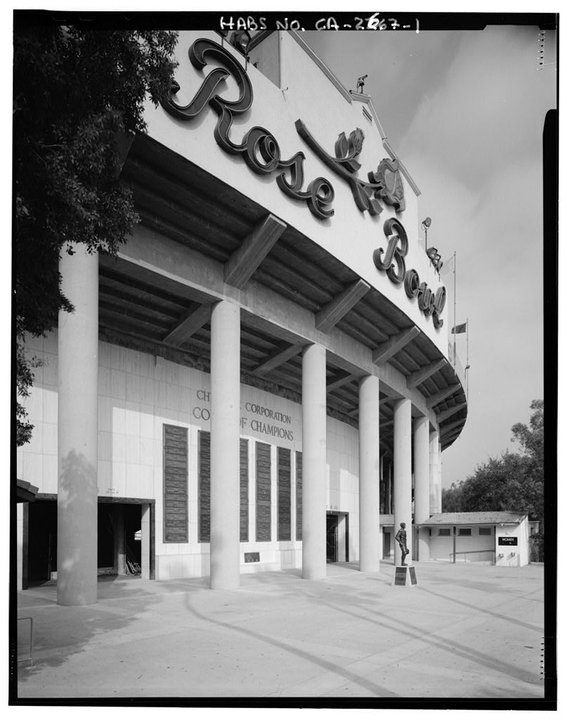
The Rose Bowl was not built for any of this. Myron Hunt designed it for Pasadena and it opened in 1922 to house the oldest post-season college bowl game; the Library of Congress survey record for the building locates its significance exactly there, in the history of American recreation, and the college game is why the horseshoe has the shape it has. Work continued on the structure in 1928, 1930, 1949, 1961 and 1973. The Los Angeles Conservancy dates its listing as a National Historic Landmark to 1987; the survey record gives the reference number 87000755 and no designation day, so none is given here.
The home club had further to travel to this game than the visiting one had to reach its hotel. The Rams' home ground for the 1979 season was the Los Angeles Memorial Coliseum, roughly twelve miles south of this pin and the subject of memory 6652. The Los Angeles Public Library's account of the game, by senior librarian Bob Timmermann, records that the Rams moved to Anaheim the following year, that it was a chilly Pasadena afternoon at 54 degrees at kickoff, and that playing close to home did not stop them being heavy underdogs. A club with a stadium twenty minutes up the freeway reached the championship game and played it as somebody else's tenant.
The league staged five Super Bowls here in all - after the 1976, 1979, 1982, 1986 and 1992 seasons - and then stopped. ABC7's account of February 2022 puts the reason to the stadium's general manager, Darryl Dunn: the league's own rule requires a host to be an NFL stadium in a market with a team, and once the Rams left for St. Louis in 1995 Los Angeles had no club to qualify it. That is set down here as attributed paraphrase rather than as his words. Nothing about the building had changed.
The league's rules about buildings run in both directions, and both directions are in this collection. After the 1970 merger it required home stadiums to seat more than fifty thousand, which emptied Wrigley Field in 1970, War Memorial Stadium in 1972 and Metropolitan Stadium in 1981, and filled Soldier Field in 1971 - memories 6687, 6722, 6680 and 6848. The host rule is the same instinct aimed at a different question. Its effect here was to disqualify the ground on which the game had drawn its largest crowd, for a reason that had nothing to do with the ground: a franchise's departure, two years after the last of those five games, of the kind that memory 6890 traces back to the antitrust verdict that made departures possible.
The second reason the figure has not moved is visible on this site now. In May 2026 the Rose Bowl Operating Company's eighty-million-dollar Lasting Legacy Campaign began converting about five thousand bench seats in the south end zone into a field-level club of lounges and premium seating, at a reported cost of thirty million dollars. Bench seats are how a stadium holds a hundred thousand people; premium seats are how it earns. The crowd recorded in 1980 and the construction going on in 2026 are the same fact seen from its two ends.
The comparison that gives the 1980 figure its scale is not with other Super Bowls but with the college game it was borrowed from. Pasadena Now's survey of May 2024 ranked this stadium fourth among Big Ten grounds, behind Michigan's 107,601, Penn State's 106,572 and Ohio State's 102,780 - three college stadiums, each of which could seat the 1980 Super Bowl crowd and have room left over.
The Rose Bowl's own present capacity is not agreed. Pasadena Now gave 92,542 in May 2024; the trade publication Coliseum reported 89,702 in December 2024. Both sit below the 1980 crowd, which was reached in a building that has been reconfigured repeatedly since. Neither figure is preferred here over the other.
Status note, 4 September 2026: the renovation is under way, with work scheduled through 2026 and further work around the 2028 Olympic Games. UCLA remains the football tenant, and Los Angeles Magazine reported on 11 May 2026 that the university's long-term future here is unsettled - a move to SoFi Stadium under discussion, Pasadena officials expecting it to stay. All of that is live and should be checked before it is relied on.
Coordinate: 34.163160, -118.165737. This pin rests on a single independent source, the United States Census TIGER geocoder for 1001 Rose Bowl Drive, and that is below the two-source standard this collection aims at; it is stated here rather than hidden. The two sources normally used for a second leg, Wikidata and OpenStreetMap's geocoder, were both unreachable from this environment on the day of writing. Rose Bowl Drive is the loop road around the stadium, so a mailing-address geocode may resolve to the ring road rather than to the centre of the bowl, and the radius is set accordingly. Precision plus or minus 200 m.
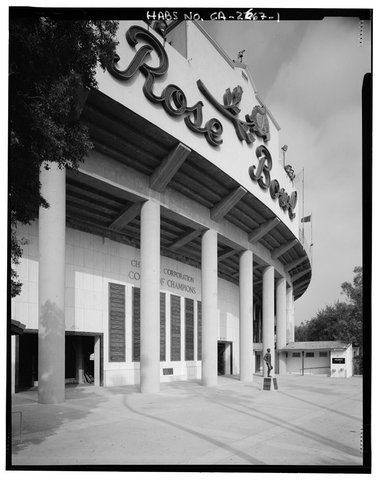
Cover: the Rose Bowl's south entrance - the cursive neon sign on the rim of the bowl, the concrete colonnade of the outer concourse, the Court of Champions plaque wall beneath it, and a small bronze figure on a plinth to the right of frame. Historic American Buildings Survey, HABS No. CA-2667-1, photograph by Tavo Olmos; Library of Congress, no known restrictions on images made by the United States Government. The catalogue record dates the documentation only as compiled after 1933, so the year of this photograph is not established. It shows the empty building from outside, and it is not a photograph of the 1980 game.



















 expand_more