


NFL History | Cleveland Municipal Stadium Site — The Championship the Goal Posts Decided Twice
· 1945-12
Personal memoryBy kevin · · Report an issue
















































Find memories left by people near you.
Distribute Bounty
This will distribute the bounty equally among all qualifying memories. This action cannot be undone.
Cancel Bounty
Are you sure you want to cancel this bounty? The remaining amount will be refunded to your account.
Success!
Operation completed successfully.
Error
Something went wrong.
NFL History | Cleveland Municipal Stadium Site — The Championship the Goal Posts Decided Twice
kevin
On Sunday 16 December 1945 the Cleveland Rams beat Washington 15-14 in this building and won the National Football League championship. Pro-Football-Reference gives the venue as Cleveland Municipal Stadium and the attendance as 32,178. The margin was one point, and both of the points that made up the difference came off the same piece of pipe.
This entry does not use the Washington club's name of that period, which the club retired in 2020. It is called Washington throughout.
The mechanism is a piece of stadium furniture. Since the rewriting of the rulebook that followed the indoor playoff game of December 1932, argued in this series at the site of Chicago Stadium, the goal posts had stood on the goal line rather than behind the end zone. That put two uprights and a crossbar inside the field of play, at the front edge of the scoring area, where a ball in flight could reach them. In Cleveland in 1945 they were made of pipe.
Early in the first quarter, with the score at nothing each, Sammy Baugh attempted a forward pass from behind his own goal line. The ball struck the goal post and rebounded into the end zone. Under the rules then in force that was an automatic safety, and Cleveland led 2-0 without having run a play in Washington territory. Pro-Football-Reference's scoring summary records the play in five words, naming Baugh and the goal post. The Evening Star of Washington, reporting from Cleveland the following morning, describes the same play at length and adds that the posts were formed of two-inch pipe, that the pass was a daring choice at nothing each rather than a blunder, and that the ball came back into the end zone off the metal. Baugh was carrying a rib injury about a week old and played only part of the first period, returning in the fourth quarter for a single snap as the holder on a field goal attempt. Frank Filchock ran the offence for the rest of the afternoon and threw both of Washington's touchdown passes.
The second goal post play is the one that almost never survives into a retelling, and it is the one that decided the game.
In the second period Bob Waterfield threw a touchdown pass to Jim Benton and then attempted the conversion. The kick was low. It was tipped at the line by the Washington tackle John Koniszewski, and the deflection sent it up into the crossbar, where it struck and dropped over rather than back. That was Cleveland's only successful extra point of the day; Waterfield missed the other one. So the posts took two points off Washington in the first quarter and gave Cleveland one point in the second, and Cleveland won by one.
Francis E. Stann, writing his column for the Evening Star from Cleveland on 17 December, did the subtraction the next morning. Under the college rules of the day, which set the posts ten yards back on the end line, neither play could have happened, and by his arithmetic the score would have been Washington 14, Cleveland 12. He also noted the symmetry: a pass into one post cost Washington the win, and a kick into the other cost it the tie. This is a contemporaneous account and it is reached here as machine transcription of a scanned page, so it is reported as attributed paraphrase rather than quoted.
Two sources of this quality do not agree on everything, and the disagreements are left standing. Pro-Football-Reference gives Steve Bagarus's touchdown catch as 38 yards, Benton's as 37 and Bob Seymour's as 8; the Evening Star gives 39, 38 and 9. The two agree on Jim Gillette's 44-yard touchdown catch. There is also a running-score discrepancy inside the newspaper itself: Stann's column puts the score at 15-7 immediately after the deflected conversion, while the box score and the paper's own game report by Lewis F. Atchison put Cleveland at 9-7 at that moment and 15-7 only after Gillette scored. One of those is a slip, and this entry does not know which; the observation that the two cannot both be right is this entry's arithmetic.
The afternoon was extremely cold. The Pro Football Hall of Fame's account of cold championship games gives six degrees Fahrenheit at kickoff with gusts taking it near zero, and describes a playing surface that had been protected under straw, paper and a tarpaulin over five inches of snow and came out closer to a rink than a field. The cold shows up in the gate in a way that is unusually well documented. The Evening Star reports that 35,305 tickets were sold for a game 32,178 people actually attended, so about three thousand people who had paid stayed away from a championship in their own city. The paper attributes their absence to the radio.
The same report itemises the money, and one line in it belongs to a longer argument in this series about early professional football as a tenant rather than an owner. After federal and state taxes of $31,537.37, the net gate was $133,005.43, and a rental of $10,000 payable to the stadium was deducted from it before the players were paid. Radio rights of an unstated amount were then added, producing a player pool the paper records as a record $95,261. Each Cleveland player received $1,469.74 and each Washington player $902.47. A league champion played for a city's building and the rent came off the top of the players' share.
The league changed the rule, and it changed exactly half of it. At the meetings of 11 January 1946, the same gathering that installed Bert Bell as commissioner, the Hall of Fame's chronology records that forward passes were made automatically incomplete on striking the goal posts. That disposes of the safety. It does not touch the other play: a placekick that strikes the crossbar and falls over is good, then and now, so the deflected extra point that produced Cleveland's margin would still count today. Reading the January 1946 change as an answer to one of the two plays and not the other is this entry's own reading of what the amendment covers.
The posts themselves stayed on the goal line for another twenty-eight seasons. On 25 April 1974 the league moved them from the goal line to the end lines, in the same set of rule changes that moved kickoffs back to the 35-yard line and added a sudden-death period to preseason and regular-season games. From that April the field of play contained no metal.
There is a coda about the winners. The same January 1946 meetings that made a pass hitting a goal post incomplete also granted Dan Reeves permission to move his champion club to Los Angeles, and the Rams left the city whose stadium they had just rented for a championship. What happened when they got there is argued in this series at the Los Angeles Memorial Coliseum, where a condition attached to the lease of a publicly owned building did more to end the league's colour line than the league did. Cleveland was without professional football for a matter of months rather than years: the All-America Football Conference put a club into this same stadium in September 1946, which is argued in this series at Cleveland Municipal Stadium under a different question entirely.
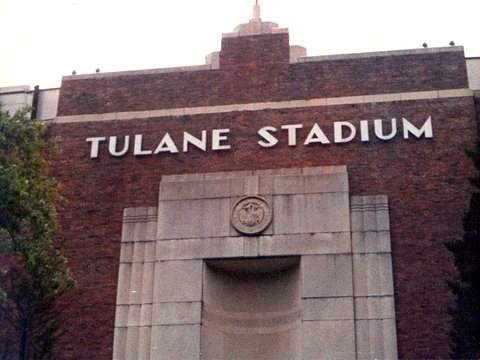
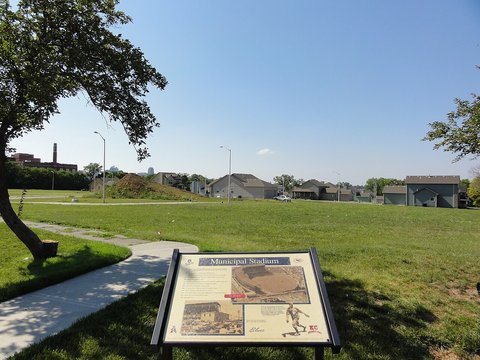
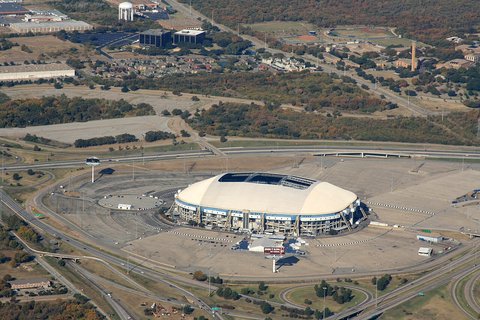
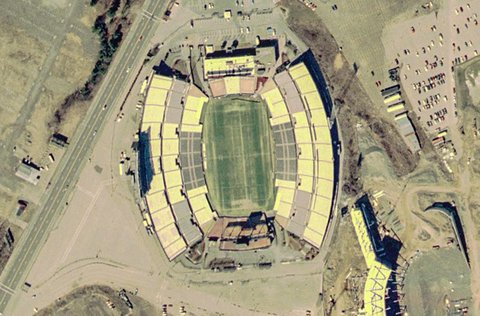
Coordinate. The pin is at 41.506072 north, 81.699635 west, with a precision radius of 120 metres. It was computed here as the shoelace centroid of the outer ring of OpenStreetMap way 41020147, retrieved from the OpenStreetMap raw API and stitched from its 63 nodes, enclosing about 265 metres north to south by 276 metres east to west. That way is the stadium now standing on this ground, tagged with its current name, its former names and an address on Alfred Lerner Way; Cleveland Municipal Stadium itself, demolished in 1996, is not separately mapped. The United States Census TIGER geocoder resolves the site's older street address, returned verbatim as 1085 W 3RD ST, CLEVELAND, OH, 44114, to a point 354 metres south of that centroid. That is a mailing address on the street rather than a building footprint, and the offset is reported rather than averaged away. The radius of 120 metres is set wide deliberately, because the 1945 building and its successor are not the same shape and the older footprint is the one this entry is about. This series already pins a different question at this ground, and that pin sits 28 metres from the centroid computed here; the agreement of two separately derived points is what establishes that the successor stands on the same ground rather than beside it, a distinction that has been got wrong elsewhere in this series.
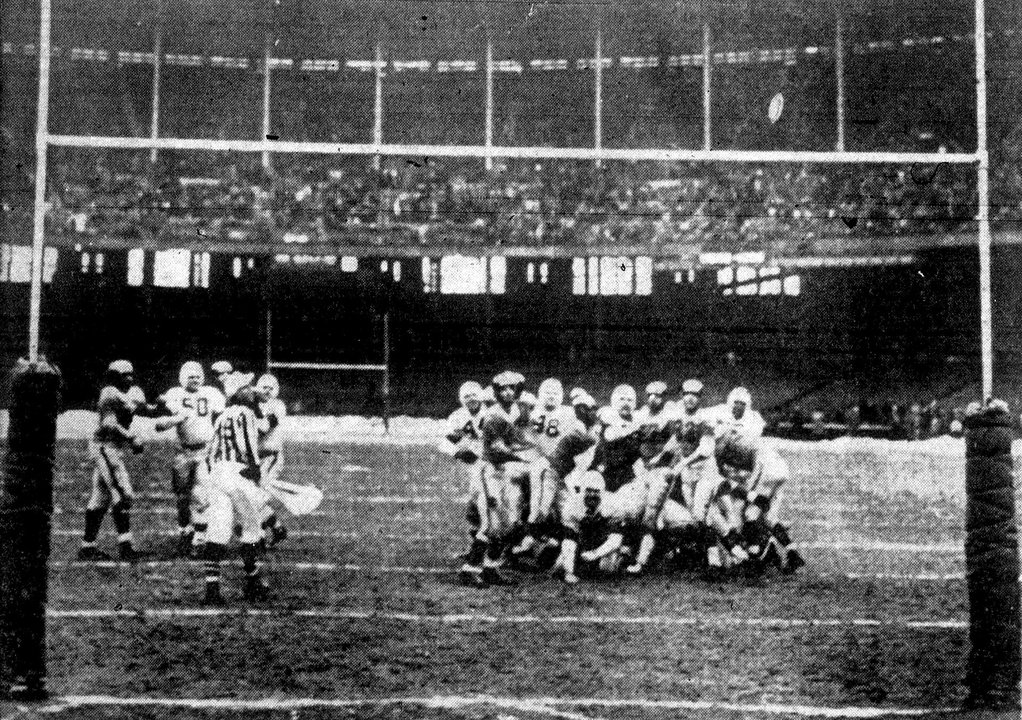
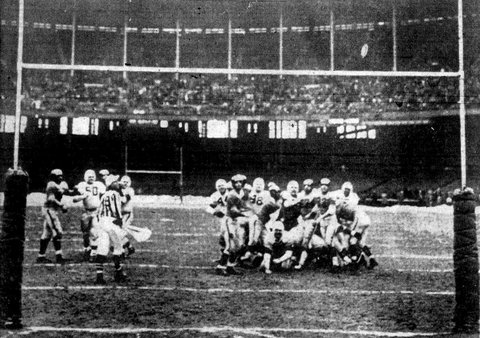
Cover image: a placekick at this stadium in the National Football League championship game of 24 December 1950, five years after the game this entry is about. It is not a photograph of the 1945 game, and no free-licensed photograph of that game was found. It is used because it shows the thing the entry argues. The camera is behind the goal, and the posts fill both edges of the frame with the crossbar across the top, standing on the playing surface at the front of the end zone with the padded base of the near upright a few feet from the players; the ball is visible in flight beyond the bar. The file was opened and examined before use. It is in the public domain, credited on Wikimedia Commons to the Los Angeles Daily News with the photographer unknown. The Commons description identifies the kicker as Lou Groza of the Cleveland Browns and the beaten club as the visiting Los Angeles Rams, and gives the kick as 14 yards; Pro-Football-Reference gives the winning kick as 16 yards. Both figures are reported here. The losing club in that photograph is the same franchise that won the 1945 championship in this building and then left.
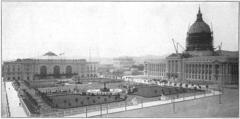
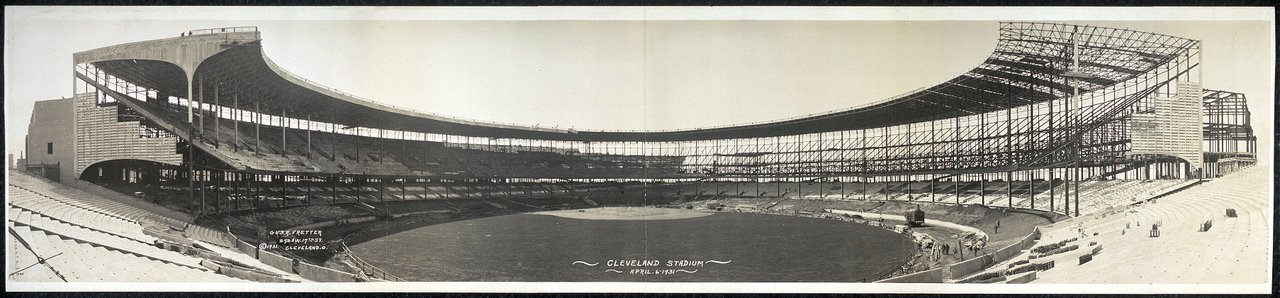
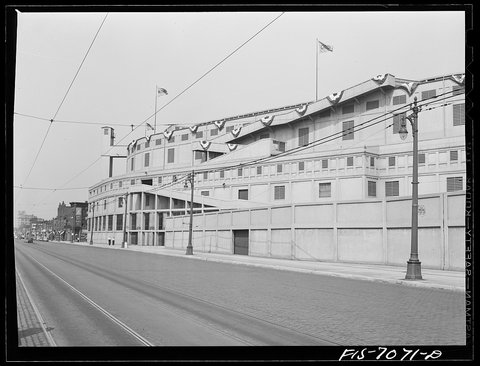
Second image: Cleveland Stadium under construction, photographed on 6 April 1931, four months before it opened, from the Panoramic Photographs collection of the Library of Congress, which records no known restrictions on publication and no copyright renewal found. The negative was deposited by Gus. A. Fretter of 2923 West 17th Street, Cleveland, and the file was opened and examined: the photographer's name, that street address and a 1931 copyright mark are inscribed in the frame itself, matching the catalogue record, and the caption written on the negative names the building and the date. It shows the upper deck as bare steelwork, seats stacked in bundles on finished concrete risers, and the field still raw ground. The scale of the empty bowl is the point of including it: this is the building that fourteen years later held a championship crowd of thirty-two thousand and looked half full.
changes?
delete this memory?
We detected that you have a Blox in your crypto wallet! We will import the Blox into your account.
Click on done below to complete the import.
Welcome Back!
Sign in to preserve cherished moments
Don't have an account?
Welcome!!
Sign up and start preserving cherished moments
?
?



Choose your payment method
Buy with Metablox Credit
Do you want to mint Blox with Metablox Credit?
Which Crypto would you like to use?
Purchase Confirmed!
Your Blox is being minted on-chain and will appear in your profile shortly.
Log in or sign up to claim your Blox.
How many credits do you want to buy?
$100 USD = 1 Metablox Credit = 1 Blox.
Use Metablox Credit to mint any Blox you want on the map.
 expand_more