
NFL History | Levi's Stadium, Santa Clara — The Grass Was Grown Somewhere Else
· 2016-2
Personal memoryBy kevin · · Report an issue




























Find memories left by people near you.
Distribute Bounty
This will distribute the bounty equally among all qualifying memories. This action cannot be undone.
Cancel Bounty
Are you sure you want to cancel this bounty? The remaining amount will be refunded to your account.
Success!
Operation completed successfully.
Error
Something went wrong.
NFL History | Levi's Stadium, Santa Clara — The Grass Was Grown Somewhere Else
kevin
On 7 February 2016 the fiftieth Super Bowl was played at Levi's Stadium in Santa Clara, California. Pro-Football-Reference's box score names the venue, gives a 6:39pm start and an attendance of 71,088, and prints the quarters as Carolina 0, 7, 0, 3 and Denver 10, 3, 3, 8. Denver won by 24 to 10. Those are the table's own figures. No halftime score is stated here, no season records are cited, and nothing about either club's year is inferred from the four cells.
The grass those teams played on had been laid on 11 January, and it was raised on a farm which one of the sources below places about 117 miles from the building.
An account by Tim Newcomb for Sports Illustrated, published 23 January 2016, records that the work began on 4 January with the major installation on 11 January, that 75,000 square feet of sod arrived on twenty-five trucks in 550 one-ton rolls, and that the grass was a Bermuda 419 hybrid overseeded with perennial ryegrass, the same variety Newcomb reports the 49ers had used successfully in 2015. He names Ed Mangan as the league's field director and Jim Mercurio as the stadium's vice-president of operations and general manager.
An article carried by SportsField Management under a 12 January 2016 date says where the sod came from. West Coast Turf grew it at its Livingston facility in northern California, which the article puts at about 117 miles from the stadium. It describes a hybrid bermuda and rye blend cut two inches thick, grown for eighteen months by a layering technique meant to build a deep root system, and laid at Santa Clara by the company's crews together with league personnel over an expected two days. John Marman, the company's vice-president of sales and marketing, is reported there as saying that conventional sod used to be good enough because it only had to hold up for the game, and as pointing to a modern field's need to survive several entertainment events within a season. Neither wording is quoted here. Both reached this entry through a page summary rather than as text read directly, and the standard this series applies is that a quotation needs a link to the exact wording.
The two accounts do not agree about the supplier's history with the game. Newcomb writes that West Coast Turf was providing a Super Bowl field for the first time since Super Bowl XXXVII in 2003. The trade article calls this the company's eighth Super Bowl installation and lists seven earlier ones, among them Super Bowls XXXVIII and XXXIX, which were played after 2003. The disagreement is recorded rather than settled.
The field was not new because the building had never had grass. It was new because the building's grass kept failing. Newcomb's January 2016 article states that there had been no fewer than five resods since the original field was installed.
The first of those came within days of the stadium's first professional football. CBS San Francisco, reporting on 21 August 2014, records that the original sod had been laid in April 2014 and was a variety called Bandera Bermuda, chosen for its tensile strength and for using less water than other grasses in league use. The first preseason game, against Denver on 17 August, left the surface full of divots. At practice on 20 August a receiver lost his footing on uneven turf; the head coach, Jim Harbaugh, stopped the session and moved the team to its training facility, and crews began pulling up sod the following morning. The same report notes that a West Coast Turf spokesman, Greg Dunn, had said in April that there would be more than adequate time for the grass to establish. The club's next preseason game was on 24 August against San Diego and its first regular-season home game on 14 September against Chicago.
Newcomb's own report of that week, also dated 21 August 2014, adds that patches had already been replaced on the Tuesday before the full effort, records the club's project executive for the stadium, Jack Hill, describing Bandera Bermuda as a hearty and tolerant strain, and gives the area of turf as 2.5 acres.
Two area figures therefore sit in this entry and they are not reconciled: 2.5 acres of turf in August 2014, and 75,000 square feet of delivered sod in January 2016. A field and a delivery are not necessarily the same quantity, and no arithmetic is done here to make them agree.
A working paper by Robert Baumann, Victor Matheson and Debra O'Connor — College of the Holy Cross, Department of Economics Faculty Research Series, Paper 17-05, August 2017 — records that Levi's Stadium is owned by the Santa Clara Stadium Authority, a public entity established in February 2011, while the 49ers manage all operational and management functions. It gives the opening as August 2014 and the cost as rising from an initial estimate of 937 million dollars to about 1.3 billion by mid-2013. Newcomb's 2014 article gives the cost as 1.2 billion. The two figures are left as they were found. The same paper records that the design allows a variety of events including international soccer, motocross and concerts, and lists a Major League Soccer match on 2 August 2014, a college football game in October 2014, WrestleMania 31 in March 2015, and the February 2016 championship, which it names Super Bowl L rather than Super Bowl 50.
It would be easy to put those last two things together and say the other events wore out the grass. No source consulted here says that about this building, and this entry does not say it either. What the sources support is narrower and duller: a supplier's sales executive described a general change in what sod is now asked to survive, and an economics paper described a stadium designed for many kinds of use. They are two separate statements and they are left separate.
The assumption a spectator brings to a field is that it grew where it is being played on. At Santa Clara it had not. It was cultivated on a farm for eighteen months, cut, rolled, loaded, driven across the state, laid down on 11 January and used once, by two teams, on 7 February. A surface of that kind is closer to a floor than to a lawn: ordered, delivered, installed against a calendar, and replaced when it fails. What the record at this address shows between April 2014 and January 2016 is a field that failed repeatedly and was replaced each time, and a championship played on one that had been grown somewhere else on purpose.
Status note, September 2026. This entry describes the building, its ownership and its playing surface as its sources record them: a CBS San Francisco report and a Sports Illustrated article of August 2014, a Sports Illustrated article of January 2016, a SportsField Management article under a January 2016 date, a College of the Holy Cross working paper of August 2017, and Pro-Football-Reference's box score for 7 February 2016. Nothing here establishes what surface the stadium has today, who manages it now, or how many times it has been relaid since.
Coordinate. One method, and it is disclosed. The United States Census Bureau's TIGER geocoder returned an empty match set for the stadium's own address, 4900 Marie P. DeBartolo Way, Santa Clara, CA 95054. It is not the first venue in this series whose well-known address is absent from the federal address file. A control query on Santa Clara City Hall, 1500 Warburton Avenue, answered at once at 37.355945 / -121.955623, with the matched string reading 1500 WARBURTON AVE, SANTA CLARA, CA, 95050, so the geocoder was healthy and the address file was not. A query on the stadium's boundary street, 4900 Centennial Blvd, matched as 4900 CENTENNIAL BLVD, SANTA CLARA, CA, 95054 and returned 37.401827 / -121.968492, which is the point published here. A second query on the same street at 4400 came back empty, so the 4900 result is an interpolation across a populated address range rather than a survey of a structure. The Historical Marker Database returns nothing for a Santa Clara stadium search, and Santa Clara is not a Socrata city, so no municipal address-point layer was reachable to this task. The published point is a road point on the street running along the stadium, not the centre of the bowl, and the radius is sized from the building's footprint rather than from the geocoder's decimal places: plus or minus 300 metres.
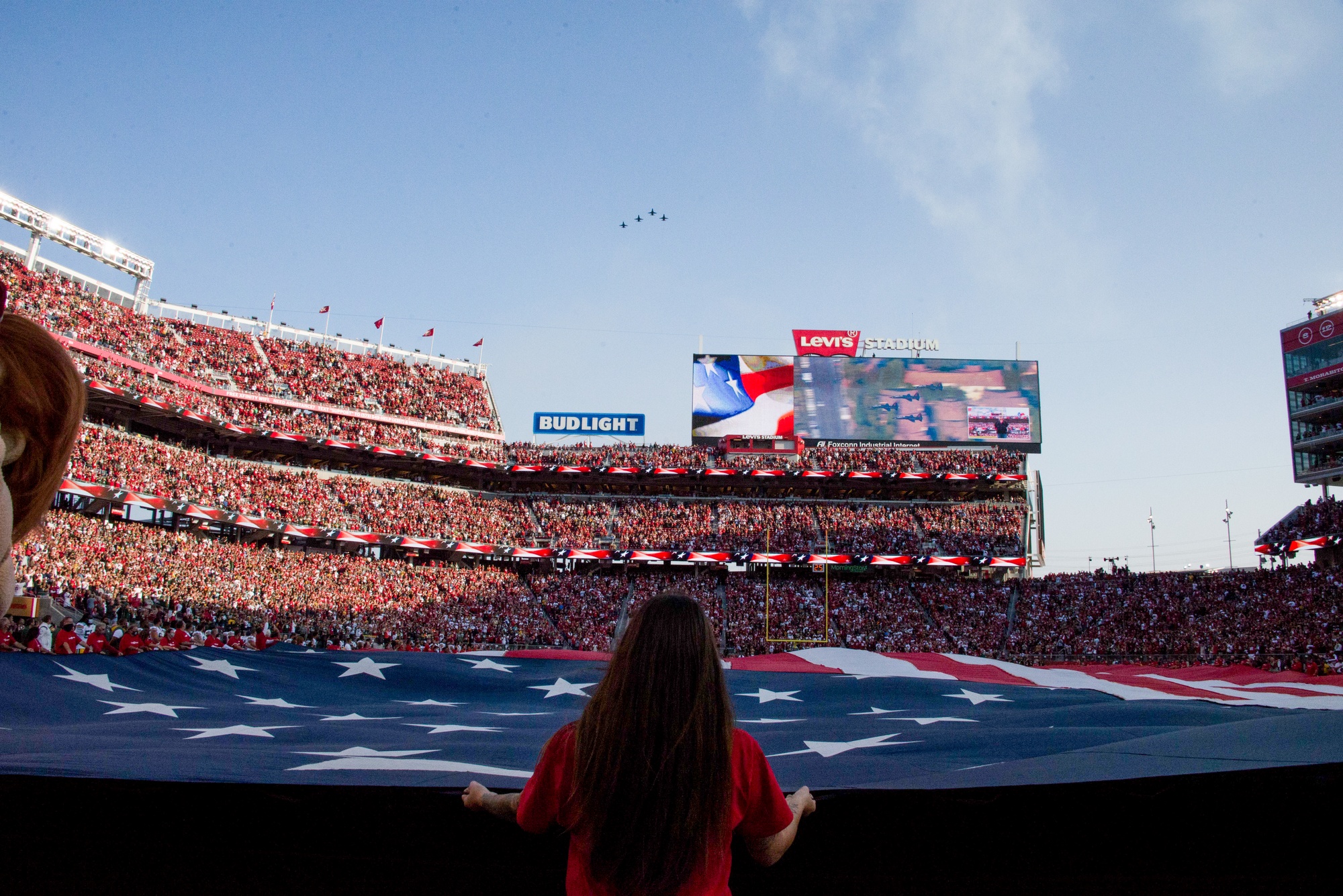
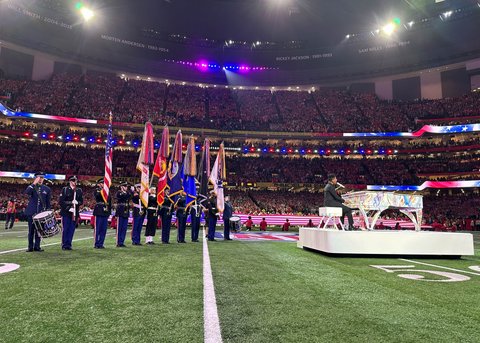
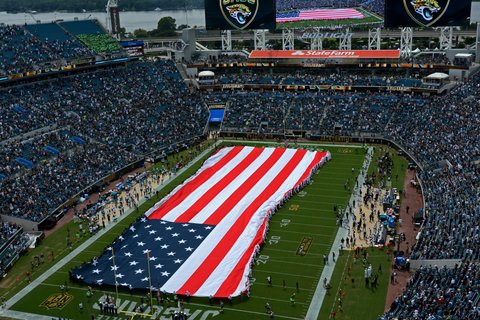
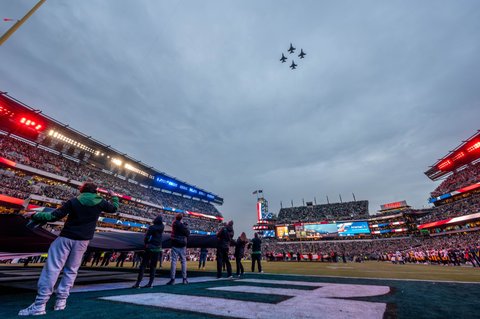
Cover image. Flag Unfurling Ceremony at Levi's Stadium, image 6884930 on DVIDS, by Senior Airman Duane Ramos of the 129th Rescue Wing, VIRIN 210926-Z-KL412-358, taken 26 September 2021. Its caption records Army Specialist Delaina Calvetti of the 129th Joint Task Force Common Operating Picture taking part in a pre-game flag unfurling before a game between the San Francisco 49ers and the Green Bay Packers, with guardsmen and civilian volunteers spreading a field-sized American flag during the national anthem as part of a salute to military veterans, and notes that Green Bay won 30-28 on a field goal in the closing seconds. The record's Location field reads only Santa Clara, California; it is the caption, and the stadium's name on the video board in frame, that place the photograph inside this building. It is not a photograph of the game this entry describes. It is also, fittingly, a photograph in which this entry's subject is entirely hidden: the flag runs from one sideline to the other and no part of the playing surface is visible anywhere in the frame.
No second image is published. The other free candidates found are further frames of the same ceremony from the same position, and would show the argument nothing new.


changes?
delete this memory?
We detected that you have a Blox in your crypto wallet! We will import the Blox into your account.
Click on done below to complete the import.
Welcome Back!
Sign in to preserve cherished moments
Don't have an account?
Welcome!!
Sign up and start preserving cherished moments
?
?
Choose your payment method
Buy with Metablox Credit
Do you want to mint Blox with Metablox Credit?
Which Crypto would you like to use?
Purchase Confirmed!
Your Blox is being minted on-chain and will appear in your profile shortly.
Log in or sign up to claim your Blox.
How many credits do you want to buy?
$100 USD = 1 Metablox Credit = 1 Blox.
Use Metablox Credit to mint any Blox you want on the map.
 expand_more