


NFL History | Aloha Stadium, Halawa — The State Bought the Game, Not the Team
· 2016-1
Unreviewed contributionBy kevin · · Report an issue































Find memories left by people near you.
Distribute Bounty
This will distribute the bounty equally among all qualifying memories. This action cannot be undone.
Cancel Bounty
Are you sure you want to cancel this bounty? The remaining amount will be refunded to your account.
Success!
Operation completed successfully.
Error
Something went wrong.
NFL History | Aloha Stadium, Halawa — The State Bought the Game, Not the Team
kevin
Aloha Stadium opened on 12 September 1975 on the ridge above Pearl Harbor, and the State of Hawaii owned it from the first day. Its landlord was a Stadium Authority sitting under the Department of Business, Economic Development and Tourism, a state department whose principal business is not football. The Authority's own account gives the bowl fifty thousand seats and four movable grandstand sections that could be repositioned between football, soccer and baseball geometries. Two pages of that same site describe those sections differently, as the first of their kind and as one of the first in the country. This entry claims neither.
What the building never had was a National Football League club. Hawaii has never held a franchise. Everywhere else in this series a government puts up money for a building so that a club will play in it, and then argues for decades about what it bought. The arrangement here ran the other way. The state owned the stadium already, had no team to put in it, and bought one game a year instead: it paid the league a fee for the right to host the Pro Bowl.
The shape of that deal is easiest to see in the year the league took the game away. The Pro Bowl of January 2010 was played in Miami, the week before the Super Bowl, as an experiment which had the side effect of keeping players from the two Super Bowl clubs out of it. The league then offered the game back to Hawaii. The Hawaii Tourism Authority's board voted nine to one to accept, at four million dollars a year for the 2011 and 2012 games, in an account published by the league itself which names Frank Supovitz, then its senior vice-president of events, Lieutenant Governor James Aiona, and the hotel executive Kyoko Kimura as the single dissenting vote. A state agency, in other words, paid to get back a game the league had removed.
The payment did not stay at four million, and the sources do not agree about where it ended up. Writing in Honolulu Civil Beat in July 2015, Eric Stinton put it at four million a year in hosting rights plus a further one hundred and fifty-eight thousand dollars for game management, with the league keeping the ticket and media revenue. An Associated Press report carried by Hawaii News Now in June 2016, when the move to Orlando was confirmed, put the annual payment at five million and reported the Authority's chief executive George Szigeti saying the money would be redirected to other events, to cultural and environmental programmes and to marketing. The two figures are a year apart and are printed here as their sources give them. This entry does not reconcile them.
Stinton's column is also where the argument about value sits. He set the Authority's own visitor claims, of twenty-five to fifty thousand additional visitors, against a paper by the economists Robert Baumann and Victor Matheson presented at a Western Economic Association International conference, which put the number between five and a half and seven thousand and found no net increase in tourism-generated money. That is a conference paper reported inside a named columnist's argument, and it is not a state finding. The Hawaii state auditor's 2018 report on the Tourism Authority, number 18-04, examines the convention centre operator, the leisure marketing contractor and the agency's procurement and administrative spending, and does not discuss the Pro Bowl at all.
The last Pro Bowl played at Aloha Stadium was on 31 January 2016, Team Irvin beating Team Rice 49-27; the Tampa Bay club's report of that afternoon counted eleven touchdowns and 960 total yards. No attendance figure is claimed here. When the move to Orlando was announced that June, the league's events executive Peter O'Reilly explained it as a matter of what Orlando could offer rather than anything Hawaii had failed to do. Read plainly, that is the arrangement in a sentence: a rights fee buys a game only for as long as the league wants to be there.
The league did come back once. On 17 August 2019 the Dallas Cowboys beat the Los Angeles Rams 14-10 at Aloha Stadium, before a crowd Hawaii News Now put at about forty-nine thousand. The Rams, announcing the fixture in March 2019, described it as the first NFL exhibition game at the stadium since 1976; the Stadium Authority's own history page records that 1976 fixture as San Francisco against San Diego on 21 August, before 36,364. Neither the Rams' announcement nor the Hawaii News Now report of the day says who paid to bring the 2019 game, and this entry makes no claim that anybody did.
Status, September 2026. The bowl is being taken down. Spectrum News Hawaii reported on 17 April 2026 that the first upper-level sections had been rolled over the day before, that three more sideline quadrants were expected in the following weeks, and that the whole demolition was estimated at about ten months, the work carried out by Aloha Halawa District Partners. The replacement, the New Aloha Stadium Entertainment District, is reported there as a 31,000-seat stadium projected to open in March 2029, to which the state has committed four hundred million dollars. That is a smaller building than the one it replaces. This paragraph describes the site as the sources consulted in September 2026 describe it, and nothing in this entry establishes what stands there now.
The coordinate. One method only, and it is a road point. The United States Census Bureau's TIGER geocoder returns nothing at all for the stadium's postal address of 99-500 Salt Lake Boulevard, Honolulu 96818; asked for the same street number as a structured query in Aiea, it matches 99-500 SALT LAKE BLVD, AIEA, HI, 96701 at 21.371876, -157.933548. A second query on the same street, at 99-510, lands about twenty-eight metres away, by calculation from the two returned points, which is what a geocoder interpolating along an address range looks like rather than a building being identified; 99-100 on the same boulevard returns no match at all, so the range is partial. No second method was found. Honolulu's municipal open-data portal is reachable and is a Socrata catalogue, but its defibrillator, traffic-camera and bus-stop layers all return nothing for the stadium, which is consistent with a state-owned asset being absent from a city inventory; the Historical Marker Database holds no entry for Aloha Stadium; and the state's own data host is not a Socrata catalogue. The precision radius below is therefore sized from the building rather than from the reading: Salt Lake Boulevard runs along the southern edge of a bowl that seated fifty thousand, so the pin is offered at plus or minus 300 metres. Note also that three names attach to this ground: the postal address says Honolulu, the federal address file says Aiea, and the district and the demolition contractor both say Halawa.
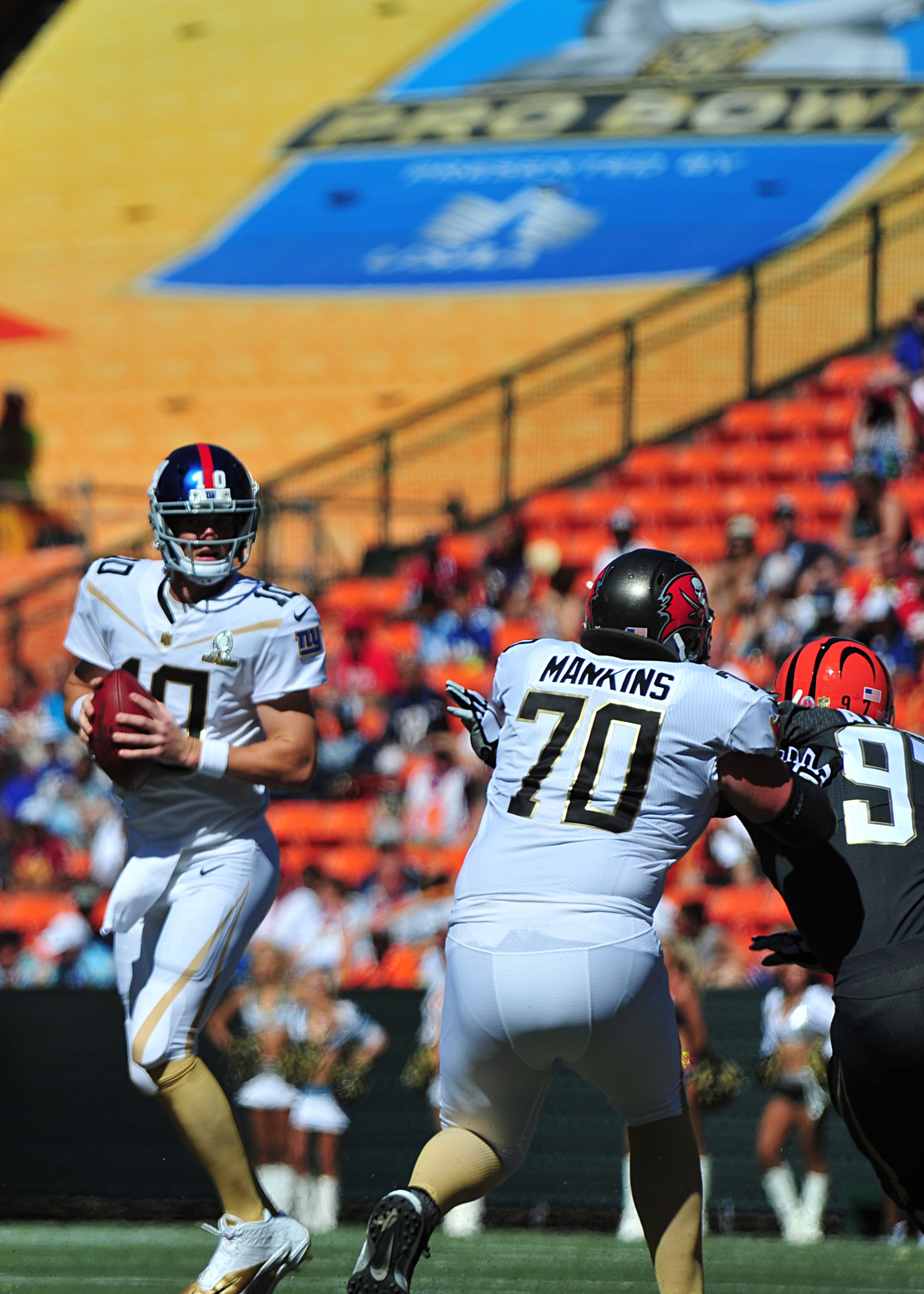
Cover image: United States Air Force photograph by Technical Sergeant Aaron Oelrich, 15th Wing, released, VIRIN 160131-F-WY331-038, via the Defense Visual Information Distribution Service. It shows Eli Manning of Team Rice looking for a receiver during the Pro Bowl of 31 January 2016, with Logan Mankins blocking; the orange upper-deck seating behind him is Aloha Stadium's own. The record's Location field reads Joint Base Pearl Harbor-Hickam, which is the photographer's unit's base and not the venue. Only the caption places the frame inside the stadium.
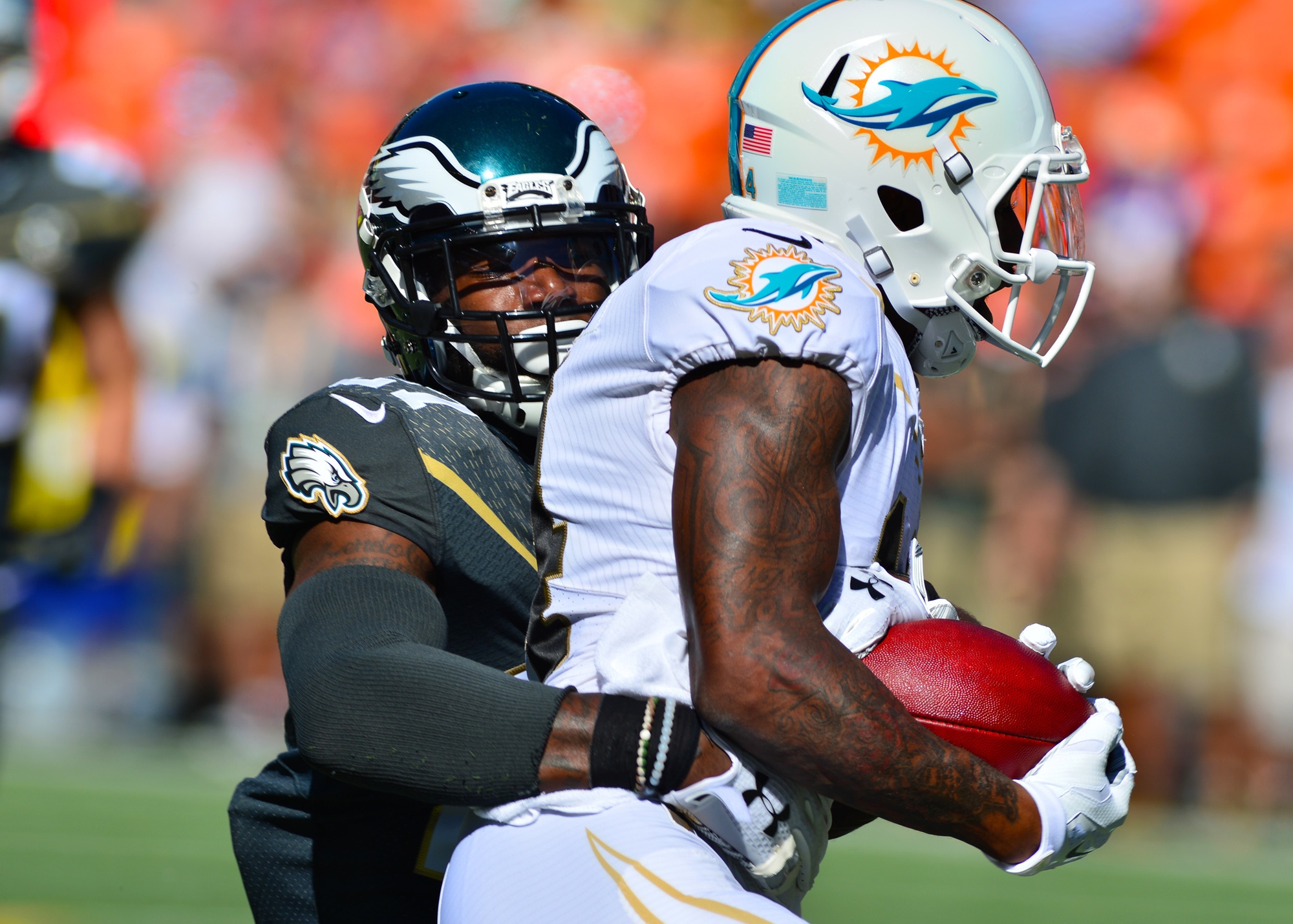
Second image: United States Air Force photograph by the same photographer, released, VIRIN 160131-F-WY331-610, showing Malcolm Jenkins of Team Irvin tackling Jarvis Landry of Team Rice at the same game. Its record carries a date taken of 1 February 2016 while its VIRIN and its caption both read 31 January. Hawaii is ten hours behind Coordinated Universal Time, which is the likeliest explanation for a late-afternoon game crossing a date boundary in the metadata; the caption and the VIRIN are preferred here.



changes?
delete this memory?
We detected that you have a Blox in your crypto wallet! We will import the Blox into your account.
Click on done below to complete the import.
Welcome Back!
Sign in to preserve cherished moments
Don't have an account?
Welcome!!
Sign up and start preserving cherished moments
?
?
Choose your payment method
Buy with Metablox Credit
Do you want to mint Blox with Metablox Credit?
Which Crypto would you like to use?
Purchase Confirmed!
Your Blox is being minted on-chain and will appear in your profile shortly.
Log in or sign up to claim your Blox.
How many credits do you want to buy?
$100 USD = 1 Metablox Credit = 1 Blox.
Use Metablox Credit to mint any Blox you want on the map.
 expand_more