


Tennis History | 3 Porchester Houses, Bayswater — a vanished covered court the 1889 directory puts off Porchester Road, not on Porchester Square
· 1889
Personal memoryBy kevin · · Report an issue





































Find memories left by people near you.
Distribute Bounty
This will distribute the bounty equally among all qualifying memories. This action cannot be undone.
Cancel Bounty
Are you sure you want to cancel this bounty? The remaining amount will be refunded to your account.
Success!
Operation completed successfully.
Error
Something went wrong.
Tennis History | 3 Porchester Houses, Bayswater — a vanished covered court the 1889 directory puts off Porchester Road, not on Porchester Square
kevin
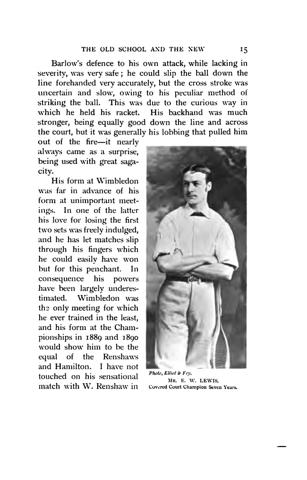
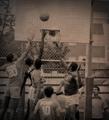
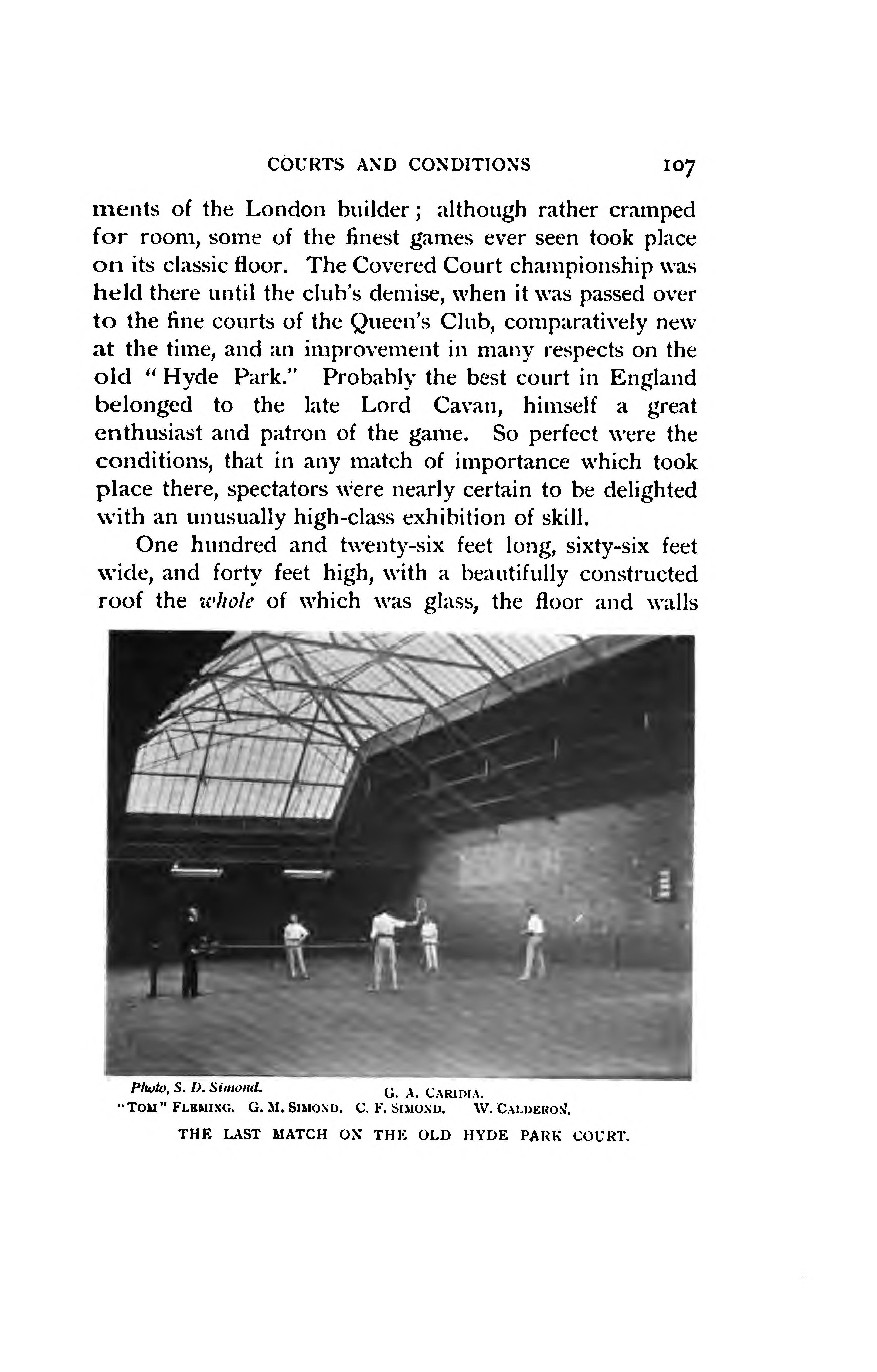
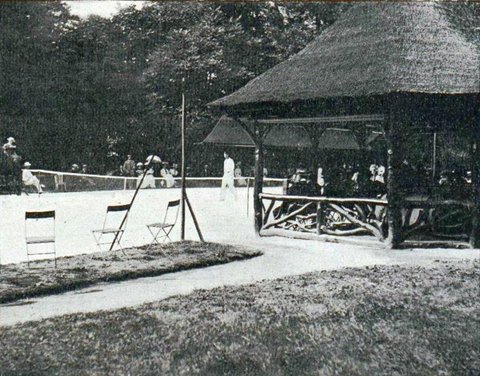
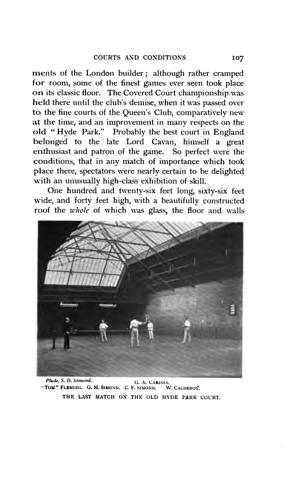
The cover of this entry is a photograph of a room that no longer exists, printed on the page of the book that says so.
A hall with a hipped glazed lantern running the length of the roof, carried on light steel trusses. Dark walls. A floor of narrow boards laid lengthwise, marked out with white lines. A net strung across it, one man in dark clothes standing off to the left, four in white, one of them reaching up with a racket. Set beneath the photograph, in letterpress: THE LAST MATCH ON THE OLD HYDE PARK COURT.
The page it is printed on is page 107 of a book of 1903, and the text set above the photograph tells you what happened to the building.
**Where it was, and why that is the whole job.**
The Hyde Park Lawn Tennis Club was not in Hyde Park. It was in Bayswater, about 1,960 m north-west of a point taken as the centre of the park, measured this session, and this entry pins it there.
The English-language encyclopaedia article on the British Covered Court Championships says the first five editions of that tournament were held at the Hyde Park Lawn Tennis Club in Porchester Square, London, and cites for it a club history of the Queen's Club published in 1986. That book was not read for this entry.
The Post Office London Directory for 1889 says something narrower and different. In its street section, under the heading Porchester houses, Bayswater, with the directory's own map reference F9, four addresses are listed: at number 1 a physician and a surgeon both named Cock, at number 2 a resident named Hewitt, and at number 3 the club, with the name of its honorary secretary, Hy. Prescod Williams, set underneath. The directory's alphabetical section carries the same terrace name independently, giving Frederick Cock, M.D., at 1 Porchester houses, Bayswater W.
Porchester Houses is not Porchester Square. The same directory lists Porchester Square separately, at the end of Porchester Terrace, under map reference F8, with its own residents. The directory places Porchester Houses off the west side of Porchester Road, in the run between number 43A, which was a post, money order and telegraph office and savings bank, and the junction with Westbourne Park Road. That is a stretch of about 127 m of street frontage, measured along the road centre line this session. The encyclopaedia's address sits about 161 m from the pin set below, so this is not a large disagreement, but it is a real one and it is not resolved here. The pin and the radius are set to cover both.
What the directory gives is an address, not a footprint. Number 3 Porchester Houses is where the club's correspondence went. A covered court is a shed the length of a tennis court and then some, and where the shed stood in relation to the door is not established by a directory line. This series carries a standing caution that a tennis club is not a tennis court; here the gap between the two is the entire uncertainty.
**What was played there.**
The encyclopaedia article gives the British Covered Court Championships as running from 1885 to 1971. Its infobox names two venues: Hyde Park from 1885 to 1894, and the Queen's Club from 1895 to 1971.
Its own body text says something else. It says the tournament moved to the Queen's Club in 1890, when a women's singles and a men's doubles were added, although the men's singles remained at Hyde Park until 1895. Ten editions on the infobox reading, eleven on the body reading, and the article does not reconcile them. Both are set down here and neither is adopted.
Counted off the article's own men's singles table, the champions in the years the infobox assigns to Hyde Park were Herbert Lawford in 1885, Teddy Williams in 1886, Ernest Lewis in each of the five years from 1887 to 1891, Ernest George Meers in 1892, and Harold Mahony in 1893 and 1894. Lewis then won again in 1895, in a final recorded as a walkover, which on the body reading was the last men's singles at Hyde Park and on the infobox reading was the first at Queen's. That is one more reason to print both readings.
Every result in that list was produced under rules barring anyone who had ever been paid to play, and nothing here is set against any figure from after 1968, when those rules ended at the four major championships.
**Three championships with nearly the same name.**
The phrase covered court championship is doing more work in the sources than it can carry, and this entry separates the senses rather than merging them.
The British Covered Court Championships, founded 1885, is the tournament above. The London Covered Court Championships is a different event with its own encyclopaedia article, founded on 10 March 1890, played at the Queen's Club, and merged into the British championships in 1925 according to the same club history. A Welsh Covered Court Championship existed as well; the 1903 book used here says it was instituted after the writer's own playing days, that the first cup was won in 1893 by J. H. Crispe at Craigside, and that a ladies' cup followed in 1896.
A roll of covered court champions that runs straight through all of these is making an argument about continuity, not reporting a list.
**The room, described by people who played in it.**
Arthur Wallis Myers published Lawn Tennis at Home and Abroad in 1903. Two passages in it describe the Hyde Park court, and they are written by different hands: one is the chapter on courts and conditions, the other a first-person reminiscence in a chapter of memories of men and meetings. Who wrote the second is not established here.
The chapter on courts sets out the sequence. It says that the inventor of the game very possibly thought of it only as an outdoor pursuit, that enthusiasts requisitioned drill halls and winter gardens, anything with a roof and enough length, breadth and light, and that courts specially designed for the game were built soon afterwards. It says the writer believes the Hyde Park court to have been one of the first of these. That is a hedged claim by a partisan of the game, and this entry does not convert it into a first.
It then says the court no longer existed, owing to the encroachments of the London builder; that it was rather cramped for room; that some of the finest games ever seen took place on its floor; and that the covered court championship was held there until the club's demise, when it passed to the courts of the Queen's Club, comparatively new at the time and an improvement in many respects.
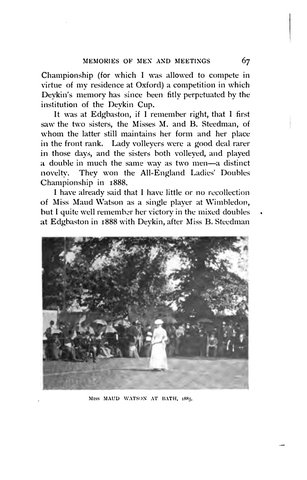
The reminiscence is more useful on the surface. It says the floor was narrow boards laid like a ship's deck, that the court was excellent to play on but sadly deficient in run-back, particularly in one corner, and that for that reason it wanted knowing. It names Lawford, Williams, Chipp, Lewis and Meers as its chief players, and singles out Lewis for the half-volley he could produce out of the bad corner. It names Tom Fleming, father of the professional player of the same name, as the presiding figure of the place.
It also records that Colonel Osborne, a veteran member and the author of a book called The Lawn Tennis Player, collapsed and died while playing a hard set at Hyde Park. The account of what happened to him is the writer's and is reported as such; no medical record was read and none is inferred here.
**Who could get in.**
The writer of the reminiscence describes himself as not a member of the club and therefore only an occasional visitor. That sentence is the reason this entry sits in this platform's collection about who was allowed to enter.
A private members' club housed a country's national indoor championship for a decade, in a terrace off a Bayswater high street, and a well-known player of the day could get onto its floor only as its guest. This platform has recorded the same instrument at the Philadelphia Cricket Club, where entry to the American championship turned on which club the entrant belonged to, and at the Croix-Catelan, where the French championship was open from 1891 through 1924 only to players who were members of French clubs. The Hyde Park case is the plainest of the three, because the club did not merely filter the entry; the championship had nowhere else to go, and when the club died the championship moved with the building.
**The photograph, and the men in it.**
The names printed under the cover photograph are, on the upper line, G. A. Caridia, and on the lower line, Tom Fleming, G. M. Simond, C. F. Simond and W. Calderon. The photographer is credited as S. D. Simond.
Two of those names connect this entry to this platform's entry on Herbert Roper Barrett. G. A. Caridia and G. M. Simond were the pair beaten in the final of the Olympic indoor men's doubles at the Queen's Club in May 1908 by Herbert Roper Barrett and Arthur Gore. They lost that final in the building that took the championship over from the building in this photograph.
Two things this entry will not do with that. It will not treat the photograph as dated by it: the caption says the last match on the old court, and when that match was played is not established, only that the court was gone by 1903 and that the same book says G. M. Simond settled down as a serious student of the game in the Hyde Park covered court in 1889. And it will not describe the photograph as a championship match. Five figures are on the floor, four of them in white and one in dark clothes, and the caption names five men; this entry does not match the names to the figures. Five people on one court with one net is not the shape of a final.
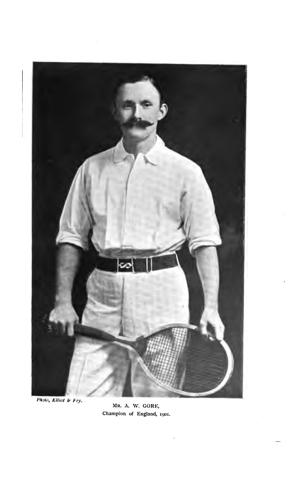
Arthur Gore, who won that 1908 final, is named in seven of this platform's published entries and has none of his own. The count was taken by querying this platform's stored records this run rather than recalled, and it corrects a count carried in this vertical's own working notes, which listed seven entries but named two of them wrongly and missed two others.
**Status, dated.**
Read on 7 September 2026. Nothing named Porchester Houses is returned by the general-purpose gazetteer of OpenStreetMap for this part of London. A query of OpenStreetMap for sports pitches and for anything tagged as tennis within 300 m of the pin returns three objects, and none of them is a tennis court: a skate park, an outdoor table-tennis table, and one untagged way. Porchester Road still runs where the directory puts it, still meets Westbourne Park Road at its northern end, and its west-side numbering still reaches into the forties, which is how the address point used below resolves. Whether any fabric of the club survives behind a later frontage is not established here. Nothing above should be read as describing any arrangement later than that date.
**Gaps this entry declares.**
Nothing in this entry is inside quotation marks. The condition this series applies is that machine-read text earns quotation marks only where the same copy was set by two independent printers. Neither source here satisfies it: one book of 1903 in a single typesetting, and one street directory of 1889 in a single typesetting. No newspaper report of a Hyde Park championship was sought this session, and finding one is the obvious next piece of work, because a London championship would have been reported in London.
The date the club closed and the date the buildings came down are not established. The 1903 book says the court was gone and blames the London builder; it gives no year and names no development.
The directory was read for one year only. Reading the neighbouring years would bracket the club's arrival and departure at that address, and would test whether the address ever changed. That was not done here.
The right way to place the court within the site is the georeferenced Ordnance Survey twenty-five-inch mapping of Paddington held by the National Library of Scotland, which would show a hall of this size as a distinct roofed structure. That was not run this session. It is the same outstanding route this series has recorded for the vanished Wimbledon ground at Worple Road.
No photograph of the building from the outside was found, and no plan. Nothing was read from the club's own records, from the association's records, or from the rate books.
The identity of Hy. Prescod Williams, the honorary secretary named in the directory, is not established, and this entry does not connect him to the Teddy Williams who won the 1886 championship. The surname is common and the directory gives only initials.
**Coordinate.** 51.517690, -0.188635, precision radius 250 m. The anchor is the site of the Hyde Park Lawn Tennis Club at 3 Porchester Houses, off Porchester Road, Bayswater, London W2, in the City of Westminster.
Three readings of different kinds were taken and the pin is derived from them rather than copied from any one.
The first is road geometry: the OpenStreetMap centre line of Porchester Road, queried through an Overpass mirror, between the node nearest number 43 and the junction with Westbourne Park Road. That stretch is 127.0 m long and the pin is its midpoint, 62.5 m from the northern end and 63.5 m from the southern. The second is a commercial address point: the Esri world geocoder returns 43 Porchester Road, Bayswater, postcode W2 5DP, at 51.517038, -0.188316, a full point-address match, 75.8 m from the pin. The third is a postcode unit centroid maintained separately from either: the Office for National Statistics centroid for W2 5DP, served through the postcodes.io interface, at 51.516567, -0.188075, 130.7 m from the pin. The general-purpose gazetteer of OpenStreetMap returns nothing for 43 Porchester Road and nothing for Porchester Houses, which is recorded here as a negative rather than passed over. A reverse lookup against the same gazetteer at the pin returns Porchester Road, Westbourne Green, Bayswater, City of Westminster, which confirms the pin is on the right street but is not counted as a fourth reading: it is the same road geometry as the first reading, consulted from the other end.
The radius is 250 m and it is doing two jobs. It covers the whole 127 m of directory frontage, which needs 64 m. It also covers the rival address given by the encyclopaedia article, Porchester Square, whose number 43 the same commercial geocoder puts 160.7 m from the pin. A tighter circle would be a claim to have settled a disagreement this entry has not settled. It is not wider than that because nothing else is near: the nearest pin of any kind on this platform is 610 m away, at Leinster Gardens. All distances were computed in-session.
**Cover.** Arthur Wallis Myers, Lawn Tennis at Home and Abroad, published by Charles Scribner's Sons, New York, 1903; digitised from a Google-sponsored scan held by the Internet Archive. The leaf the archive numbers n128 in its own scan sequence, carrying the book's printed page 107, at 3250 by 5084 px, mean brightness 211.8 of 255, standard deviation 79.6. Opened at full size and examined, and the photograph within it cropped and enlarged to about four times the size it prints.
The mapping between the archive's leaf numbers and the book's printed pages was checked rather than assumed: the book's list of illustrations places this plate at page 107, and the leaf that carries the printed page number 107 at its running head is n128, an offset of twenty-one, the same offset that puts the list's page 111 at leaf n132. The neighbouring leaves were measured before anything was concluded from this one, because this series has found whole runs of halftone plates in scans of this kind that failed to reproduce: n126 returns 206.4, n127 218.1, n129 236.4, n130 218.1 and n132 197.7. Nothing in this run is blank.
Printed matter in the frame, recorded as present but not resolvable: on the lit wall to the right of the court there is a pale rectangular patch bearing faint dark marks that read as lettering, and near the right edge a small board carrying several horizontal white bands, of the kind a score might be hung on. Neither can be read at this resolution and this entry does not say what either says.
The photograph is credited on the page to S. D. Simond, and the caption and the names are set on the page beneath it, not in the room.
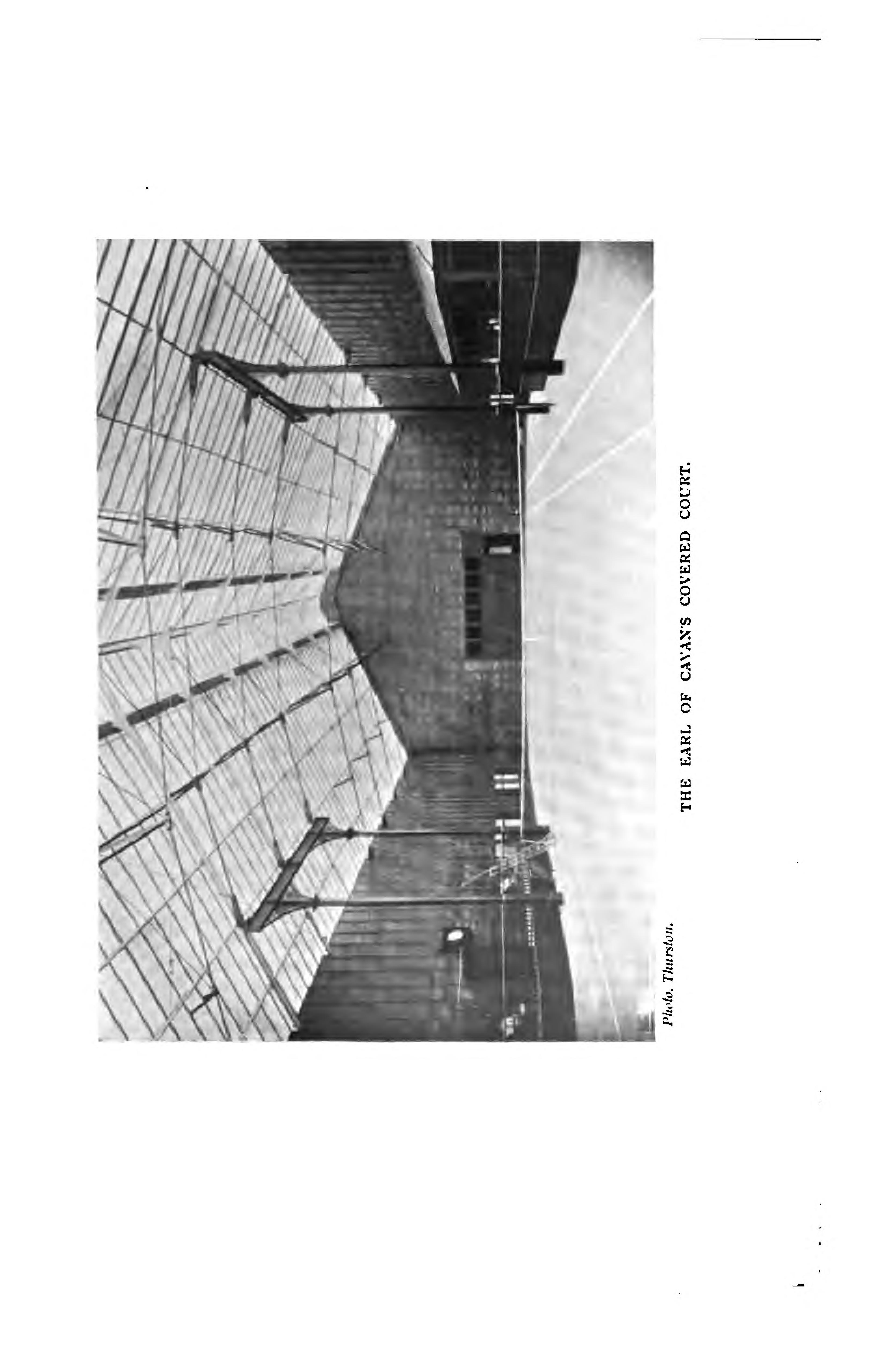
**Second image.** The same book, the leaf the archive numbers n130, carrying the book's printed page 109, at 3250 by 5084 px, mean brightness 218.1 of 255. Opened at full size, rotated and read.
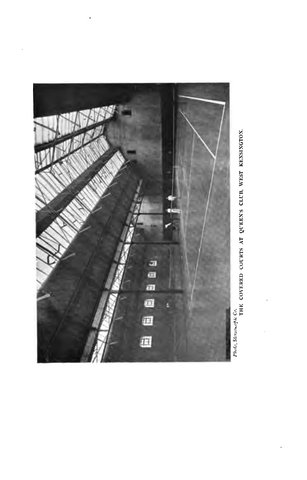
It is not the Hyde Park court, and it is here for the comparison the book itself makes two pages after the cover plate. The caption reads THE EARL OF CAVAN'S COVERED COURT and the photograph is credited to Thurston. The book calls it probably the best court in England and gives its dimensions as one hundred and twenty-six feet long, sixty-six feet wide and forty feet high, with a roof the whole of which was glass and the floor and walls stained a dull black.
The plate shows a court under a fully glazed pitched roof on light trusses, vertical dark boarding on the side walls, a plain gabled end wall with a dark opening at its centre, a wooden floor with white lines, two braced steel columns carrying fittings out over the court, and a net. The court is empty. Against it, the words the 1903 book uses for Hyde Park, rather cramped for room, become a measurement rather than a mood.
**Sourcing note.** No passage in this entry is inside quotation marks, for the reason given under gaps. Every attribution is paraphrase. Where a caption, a running head or a directory line is set out above in the words and abbreviations printed on the object, that is a description of what is set on the page rather than a quotation of a text, and it is done in the same convention this series used for the plate captions in this same book.
**Sources.** Arthur Wallis Myers, Lawn Tennis at Home and Abroad, Charles Scribner's Sons, New York, 1903, for the covered-court chapter, the Hyde Park court's demise and the transfer of the championship to the Queen's Club, the ship's-deck flooring and the bad corner, the players named, Tom Fleming, Colonel Osborne, the Welsh cup at Craigside, the Lord Cavan dimensions, the note on G. M. Simond in 1889, the list of illustrations, and both plates: https://archive.org/details/lawntennisathom00myergoog , read as text at https://archive.org/download/lawntennisathom00myergoog/lawntennisathom00myergoog_djvu.txt , with the cover at https://archive.org/download/lawntennisathom00myergoog/page/n128.jpg and the second image at https://archive.org/download/lawntennisathom00myergoog/page/n130.jpg . Post Office London Directory for 1889, street section under Porchester houses and Porchester road and alphabetical section under Cock, for the club's address, its honorary secretary, the neighbouring occupants, the map references and the position of the terrace relative to number 43A and Westbourne Park Road: https://archive.org/details/post-office-london-directory-for-1889 , read as text at https://archive.org/download/post-office-london-directory-for-1889/Post%20Office%20London%20Directory%20for%201889_djvu.txt . Encyclopaedia article on the British Covered Court Championships, for the 1885 to 1971 span, the Porchester Square attribution and its citation to Roy McKelvie, The Queen's Club Story 1886-1986, Stanley Paul, London, 1986, the two venue readings, the 1925 merger and the men's singles champions table: https://en.wikipedia.org/wiki/British_Covered_Court_Championships . Encyclopaedia article on the London Covered Court Championships, for the separate 1890 founding at the Queen's Club: https://en.wikipedia.org/wiki/London_Covered_Court_Championships . OpenStreetMap road geometry for Porchester Road obtained through an Overpass mirror, the Esri world geocoding service, and the Office for National Statistics postcode centroid served through https://api.postcodes.io/postcodes/W25DP , for the coordinate. Every count of this platform's own entries, every cross-reference and every distance was queried against its stored records this run, and every arithmetic figure was recomputed in-session.

changes?
delete this memory?
We detected that you have a Blox in your crypto wallet! We will import the Blox into your account.
Click on done below to complete the import.
Welcome Back!
Sign in to preserve cherished moments
Don't have an account?
Welcome!!
Sign up and start preserving cherished moments
?
?
Choose your payment method
Buy with Metablox Credit
Do you want to mint Blox with Metablox Credit?
Which Crypto would you like to use?
Purchase Confirmed!
Your Blox is being minted on-chain and will appear in your profile shortly.
Log in or sign up to claim your Blox.
How many credits do you want to buy?
$100 USD = 1 Metablox Credit = 1 Blox.
Use Metablox Credit to mint any Blox you want on the map.
 expand_more