


Military History | Housesteads East Curtain — The Building That Survived by Being a Sheepfold
· 1851-6
Unreviewed contributionBy kevin · · Report an issue


























































Find memories left by people near you.
Distribute Bounty
This will distribute the bounty equally among all qualifying memories. This action cannot be undone.
Cancel Bounty
Are you sure you want to cancel this bounty? The remaining amount will be refunded to your account.
Success!
Operation completed successfully.
Error
Something went wrong.

Military History | Housesteads East Curtain — The Building That Survived by Being a Sheepfold
kevin
In June 1851 Charles Roach Smith walked the Roman Wall in what he called very inclement weather, and at Housesteads he stopped long enough to draw a building that is no longer there.
It stood inside the fort, on the east side. In his sketch it is roofless, its wall-heads turfed over, with a doorway and two small openings along the long face and the ground falling away below. He took it for Roman work. "It exhibits a small Roman house," he wrote, "on the eastern side of the interior of the station, which has fortunately been preserved, while temples and public edifices have been destroyed, from the simple fact of its having been found useful as a sheep-fold." The external walls, he judged, stood almost to their original height.
John Collingwood Bruce reached the same conclusion from the stone. In the second edition of The Roman Wall, published in 1853, he placed it "near the south-east corner of the station" and found that its basement course, its mortar and its masonry "encourage the supposition that the greater part of the building is of ancient date". Bruce had the woodcuts prepared, Roach Smith records, "specially for my use".
Neither man went further. Roach Smith left "its complete investigation" to "my friends Mr. Bruce and Mr. Clayton"; Bruce wrote only that it "will repay examination". The National Trust's record for this stretch of curtain says the area was cleared in the nineteenth century to reveal the Roman wall, and that the building it calls the east bastle was entirely removed at some point between 1860 and 1895.
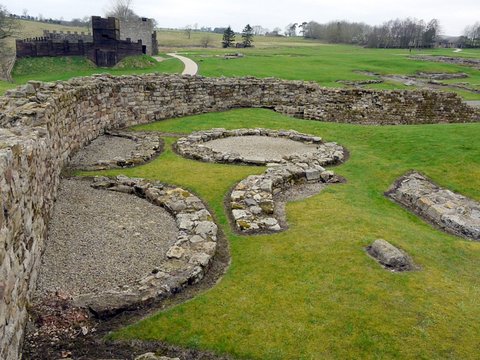
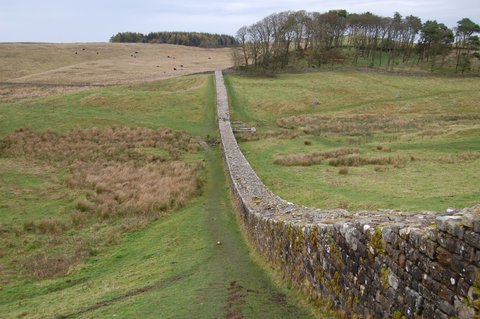
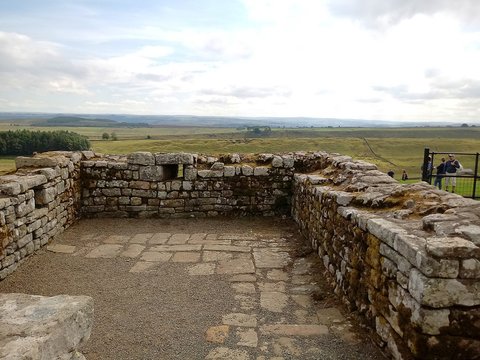
Two men saw it and both called it Roman. The record now calls it a bastle, a fortified farmhouse of the Anglo-Scottish border. Walk the east side today, between the east gate and the latrines, and there is exposed curtain wall, a barrack block Bosanquet excavated in 1898, and grass.
📸 Cover: page 188 of Charles Roach Smith's Collectanea Antiqua, volume II, London, 1852, which carries both woodcuts. The upper one shows the building on its slope, roofless, with the wall-heads turfed over; the lower one is the angle of one of its walls. Public domain; digitised by the Wellcome Library and released under the Creative Commons Public Domain Mark.



changes?
delete this memory?
We detected that you have a Blox in your crypto wallet! We will import the Blox into your account.
Click on done below to complete the import.
Welcome Back!
Sign in to preserve cherished moments
Don't have an account?
Welcome!!
Sign up and start preserving cherished moments
?
?



Choose your payment method
Buy with Metablox Credit
Do you want to mint Blox with Metablox Credit?
Which Crypto would you like to use?
Purchase Confirmed!
Your Blox is being minted on-chain and will appear in your profile shortly.
Log in or sign up to claim your Blox.
How many credits do you want to buy?
$100 USD = 1 Metablox Credit = 1 Blox.
Use Metablox Credit to mint any Blox you want on the map.
 expand_more