


NFL History | Yale Bowl, New Haven — The Earthwork That Took a Professional Tenant
· 1973-10
Personal memoryBy kevin · · updated · Report an issue























































Find memories left by people near you.
Distribute Bounty
This will distribute the bounty equally among all qualifying memories. This action cannot be undone.
Cancel Bounty
Are you sure you want to cancel this bounty? The remaining amount will be refunded to your account.
Success!
Operation completed successfully.
Error
Something went wrong.

NFL History | Yale Bowl, New Haven — The Earthwork That Took a Professional Tenant
kevin
On Sunday 7 October 1973 the New York Giants played a home game against the Green Bay Packers, kicking off at one o'clock in the afternoon and losing 16-14. The Pro-Football-Reference box score for that game names the venue in a single line: the Yale Bowl. Attendance is printed there as 70,050. The quarters are printed as Green Bay 7, 0, 6, 3 and New York 7, 0, 0, 7; no halftime figure is given here, and none is computed.
The move is visible in the club's own box scores rather than in any announcement. The Giants' first home date of that season, 16 September against Houston, names Yankee Stadium. Their second, 23 September against Philadelphia, names Yankee Stadium. Their third names the Yale Bowl, in New Haven, Connecticut. Pro-Football-Reference's season pages list the Yale Bowl as the club's stadium for 1973 and again for 1974, and Shea Stadium for 1975.
Connecticut History, a project of CTHumanities, sets out the reason in an article by Andy Piascik published on 26 September 2021 and revised on 5 October 2023: in 1973 and 1974 the Giants played their home games at the Yale Bowl while renovations went on at Yankee Stadium, their former home, and workers finished construction on Giants Stadium, their future one. The club's administrative offices stayed in Manhattan. Yale's athletics department gives the same two seasons and the same reason, and adds that the Giants also played exhibition games at the Bowl during the 1970s against the New York Jets.
That much is a familiar shape in this series: a professional club with no building of its own, renting. What makes this particular tenancy worth a pin is not the arrangement but the building the arrangement reached for.
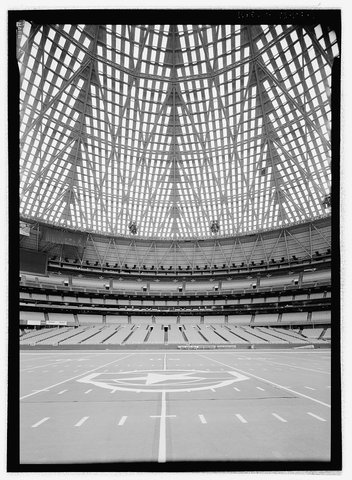
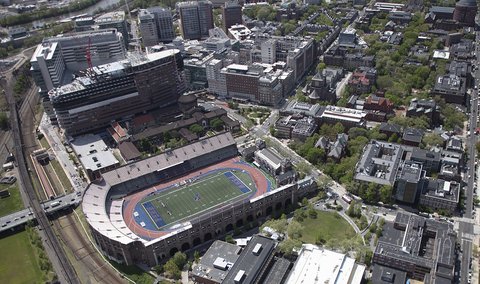
The New Haven Preservation Trust describes how the Yale Bowl was made. Charles A. Ferry designed it, and it was built in 1913 and 1914 at 81 Central Avenue by digging a large pit and mounding the excavated earth around it. The playing field sits twenty-seven feet below the exterior grade. Reinforced concrete was applied to form continuous rings of seats, and thirty concrete tunnels were driven through the earthen embankment to get spectators in and out. Yale's own facility record gives the dimensions as 930 feet long and 750 feet wide, covering twelve and a half acres, and dates the opening to 21 November 1914, for a game against Harvard. Ferry's commission, the university says, was to replace Yale Field.
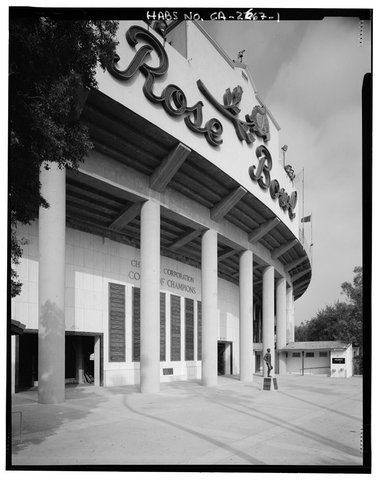
The Trust makes two further claims that bear directly on why a National Football League club could be housed here. The Bowl was the largest stadium at the time of its construction, and it remains the second oldest active college stadium in the United States. And its shape travelled: the Trust states that the Rose Bowl of 1922 and the University of Michigan's stadium of 1927 took basic elements of their design and construction pattern from it. Both the Trust and the university record the National Historic Landmark designation of 1987.
So the building that took the Giants in 1973 was not simply a large college ground that happened to be free. On the Trust's account it is the ground the later bowls took their pattern from, rented to the professional game by the institution that had dug it. Yale's figure for the original seating is 60,617, in place from the opening in 1914. No source consulted here says what, if anything, was altered in the Bowl to accommodate a professional tenant, and this entry makes no claim that anything was.
The capacity question this series usually asks cannot be answered cleanly for this date. Yale gives three figures and they describe three different moments: an original 60,617; a present 61,446; and that present figure as a reduction from 70,869 following alterations in 1994 and in 2006. Nothing consulted states what the Bowl seated on 7 October 1973. The attendance of 70,050 is therefore printed on its own above, with no ratio taken against any of the three, and the question of how full the Bowl was that afternoon is left open rather than answered from whichever of the three figures happens to be nearest.
Another entry in this series covers a university stadium at Clemson taking a professional tenant, and the question there is who paid whom. The question here is a different one. It is not about the terms of the letting; it is about the form of the building that did the letting.
Connecticut's other appearance in league records is older and shorter, and Piascik sets it out in the same article. George Mulligan established the Waterbury Blues in 1924 and moved the club to Hartford for the 1926 National Football League season, playing home games at the Velodrome in East Hartford. The official league debut came on 26 September 1926 against the New York Giants, a 21-0 loss before roughly 6,500 people. The Blues finished 3-7, beating the Brooklyn Lions 16-6, the Canton Bulldogs 16-7 and the Dayton Triangles 21-0. Poor attendance, worsened by heavy rain, led Mulligan to cancel several December fixtures to conserve money, and the last game was played on 27 November, a 16-0 loss to Duluth. In 1927 the league moved to reduce the number of clubs and voted Hartford out. Piascik records that Hartford remains the only National Football League franchise the state has had. The opponent in the Blues' league debut in 1926 and the tenant at the Yale Bowl in 1973 are the same club.
Status note, written September 2026. This entry describes the Bowl, its construction and its capacities as its sources record them, the most recent of them revised in 2023, and describes the 1973 game as the box score records it. Nothing in it establishes what the Bowl seats today beyond the university's stated present figure, what its playing surface is now beyond the synthetic surface the university dates to 2019, or what use is made of it in any current season.
Coordinate. Two independent records were obtained and they do not agree. The United States Census Bureau's TIGER geocoder, asked for 81 Central Avenue, New Haven, Connecticut 06515 - the address the New Haven Preservation Trust gives for the Bowl - returned 41.311338, -72.963549, with the matched string reading 81 CENTRAL AVE, NEW HAVEN, CT, 06515. That is a road point on the street, not a survey of the structure: asking the same geocoder for 200 Central Avenue returned 41.314921, -72.963819, a separate point further along the same street, which shows the first result to be an interpolation along an address range. A control query on New Haven City Hall, 165 Church Street, matched exactly and returned 41.306885, -72.925077, so the geocoder was healthy. The second record is the Historical Marker Database's entry 142770 for the Walter Camp Memorial, whose field GPS reads 41.310363, -72.959537, and whose location description places it on Derby Avenue, Connecticut Route 34, as the entrance to Walter Camp Field, universally known as the Yale Bowl. The pin used here is that marker's reading, because it is the record whose own description places it at the Bowl rather than on a street beside it. The two records sit on different sides of a structure the university measures at 930 by 750 feet, which is the scale of the disagreement and the reason for it; neither record is the centre of the oval. The precision radius of 300 metres is sized from that footprint and that separation, not from the decimal places of either reading. One further disagreement is left unresolved: the marker database places the gateway in West Haven, 06516, while the Bowl's own address and the Connecticut History article place the stadium in New Haven. No source consulted here states whether the structure crosses the municipal boundary, and this entry does not decide it. A New Haven municipal address-point layer was sought through the Socrata catalogue and none was reachable.
Cover image. United States Army photograph by Staff Sgt. Mikki L. Sprenkle, Army Multimedia and Visual Information Division, VIRIN 140927-A-KH856-682, image 1599312 in the Defense Visual Information Distribution Service, taken 27 September 2014 and released. The record's own location field reads only New Haven, Connecticut; it is the caption that places the frame at the Army versus Yale football game, and the caption is what this entry relied on. The photograph shows Army's quarterback releasing a pass, with the Bowl's seating behind him rising in the single continuous rake described above, no upper tier and no roof. It is a college game in 2014, not a professional one in 1973, and it is used here because it shows the geometry the Giants moved into. A second frame from the same set, of a parachutist described in its caption as descending into the Bowl, was opened and rejected: it shows only sky.





changes?
delete this memory?
We detected that you have a Blox in your crypto wallet! We will import the Blox into your account.
Click on done below to complete the import.
Welcome Back!
Sign in to preserve cherished moments
Don't have an account?
Welcome!!
Sign up and start preserving cherished moments
?
?


Choose your payment method
Buy with Metablox Credit
Do you want to mint Blox with Metablox Credit?
Which Crypto would you like to use?
Purchase Confirmed!
Your Blox is being minted on-chain and will appear in your profile shortly.
Log in or sign up to claim your Blox.
How many credits do you want to buy?
$100 USD = 1 Metablox Credit = 1 Blox.
Use Metablox Credit to mint any Blox you want on the map.
 expand_more