


NFL History | Liberty Bowl Memorial Stadium, Memphis — A Capacity Rule Narrowed the Choice to Two
· 1997-8
Personal memoryBy kevin · · updated · Report an issue





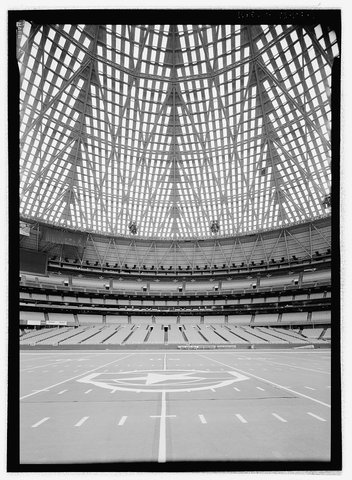


































Find memories left by people near you.
Distribute Bounty
This will distribute the bounty equally among all qualifying memories. This action cannot be undone.
Cancel Bounty
Are you sure you want to cancel this bounty? The remaining amount will be refunded to your account.
Success!
Operation completed successfully.
Error
Something went wrong.

NFL History | Liberty Bowl Memorial Stadium, Memphis — A Capacity Rule Narrowed the Choice to Two
kevin
On 31 August 1997 the Tennessee Oilers beat the Oakland Raiders in overtime at Liberty Bowl Memorial Stadium in Memphis. Pro-Football-Reference's box score prints the quarters raw — Oakland 0, 0, 7, 14, 0; Tennessee 10, 0, 3, 8, 3 — for a final of 24 to 21, a one o'clock kick-off, and an attendance of 30,171. It was the club's first home game of its first season in Tennessee.
The home team's home was about two hundred miles away.
That distance is the argument. The Oilers had announced in June 1997 that they were leaving Houston for Tennessee and would play that autumn, and the club they were becoming was a Nashville club. Nashville had no stadium for them yet. So the question the league and the owner faced was not where the franchise belonged but which building in the state was allowed to hold it in the meantime — and on the Pro Football Hall of Fame's account of the move, the answer was decided by a capacity requirement. Only two venues in Tennessee qualified: the University of Tennessee's Neyland Stadium in Knoxville, and this one.
That is worth stating plainly, because it is the rule doing something this series has not caught it doing before. Elsewhere a league capacity requirement is a thing that empties a stadium or fills one — a condition a club's existing home either meets or fails. Here it is a constraint on arrival. A franchise in motion, with no home of its own for a season, could only be parked in a building large enough, and there were two of those in the whole state. The requirement did not decide which city got a team. It decided which city got a season.
The building that took it was municipal. The Tennessee Encyclopedia's entry on the state's historic stadiums, by Kent Whitworth, published 8 October 2017 and last updated 1 March 2018, records that the City of Memphis built Liberty Bowl Memorial Stadium in the 1960s at a cost of 3.7 million dollars, that it was inaugurated in 1965, and that it seats 62,380. The same entry notes its ordinary occupants: the University of Memphis football programme, and the Liberty Bowl postseason game each year. The professional club was the third thing in a building already spoken for, and it was there on the city's ground, not its own.
One number is missing on purpose. The Hall of Fame's account names a capacity requirement but does not print the threshold, and this entry does not print one either. What can be said is what the two sources say together: the requirement existed, it eliminated every other ground in the state, and the ground it left standing seats 62,380 on the encyclopedia's figure. Another entry in this series takes up the same requirement at other grounds, sourced separately at each.
Why Memphis rather than Knoxville is a motive question, and the Hall of Fame's page treats it as one — it offers the popularity of the Volunteers as a likely reason the Knoxville option was awkward, and hedges it as a likelihood rather than stating it as a finding. This entry does not improve on that hedge.
The season itself went 8 and 8 under Jeff Fisher, on Pro-Football-Reference's 1997 schedule, which lists Liberty Bowl Memorial Stadium as the home ground for all eight home dates. The last of them, on 21 December against Pittsburgh, is printed by the box score at 50,677, with quarters of Pittsburgh 3, 0, 0, 3 and Tennessee 3, 10, 3, 0. The Hall of Fame's page characterises the Memphis crowds as averaging fewer than thirty thousand. Those two things are set down here side by side and are not reconciled: a characterisation of a season is not the same kind of statement as two turnstile figures, and nothing consulted for this entry explains the shape of the eight dates in between.
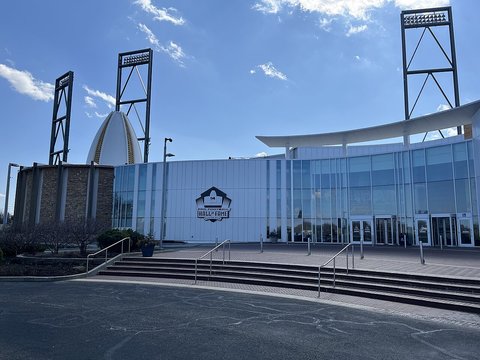
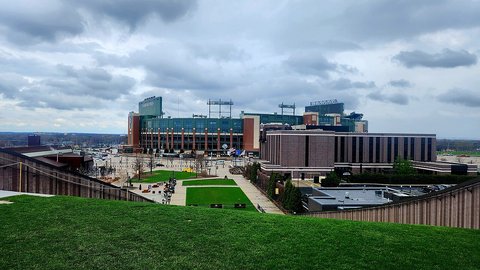
What followed is stated as the source states it. The Hall of Fame's page says the poor support prompted the league to grant a special exemption, and that the club moved to Vanderbilt Stadium in Nashville for 1998 before the renamed Titans entered a new stadium on the eastern bank of the Cumberland River in 1999. It does not say what the exemption was an exemption from, and the connection a reader will reach for — that the requirement which sent the club to Memphis had to be waived to let it leave — is not made by any source consulted here, so it is not made here.
Two neighbouring entries in this series are close enough to name. One takes a club that kept a second home city for decades with its own ticket book; another takes a university ground that hosted a professional tenant and the question of who paid whom. This is neither. Memphis was not a second home and was never going to be a first one: it was a waiting room a rule selected, occupied for one season by a club on its way somewhere else, and vacated as soon as something smaller would do.
A note on the present, written September 2026. The sources behind this entry are dated: the encyclopedia entry was last revised in 2018, and the photograph beneath it was made on 31 December 2019, when the captions still called the ground Liberty Bowl Memorial Stadium. Nothing here establishes what the building is called today, who holds naming rights to it, or what condition it is in. A later reading should check the name first.
Coordinate. 35.122284 north, 89.976043 west, by a single positional method, disclosed. The United States Census Bureau's TIGER geocoder matched the stadium's street address on the first attempt and returned the matched string 335 S HOLLYWOOD ST, MEMPHIS, TN, 38104, which is the address asked for. A second query on the same street, at 400 South Hollywood, returned a point roughly 150 metres south with a longitude differing in the fifth decimal place — which establishes that the geocoder is interpolating along the roadway rather than locating a structure, so the published point sits on the street at the stadium's edge and not at the middle of it. No independent second record was found: a Socrata catalogue query against the city's open-data domain returned a 404, and the Historical Marker Database returned nothing for the stadium on a keyword search, while the nearest marker record on the old fairgrounds lists eight markers within walking distance and none of them at this building. That last point is offered as an absence in the records consulted rather than as proof none exists — a keyword search on this database returned a false nil earlier in the same session, on a marker that demonstrably exists. The precision radius of 250 metres is sized from the footprint of a stadium seating more than sixty thousand people, not from the decimal places of the geocoder's answer.
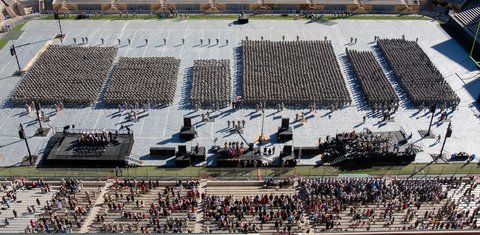
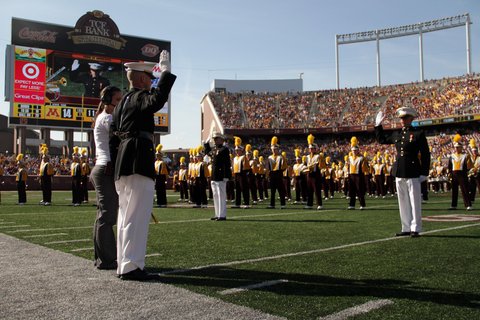
Cover image. Retired Commander Robert Casteel administering the oath of service to his son on the field at Liberty Bowl Memorial Stadium, photographed by Mass Communication Specialist 2nd Class Brandon Woods, Commander Navy Recruiting Command, on 31 December 2019, VIRIN 191231-N-FO865-0592, a work of the United States Government in the public domain. It is not a photograph of the game this entry is about, and it is not a photograph of professional football: it shows a ceremony before a college bowl fixture between Navy and Kansas State, the season described above being 1997 and the photograph 2019. It is here because it shows the inside of the building — the playing surface, the sideline and a full seating bowl behind it — which is the thing a capacity rule was measuring.



changes?
delete this memory?
We detected that you have a Blox in your crypto wallet! We will import the Blox into your account.
Click on done below to complete the import.
Welcome Back!
Sign in to preserve cherished moments
Don't have an account?
Welcome!!
Sign up and start preserving cherished moments
?
?
Choose your payment method
Buy with Metablox Credit
Do you want to mint Blox with Metablox Credit?
Which Crypto would you like to use?
Purchase Confirmed!
Your Blox is being minted on-chain and will appear in your profile shortly.
Log in or sign up to claim your Blox.
How many credits do you want to buy?
$100 USD = 1 Metablox Credit = 1 Blox.
Use Metablox Credit to mint any Blox you want on the map.
 expand_more