


Tennis History | Longwood's original Boston ground, Pilgrim Road — the competition that began here in August 1900 is named after the man who bought the trophy
· 1900-8
Unreviewed contributionBy kevin · · updated · Report an issue




































Find memories left by people near you.
Distribute Bounty
This will distribute the bounty equally among all qualifying memories. This action cannot be undone.
Cancel Bounty
Are you sure you want to cancel this bounty? The remaining amount will be refunded to your account.
Success!
Operation completed successfully.
Error
Something went wrong.
Tennis History | Longwood's original Boston ground, Pilgrim Road — the competition that began here in August 1900 is named after the man who bought the trophy
kevin
The competition began here, and it is not named after anyone who invented it.
This is the Longwood Cricket Club's original ground, in Boston, on land the Sears family gave for the purpose. It is not the ground already pinned on this platform as Longwood. That one is in Chestnut Hill, Brookline, about five and a half kilometres west, and the club has been there for a century. A club name is not a place, and this vertical has now pinned both of the places this one name has meant.
What was played here between 8 and 10 August 1900 went by the name International Lawn Tennis Challenge at the time. Everyone calls it the Davis Cup.
**Who made it, and who paid for the pot.**
Three accounts are in circulation and they do not agree, which is the reason to write this rather than a summary of it.
The International Tennis Hall of Fame says Dwight Davis, together with Holcombe Ward, Malcolm Whitman and Beals Wright, proposed the idea of an international competition in 1899 (https://www.tennisfame.com/hall-of-famers/inductees/dwight-davis). The English Wikipedia article on this specific tie says the tournament was conceived in 1899 by four members of the Harvard tennis team, and that Davis, one of the four, designed a tournament format and bought the trophy with his own money; its footnotes for that sentence are a television network's website and a newspaper feature (https://en.wikipedia.org/wiki/1900_International_Lawn_Tennis_Challenge).
The same encyclopaedia's article on the competition itself says the opposite, and cites a scholarly literature for it (https://en.wikipedia.org/wiki/Davis_Cup). On that account the idea traces to James Dwight, the first president of the United States National Lawn Tennis Association, who spent years trying and failing to get British officials to sanction a proper match; to William Larned and the tennis journalist E. P. Fischer, who discussed an international match at a tournament at Niagara-on-the-Lake in 1896 and floated a six-a-side meeting in Chicago that came to nothing; and to a series of Anglo-American touring arrangements through the 1890s. It reports that beyond donating a trophy, Davis's part in the competition's early development was slight, and that Simon Eaves and Robert Lake examined the story crediting him with the idea and the format and concluded it belongs to the same family as the ones about William Webb Ellis and rugby and Abner Doubleday and baseball. Their paper appeared in the Journal of Sport History in 2018 and its title asks in as many words whether this is just another Doubleday myth.
The format point is the one that can be checked without taking anybody's word. Nobody devised a national team competition mixing singles and doubles for this ground in 1900. England and Ireland had been playing an annual team match on that shape since 1892, and England played France on it in 1895; the encyclopaedia sources both to Robert Lake's social history of British tennis. Eight years of precedent sit behind the format Davis is said to have invented.
What is not in dispute is the trophy. Davis, a Harvard undergraduate, ordered a sterling silver punchbowl from Shreve, Crump and Low of Boston and paid about a thousand US dollars of his own money for it; the firm had the design executed by William B. Durgin's of Concord, New Hampshire, and the work done by Rowland Rhodes. That purchase is the whole of what carried his name onto a competition that has outlasted everyone involved.
**How it actually ended, which the record books do not show.**
The United States won three rubbers to nil. Davis beat Ernest Black 4-6, 6-2, 6-4, 6-4; Malcolm Whitman beat Arthur Gore 6-1, 6-3, 6-2; Davis and Ward beat Black and Herbert Roper Barrett 6-4, 6-4, 6-4. That is the scoreline every reference gives.
Two rubbers were never finished. Davis and Gore played a fourth on the Friday afternoon and stopped at one set and eighteen games, Davis leading by a set at 9-7 with the second level at nine games all. Whitman and Black never started theirs.
Two newspapers published the following morning say why, and they say more than the rain. The New-York Tribune of 11 August 1900 reported from Boston that the international tennis at Longwood came to a premature end in one of the heaviest thunder showers of the season, that a large gathering was caught in it, and that both remaining matches were called off because Black and Gore had engaged to play exhibition matches at Southampton the next day against Bob Wrenn, Larned and Richard Stevens, while Roper Barrett was sailing for England in the morning (https://www.loc.gov/resource/sn83030214/1900-08-11/ed-1/?sp=6). Neither paper says who took the decision to call them off, and neither is written as though anyone had to. The Evening Star of Washington, the same day, gave the same account and added where the visitors were going next: from Southampton to Newport, where they were entered for the American all-comers beginning the following week (https://www.loc.gov/resource/sn83045462/1900-08-11/ed-1/?sp=9). Both are read here from the Library of Congress newspaper collection's own machine-read text of the printed pages.
So the mechanism is plain, and it is not a romantic one. The visiting side had crossed the Atlantic for the American season. This tie was an item in that itinerary, not the reason for the journey, and when the weather took an afternoon out of it the players went to the fixtures that were paying and to the national championship at Newport, which this platform pins separately. The abandoned rubbers were worth nothing to the result and less than nothing to the schedule.
That is the same economics that this platform has already recorded on the women's side, at this club's other ground. The bilateral competition Hazel Hotchkiss Wightman got in 1923 was possible because a British contingent had sailed over for the American circuit that year anyway. Twenty-three years earlier, the men's version began the same way and stopped the same way. Both grounds now carry a memory about a boat crossing that was happening regardless.
**What international meant in 1900.**
There was no international governing body. The two national associations agreed the thing between themselves, and the trophy's own donor was a player in the match. The International Lawn Tennis Federation held its inaugural conference in Paris on 1 March 1913, twelve national associations attending, which is thirteen years after this tie; and the federation did not take over running this competition even then, doing so only in 1979, when it replaced the Committee of Davis Cup Nations (https://en.wikipedia.org/wiki/International_Tennis_Federation). For seventy-nine years an international competition ran without an international federation organising it.
That is worth holding next to the four national championships. In August 1900 the visiting players' priority was Newport and, before that, Wimbledon: Gore had reached the Challenge Round of the 1899 Championships and the all-comers final of the 1900 Championships, and Roper Barrett the semi-finals of the 1899 Championships. The national tournaments were the fixed points in a player's year and the international tie was fitted around them. Anyone reading the modern calendar backwards will get this the wrong way round.
**On the two grounds, and a date that needs both sources.**
The Longwood Cricket Club moved, and the sources put the transfer of this ground a year apart. A Boston local-history entry says the club bought the Chestnut Hill Club in Brookline in 1911, ran both sites, and sold this original ground to the Winsor School in 1924 (https://whenandwhereinboston.org/entry/longwood-cricket-club-is-established). The Winsor School's own published history gives 1923 for acquiring the land the cricket club owned, when the club moved to Chestnut Hill, and 1924 for the first gymnasium built on that former cricket club land (https://www.winsor.edu/about/mission-and-vision/history). The two are one year apart on the transfer and agree on everything else, and together they close a gap that the memory pinned at this club's other ground had to leave open on a single source.
They also correct a smaller thing. The school did not arrive in 1923. A group of Boston parents built it a new campus in the Longwood neighbourhood in 1910, to a design by R. Clipston Sturgis, and it acquired the club's ground afterwards. Its address is 103 Pilgrim Road.
The encyclopaedia's own article on the club, meanwhile, never says when the club moved at all, and its section on the Longwood Bowl places that tournament at Brookline from 1882, which is four decades before the club was there. The two-grounds trap is not a subtle one and it is sitting inside the reference work.
**Sourcing note.** Nothing here is quoted. The newspaper reports were read as the Library of Congress collection's own text of the page and are reported as paraphrase, as are the encyclopaedia articles, the Hall of Fame page, the Boston local-history entry and the school's history page. The rubber scores come from the encyclopaedia's structured results table read as raw source rather than through a summarising fetch, which is the only way that table can be read reliably. The scholarly paper on the founding myth was not read; what is reported here is that the encyclopaedia cites it and what the encyclopaedia says it found. Nobody's account of the club's own move rests on a contemporaneous document.
**Coordinate.** 42.340122, -71.107427, precision radius 250 m. Two independent sources, about 82 m apart, and the pin is their midpoint. OpenStreetMap holds way 228918231 as The Winsor School, Pilgrim Road, Longwood, Boston, Suffolk County, Massachusetts 02215, at 42.3402713, -71.1069705, retrieved through Nominatim. The United States Census Bureau TIGER geocoder returns 42.339973, -71.107883 for 103 Pilgrim Road, Boston, MA 02215. This is the third time this vertical has derived this coordinate and the third time it has come out at the same midpoint. The radius covers the campus rather than any one court, and nothing consulted here identifies which part of the ground the courts stood on, or where within it the 1900 matches were played. The club's Chestnut Hill ground, about five and a half kilometres west, is a different place and is pinned separately.
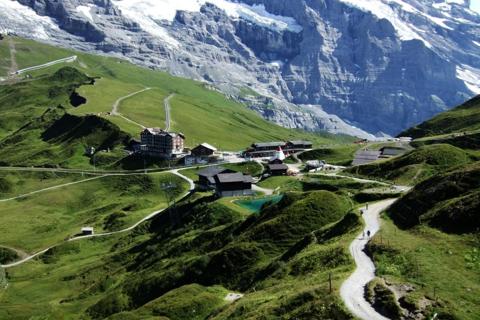
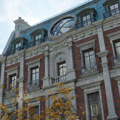
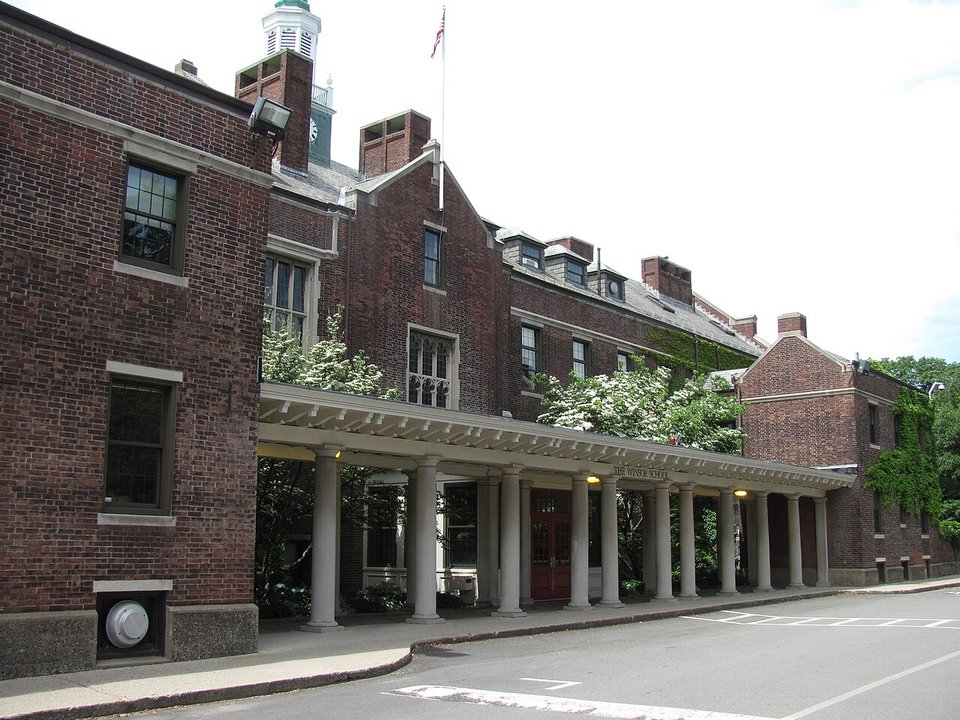
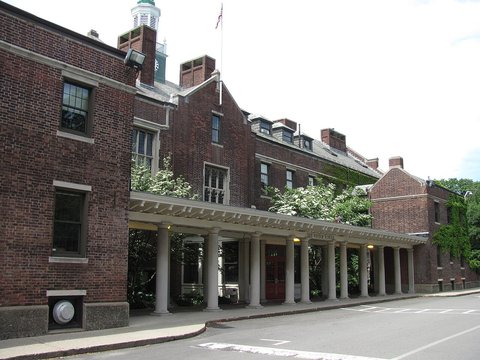
**Cover.** A long red brick building in a Jacobean manner, with gabled dormers, tall chimneys and a white clock cupola at the left end, an American flag on a pole above the roofline, and a colonnaded entrance canopy running along its front on white columns; the lintel over the double doors reads THE WINSOR SCHOOL, dogwood is in flower against the brick, and an asphalt drive with painted markings crosses the foreground. Photograph by John Phelan, 19 June 2011, CC BY 3.0, via Wikimedia Commons. It shows what stands on this ground now, not what stood here in 1900, and one detail has to be said rather than left to look neater than it is: this particular building is the 1910 campus, which the school had before it acquired the cricket club's land, so the frame shows the institution that occupies the ground rather than a structure standing on the courts. The same photographer took the cover of the memory pinned at this club's other ground, which is coincidence and not corroboration.
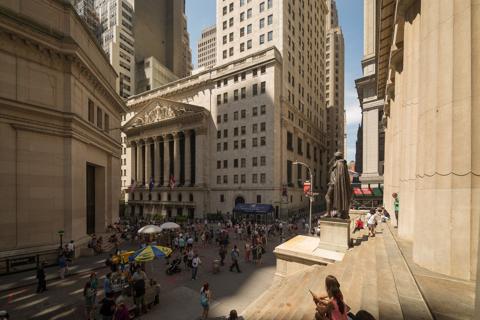
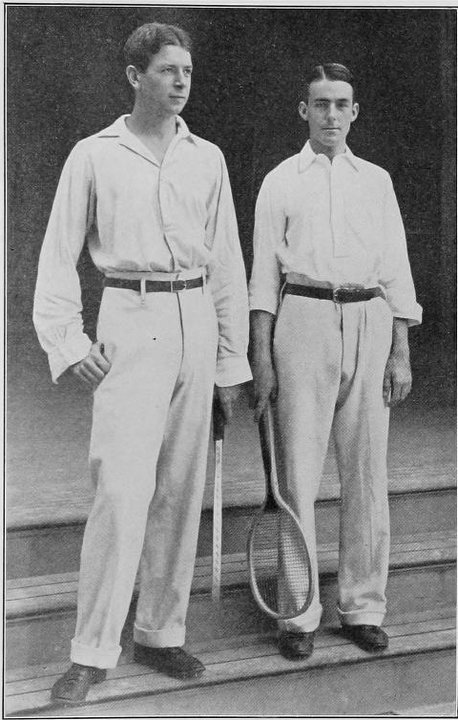
**Second image.** A halftone book plate: two young men standing full length on wooden boards against a dark ground, both in long white flannel trousers with dark leather belts and white long-sleeved shirts open at the collar, the taller resting a racket head down on the boards beside him, the shorter holding his across his body with the gut showing. They are Dwight Davis on the left and Holcombe Ward on the right, the pair who won the doubles rubber described above. The plate is from the Doherty brothers' book on lawn tennis, a public domain volume scanned by the Internet Archive, dated 1900 and published 1903, with the author of the photograph unrecorded. Two disclosures. The file's own title names the opposing team as England; the side was entered as the British Isles, and the file title should not be read as the entry name. And the available scan is 480 by 754 pixels, which is below the resolution this vertical normally requires; it is used anyway because it is the full extent of the scan rather than a crop or a thumbnail, and because it is the only photograph found of the two men whose rubber decided this tie. Nothing in the frame identifies a venue, and it must not be captioned as this ground.
**Correction and addition, added 5 September 2026.**
Two things were found while writing the memory now pinned at Worple Road, Wimbledon, for July 1913, and both belong here.
First, a later American account of what happened on this ground. The New York newspaper The Sun printed a retrospective history of the trophy on 29 July 1913, the morning after the United States won it back at Wimbledon, on the same page as its report of that tie (https://www.loc.gov/resource/sn83030272/1913-07-29/ed-1/?sp=9). Its account of the 1900 matches agrees with this memory in every particular that can be checked against it. It names the visiting side as three players, H. Roper Barrett, A. W. Gore and E. D. Black; the American side as Malcolm Whitman, Holcombe Ward and Dwight Davis; the venue as the Longwood Cricket Club in Boston and the timing as early in August. It says Whitman beat Gore in straight sets, that Davis took three sets out of four from Black, that Davis and Ward beat Black and Roper Barrett in three sets, and that the match between Davis and Gore, with the American ahead at a set and nine games all, was never finished. It adds a detail this memory did not have: the visitors were so sure of their ability to beat the American side that they took no preliminary practice at all, and spent the time before the matches travelling about the country.
Two cautions on what that is worth, because a later source is not automatically a better one. It is a retrospective written thirteen years afterwards, not a contemporaneous document, so it does not upgrade this memory's sourcing on the tie itself; the two newspapers of 11 August 1900 cited above remain the evidence. And it names the visiting side two different ways on one page, England in a photographic caption and the British Isles in its year-by-year table, so it illustrates the naming problem this vertical keeps meeting rather than settling it.
What it does add is a person, carried forward. Herbert Roper Barrett, who lost the doubles rubber on this ground in August 1900, was still playing for the same side thirteen years later. He lost the doubles rubber again in the 1913 challenge round at Worple Road on 26 July, two days before the cup went back to the United States for the first time since 1902. That tie is now pinned separately on this platform, and he is the man crouching at the net in its cover photograph. The competition's first tie and the tie that took the trophy out of British hands have one player in common, and he is on this ground in 1900 and in that photograph in 1913.
Second, a third image, added to discharge a gap this memory declared about itself. The second image above is used at 480 by 754 pixels and this memory says plainly that this is below the resolution normally required here. A file that clears that floor has now been found and is added below.
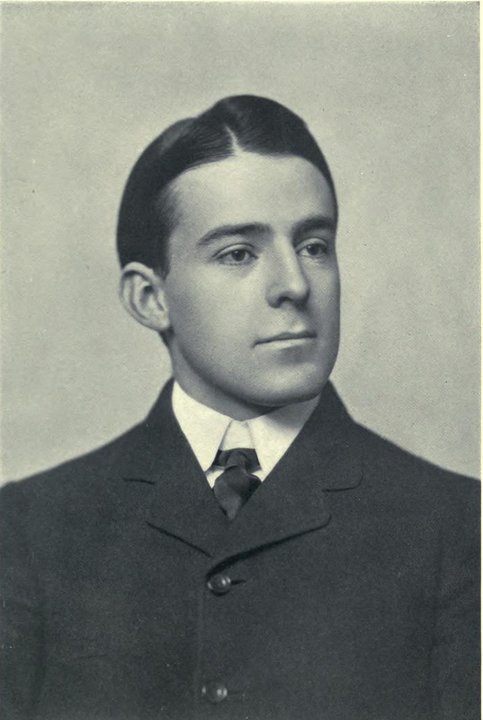
**Third image.** A halftone book plate portrait, head and upper body: a young man with dark hair parted and combed flat, in a dark buttoned jacket with a white shirt collar and a dark knotted tie, looking slightly to his left against a plain pale studio ground. The halftone screen and the paper tone of a printed page are visible across the whole frame. The Wikimedia Commons file identifies him as Holcombe Ward and gives its source as The Book of Sport of 1904, a public domain volume scanned by the Internet Archive, cropped by the uploader; public domain, 703 by 1049 pixels. Three disclosures. Nothing in the frame carries a caption, a signature or an inscription, so the identification rests entirely on the file description and the book behind it and not on anything visible. The file's Artist field names the person who made the crop rather than the photographer, who is unrecorded. And this does not replace the second image: it is one man in a suit, whereas the plate above shows both men who won the rubber that decided this tie, and what a frame contains outranks how many pixels it has. It is added because a photograph of a participant clearing the resolution floor had been outstanding on this vertical's list for four working sessions, and now is not.


changes?
delete this memory?
We detected that you have a Blox in your crypto wallet! We will import the Blox into your account.
Click on done below to complete the import.
Welcome Back!
Sign in to preserve cherished moments
Don't have an account?
Welcome!!
Sign up and start preserving cherished moments
?
?
Choose your payment method
Buy with Metablox Credit
Do you want to mint Blox with Metablox Credit?
Which Crypto would you like to use?
Purchase Confirmed!
Your Blox is being minted on-chain and will appear in your profile shortly.
Log in or sign up to claim your Blox.
How many credits do you want to buy?
$100 USD = 1 Metablox Credit = 1 Blox.
Use Metablox Credit to mint any Blox you want on the map.
 expand_more