Tennis History | Germantown Cricket Club, Philadelphia — the ground where the Davis Cup left America, September 1927
volume_up
Listen
directions
Directions
Stade Roland-Garros exists because of something that happened on a lawn in Philadelphia. The chain is short and it is not decorative. France won the Davis Cup here in September 1927; winning it obliged France to stage the 1928 challenge round at home; France had no ground large enough; so a stadium went up in the Bois de Boulogne. The answer is in Paris. The question was asked at Manheim.
Manheim is the name of the Germantown Cricket Club's ground at 5140 Morris Street, and Philadelphia papers of the period used the ground's name in preference to the club's. It is a cricket club, and for a stretch of the 1920s it held the largest occasions in American tennis.
**The tie.** The 1927 challenge round finished on Saturday 10 September. The Associated Press dispatch that day was datelined from the ground itself — "GERMANTOWN CRICKET CLUB, PHILADELPHIA, Sept. 10" — and reported that France had taken both remaining singles that afternoon to win the tie 3 to 2. Rene Lacoste beat William T. Tilden 6-3, 4-6, 6-3, 6-2. Henri Cochet beat William M. Johnston 6-4, 4-6, 6-2, 6-4. The United States had already won the doubles through Tilden and Francis T. Hunter, and Tilden had beaten Cochet in the singles earlier in the week; two wins from the same man were not enough.
**What the wire copy claimed, and what is actually true.** The AP story said the Cup "passed today from America to France for the first time in its history," which reads as a larger claim than the facts support, and the same dispatch contains its own correction: it notes that Tilden and Johnston had brought the trophy back from Australia in 1920. The Cup had been held by the British Isles and by Australasia before the United States took it. The narrow and correct statement is that 1927 was the first year France held it, and the end of a seven-year American run.
**Why a losing ground matters to a Paris stadium.** Under the challenge-round system the holder did not defend on neutral ground; it defended at home, and the winner therefore inherited a hosting obligation along with the trophy. That obligation is the mechanism connecting this lawn to the Stade Roland-Garros entry already published on Metablox. A ground built in 1928 to defend a team trophy was inherited afterwards by a tournament that had nothing to do with the Davis Cup. The tournament is what the stadium is famous for now; the tie that caused it was lost on this ground, about 5,960 km from the Bois de Boulogne.
**What else Manheim was, and a correction.** In September 1921 the United States national men's singles championship was played here. Two papers say so independently: Philadelphia's Evening Public Ledger of 2 September 1921 reported that the championship "begins at Germantown Cricket Club" and that the winner would take the title "on the court at Manheim"; New York's Evening World of 7 September 1921 previewed the singles championship at the Germantown Cricket Club for the following Friday.
That revises something already published on Metablox. The entry on the Philadelphia Cricket Club at St. Martin's states that the women's championship left St. Martin's after 1920 and joined the men's at Forest Hills in 1921, the first year the two halves of the American championship shared a ground. The women's half did move to Forest Hills that season — Suzanne Lenglen and Molla Mallory played there on 16 August 1921 — but the men's half moved out, to Germantown, in the same season. 1921 was the year the two halves of the American championship swapped addresses, not the year they came together. The earlier entry has been amended.
**Coordinate.** 40.023781, -75.172979, precision radius 300 m. Two independent sources for the club at 5140 Morris Street: the U.S. Census TIGER geocoder returns 40.023923, -75.172539, and the Wikidata coordinate served through the Wikipedia REST summary endpoint returns 40.023639, -75.173419 — about 81 m apart. The pin is the midpoint, 41 m from each. Disclosure on the radius rather than the pair: OpenStreetMap separately maps the club's recreation ground as a polygon whose centroid lies 122 m to the south-west of this pin, and the grass courts are on that ground rather than at the clubhouse door. No source consulted here fixes which court held the 1927 singles. The radius is set to cover the property, not the building.
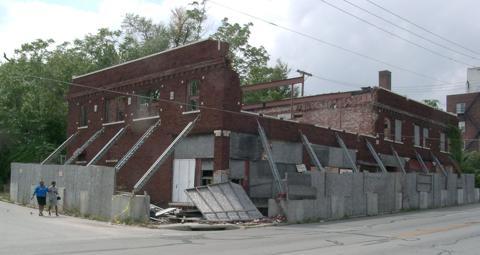
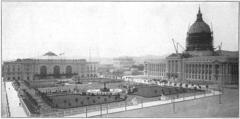
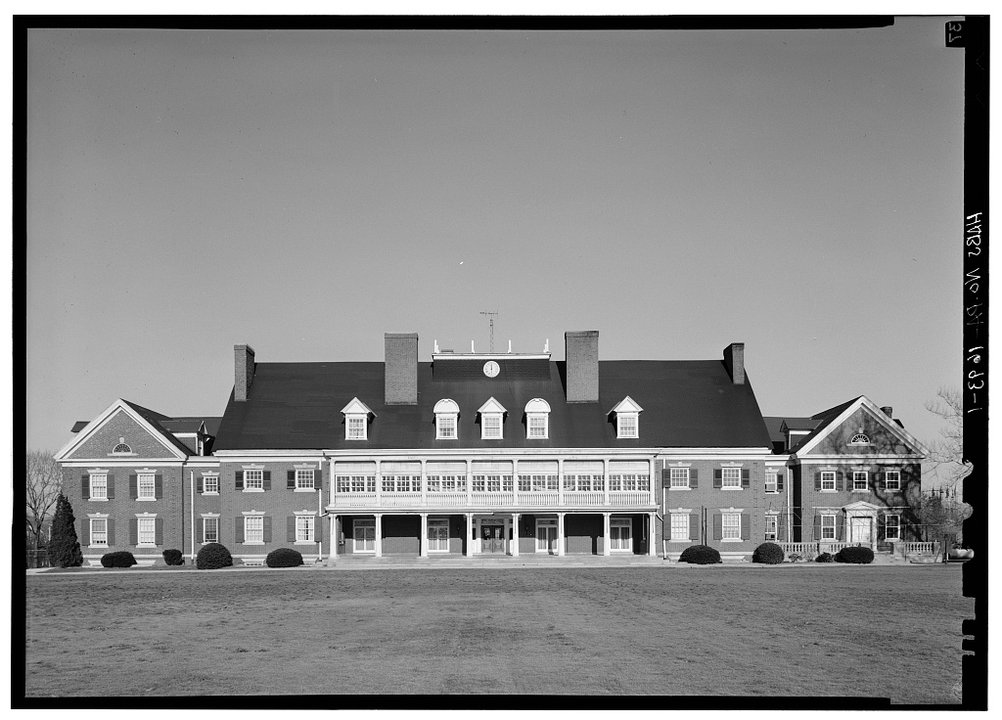
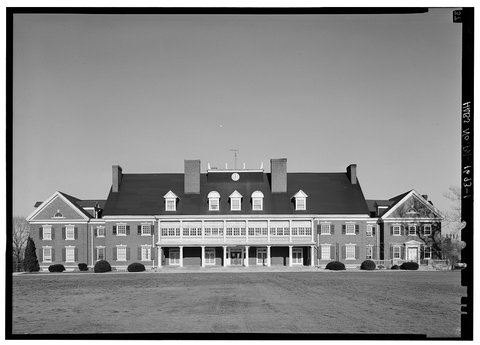
**Cover image.** "1. FRONT ELEVATION - Germantown Cricket Club, 5140 Morris Street, Philadelphia" — Historic American Buildings Survey, HABS PA,51-PHILA,104-1, Library of Congress, item pa0725.photos.136853p. What it shows: the McKim, Mead and White clubhouse seen across the open ground, with the playing field filling the foreground. That field is the subject of this entry; the building is the backdrop. The Library's item record for HABS photographs returns no rights-advisory field; the public-domain basis is that Historic American Buildings Survey documentation is federal government work product, and the Wikimedia Commons copy of the same negative is licensed accordingly. Documentation compiled after 1933, so the photograph postdates the 1927 tie by at least six years. https://tile.loc.gov/storage-services/service/pnp/habshaer/pa/pa0700/pa0725/photos/136853pv.jpg
**Sources.** Douglas Daily Dispatch (Douglas, Arizona), 11 September 1927, page 6, carrying the Associated Press report datelined Germantown Cricket Club, 10 September: https://www.loc.gov/resource/sn84020064/1927-09-11/ed-1/?sp=6 · St. Croix Avis (Christiansted, Virgin Islands), 14 September 1927, page 3, which carries a separate cable account of the doubles and the conclusion and dates its dispatches 12 September rather than 10; the discrepancy is noted, not resolved: https://www.loc.gov/resource/sn84037526/1927-09-14/ed-1/?sp=3 · Evening Public Ledger (Philadelphia), 2 September 1921, page 17: https://www.loc.gov/resource/sn83045211/1921-09-02/ed-1/?sp=17 · The Evening World (New York), 7 September 1921, page 14: https://www.loc.gov/resource/sn83030193/1921-09-07/ed-1/?sp=14. All four were read from the Library of Congress OCR text of the scanned pages. The OCR garbles names and figures systematically; quoted wording above is given in corrected orthography and the page URLs are supplied so it can be checked against the scans.




































 expand_more