Tennis History | Newport Casino, Rhode Island — the national championship was three tournaments in three states, 1887
volume_up
Listen
directions
Directions
James Gordon Bennett Jr., proprietor of the New York Herald, had the Newport Casino built on Bellevue Avenue in 1879 after falling out with the Newport Reading Room, and it opened to members in July 1880. McKim, Mead & White designed it: a shingled block with shops along the street and a horseshoe piazza behind, wrapped around lawns. It was a private social club that had tennis courts, not a tennis club with a social side, and that ordering decided who played there. Members took archery, billiards, bowling, concerts, dancing, horse shows and theatricals on the same grounds.
The United States National Lawn Tennis Association held its first men's singles championship on the Casino's grass beginning 31 August 1881. Twenty-five players entered. Richard Sears won it, and went on winning it through 1887. The men's event stayed at Newport until 1914.
What the phrase "the U.S. National Championships" concealed for the next three decades is that there was no single tournament and no single ground. Take 1887. The men's singles ran at Newport from 22 to 30 August. The men's doubles were played at the Orange Lawn Tennis Club in South Orange, New Jersey. The women's singles began on 27 September at the Philadelphia Cricket Club — five weeks after the men had finished, and about 364 km down the coast. Ellen Hansell, seventeen and from Philadelphia, beat Laura Knight 6–1, 6–0. Three championships, three states, three separate weeks, all of them national.
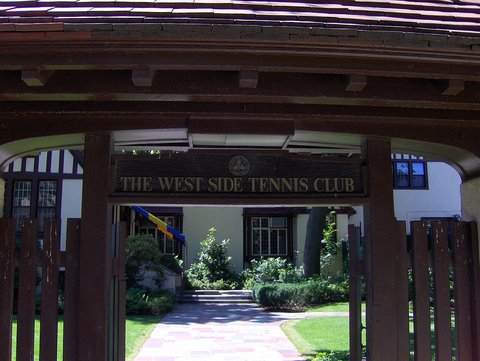
The men left first. On 5 February 1915 the USNLTA's member clubs voted at their annual meeting to move the men's championship to the West Side Tennis Club at Forest Hills, by 129 votes to 119. A players' committee drawn from the New York area had circulated a petition, gathering 125 signatures, arguing that the sport's centre of gravity had moved and that Forest Hills offered twenty-seven grass courts. Newport's defenders argued tradition, the money the Casino had put into its grounds, and a timetable they considered rushed. The account of the meeting and the vote count here follows the International Tennis Hall of Fame's own published history; a contemporaneous newspaper report of the session has not been consulted for this entry.
The women did not follow for another six years. The women's championship stayed at the Philadelphia Cricket Club until 1920 and moved to Forest Hills in 1921 — the first year the two halves of the American championship were played on the same ground, forty years after the men's event began.
Any sentence that calls Newport the home of the U.S. championship is describing half of it.
The Casino keeps grass courts and now houses the International Tennis Hall of Fame. It was listed on the National Register of Historic Places in 1970, reference 70000083, and designated a National Historic Landmark on 27 February 1987.
**Coordinate.** 41.48281, -71.30837, precision radius 200 m. Two independent sources: the U.S. Census TIGER geocoder returns 41.482855, -71.308422 for 194 Bellevue Avenue, and OpenStreetMap places the Casino complex at 41.482766, -71.308318 — about 13 m apart. The pin is the Casino complex on Bellevue Avenue, not a particular court; the grass courts lie behind the street frontage inside the horseshoe, and the radius is set to cover the grounds rather than a baseline.
**Cover image.** "Tennis Players on Newport Casino Court" — George Grantham Bain, Library of Congress, public domain. The negative carries the photographer's handwritten caption across the top: AT TENNIS, NEWPORT, and the date 8/20/09. This is 1909, not 1887 — the same ground, twenty-two years later. It is used here because of what is in the stands: tiered seating packed with women in summer dresses and wide hats, watching a championship they were not eligible to enter, which was being played that year in Philadelphia.
**Second image.** "ITHF Grounds and Newport Casino building" — Steve, CC BY-SA 2.0, 2017. A modern view of the inner courtyard: the horseshoe piazza, the clock tower and a surviving grass court. The awnings, planting and umbrellas are contemporary; the shingled structure is the 1879–80 building.





































 expand_more