Tennis History | The Waldorf-Astoria, Fifth Avenue — the officers wanted Newport and the proxies decided otherwise, February 1915
volume_up
Listen
directions
Directions
On the evening of 5 February 1915 the United States National Lawn Tennis Association held its annual meeting in the Waldorf-Astoria on Fifth Avenue and voted, 129 to 119, to move the men's national championship from the Newport Casino to the West Side Tennis Club at Forest Hills. The Sun of New York carried it the following morning under the headline "NEW YORK TO BE SCENE OF NATIONAL TENNIS TOURNEY; NEWPORT BEATEN 129 TO 119", with the deck "Arguments Wax Bitter; Vote Is Not Taken Until Nearly Midnight". The tournament, the paper noted, had been held at the Casino "for thirty-four years".
The number worth attention is not the twelve-vote margin. It is a different count, and it was supplied by the losing side. Henry W. Slocum, opening the evening session for Newport, told the room that of the association's four elected officers and the sixteen members of its executive committee, seventeen favoured Newport, one favoured the West Side club, one had not been heard from, and one was not going to be heard from, being the secretary of the West Side club himself. Slocum offered this as a reason for the membership to follow its leadership. Read the other way it describes exactly what the meeting settled: the association's officers held a near-unanimous position and it did not control the outcome, because the ballot belonged to the member clubs and the proxies they had assigned. The Sun credits the campaign that collected them to "the players committee, headed by Karl Behr" — which was not the executive committee, and had spent weeks working the membership over the executive's head.
Slocum's substantive argument was sunk cost and obligation. The Casino had spent a large sum renovating its grounds expressly for the championship, and to take the tournament away afterwards would be, he said, a stain on the association's honourable record. He and the Newport partisans who followed him, the paper observed, put great weight on sentiment.
Behr's answer relocated the ownership of the event. The championship belonged, he said, "not to the West Side Club, not to the Casino nor any other club, not to the tournament player, but to the large mass of non-tournament players, the supporters and lovers of the game." He was vehement about the Newport gallery, and about the parasols and dresses "walking up and down and talking loudly."
Not everyone arguing against Newport was arguing for Forest Hills. Holcombe Ward said he was less in favour of the West Side club than against Newport, and hoped the championship would instead be thrown open to bids from cities around the country. Richard Norris Williams, who had won the 1914 title, was given an ovation and then criticised the West Side club's playing conditions. Harold Hackett, captain of the 1913 Davis Cup team, spoke warmly of Newport and said the most fun he ever had there was the boat back to New York; because the championship was always followed by the horse show he felt like a prize horse being led into the ring, and he admitted he had never in his career watched a championship singles match, since he left Newport as soon as he could.
The meeting ran long and ragged. The debate had begun informally over the dinner between the afternoon and evening sessions. By about half past ten delegates were leaving to catch trains; a motion to close the arguments and let Behr sum up dissolved into a free-for-all in which everyone wanted to speak and all were squelched, and the vote was taken instead. Excitement was such that the roll call itself went wrong in places — George Peabody Gardner, holding a proxy for the Providence club, voted for Providence. Robert D. Wrenn, the association's president, announced the result, whereupon a motion to make the selection unanimous was seconded "without a murmur."
Three events moved, not one: the National All Comers singles, the challenge round of the national doubles, and the national interscholastic tournament. The Sun's list contains no women's event, and it should not. The women's national championship was a separate tournament at a separate ground, and this vote did not touch it. American championship histories written as a single venue chain quietly merge two events that were not in the same city, and this is one of the places the merge happens.
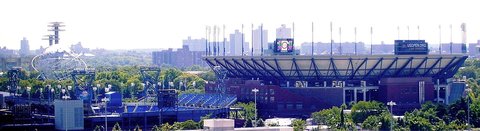
One thing the vote did not deliver was a stadium. The West Side Tennis Club had moved to Forest Hills in 1913, and what it had in 1915 was a suburban ground with a clubhouse; the horseshoe that most photographs of Forest Hills show was not built until 1923.
**On sources.** The account above is read from The Sun (New York), Saturday 6 February 1915, page 10, at https://www.loc.gov/resource/sn83030272/1915-02-06/ed-1/?sp=10 — a contemporaneous newspaper report of a meeting held the previous night. The quotations are given in corrected orthography: the Library of Congress page text is optical character recognition of a century-old broadsheet, and it garbles ordinary words and most proper names in particular (Behr appears throughout as "Hehr"). The wording of the quoted passages is legible and unambiguous; the spelling in this memory is not the file's. A second wire version of the story ran the same day in other papers and adds detail about a traded vote on the national clay court championships; that version's vote count differs from The Sun's and is a wire garble rather than a competing figure, so it is not reproduced here.
**Related memories.** Memory 9340 covers the Newport Casino and the decades when the American national championship was effectively three tournaments in three states; it carried a disclosed single-source caveat on this 1915 vote, and this memory discharges it. Memories 9325 and 9388 are at the Forest Hills ground the vote sent the championship to.
**Coordinate.** 40.748145, -73.985367, precision radius 200 m. The pin is the block, not a structure: the Fifth Avenue Waldorf-Astoria was demolished in 1929 and the Empire State Building stands on the site. The block was identified from the New York Public Library's archival finding aid for the hotel's records, MssCol 3203 (https://archives.nypl.org/mss/3203), which places the Waldorf at Fifth Avenue and 33rd Street and the Astoria at Fifth and 34th, and records the 1929 demolition. Two independently maintained geocoders were then used: the US Census Bureau TIGER geocoder returns 40.747849, -73.985077 and the New York City Department of City Planning's GeoSearch service returns 40.748441, -73.985656 — about 82 m apart, far enough to be separate readings rather than one derived from the other. The pin is their midpoint and the radius covers the block.
⚠ The Waldorf Astoria on Park Avenue is a different and later building, opened in 1931, and is already pinned on Metablox at memory 6031, about 1.4 km from here. The two hotels share a name and nothing else.
**Cover image.** "The Waldorf-Astoria, New York", Detroit Publishing Company, circa 1900. Library of Congress Prints and Photographs Division, call number LC-D4-12526, digital id det.4a08045; rights advisory "No known restrictions on publication". A three-quarter view from the street corner: the gabled Astoria mass rising behind the long lower Waldorf frontage, arcaded shopfronts and awnings at pavement level, horse-drawn vehicles and streetcar rails on wet paving, a single top-hatted figure at the right kerb. The plate carries its own printed caption, "12526. THE WALDORF-ASTORIA, NEW YORK." and "DETROIT PHOTOGRAPHIC CO.", and the negative number 12526 is scratched into the top edge.
⚠ The photograph is circa 1900, about fifteen years before the meeting described here. The Astoria wing was completed in 1897, so the building in the picture is the building the delegates argued in; the picture is not of that night.
**Second image.** "Myrick, Johnston, Behr, Murray, and Griffin [tennis]", Bain News Service, dated by the Library of Congress as between about 1915 and about 1920. Library of Congress Prints and Photographs Division, call number LC-B2-3938-7, digital id ggbain.22428; rights advisory "No known restrictions on publication". A line of men in front of a tennis net on a sunny day, some in flannels and sweaters holding racquets, the two at either end in business suits and holding straw hats. The names are written along the top of the negative in the Bain News Service's own hand, together with the negative number 3938-7.
⚠ Two cautions on this photograph. It is a tennis ground somewhere in the New York area, not the Waldorf-Astoria, and it is not the February 1915 meeting; it is included because it shows the people the story is about — Karl Behr, who ran the campaign, and Julian Myrick, who was a leading figure in the association through this period. And the negative's caption names five men while six are visible, so no individual in the line should be identified from it with confidence.
























































 expand_more