Tennis History | Flushing Meadows, New York — the US Open moved into a World's Fair building, 1978
volume_up
Listen
directions
Directions
The United States championship has never stayed anywhere for long.
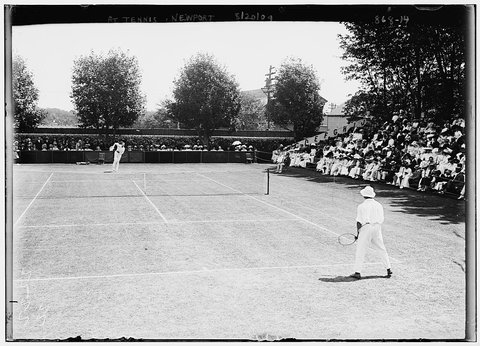
The men's singles began at the Newport Casino in 1881 and left after 1914. The women's event ran at the Philadelphia Cricket Club from 1887 and left after 1920. Both ended up at the West Side Tennis Club in Forest Hills, and by the mid-1970s that ground had run out of room — a members' club on a residential block, with nowhere to put the seating an American major had come to need.
The replacement was spotted from the air.
In January 1977, flying into LaGuardia, the incoming president of the United States Tennis Association, W. E. "Slew" Hester, looked down on Flushing Meadows-Corona Park and saw a large stadium standing mostly idle. It was the Singer Bowl, put up for the 1964-65 New York World's Fair and named for the sewing-machine company that paid for it. Hester asked New York City for the building and the land around it.
The city agreed. The Singer Bowl was cut into two arenas — Louis Armstrong Stadium and the adjoining Grandstand — and the USTA National Tennis Center opened in August 1978, on city parkland held under a long lease. A national championship moved into a second-hand exhibition building.
The surface changed with the address, and it had changed once already. The tournament was played on grass from 1881 through 1974, on clay at Forest Hills from 1975 to 1977, and on an acrylic hard court, DecoTurf, from 1978; Laykold replaced DecoTurf in 2020. No other major championship has changed surface twice inside four years.
It shows up in the record. The International Tennis Hall of Fame describes Jimmy Connors as "the only player in history to win the US Open on all three surfaces" (https://www.tennisfame.com/hall-of-famers/inductees/jimmy-connors). He won it in 1974, 1976, 1978, 1982 and 1983 — which is to say once on grass at Forest Hills, once on clay in the same stadium, and three times on hard courts in Queens. Read straight down a list of champions, that looks like one tournament. It was three.
The 1978 stadium is itself gone. Wikidata records the original Louis Armstrong Stadium, capacity 10,200, as ending in October 2016; a stadium of the same name opened on the site in 2018.
**Status note.** Written 3 September 2026. The US Open is still played on this ground, which has been rebuilt around its 1978 core more than once since.
**On sourcing.** The account of Hester spotting the Singer Bowl from an aircraft in January 1977 is carried by the secondary literature and by the venue's own published history; no contemporaneous 1977 document recording it was located for this memory. The surface dates and the venue chronology are documented independently.
**Coordinate.** 40.74842, -73.84494, precision radius 500 m. Two independent sources: the New York City Department of City Planning geocoder returns 40.74726, -73.84333 for the National Tennis Center, and OpenStreetMap's extent for the same complex gives 40.7495765, -73.8465422 — about 374 m apart, which is what a site of this size produces rather than a disagreement. The pin is the midpoint of the two. It marks the grounds, not a court: this is a complex of more than twenty courts and several stadiums, and no individual court should be read off it. For orientation, Wikidata places the 1978-2016 Louis Armstrong Stadium at 40.750944, -73.8455, roughly 285 m north of this pin.
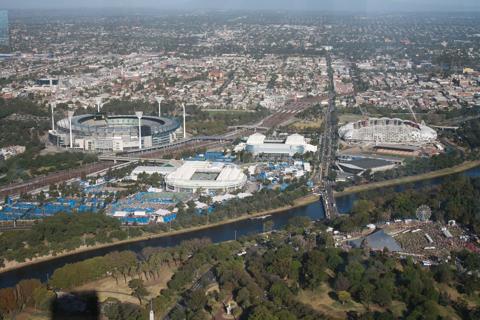
**Cover image.** The USTA Billie Jean King National Tennis Center seen from Citi Field, 28 August 2010. Photograph by Beyond My Ken, CC BY-SA 4.0 via Wikimedia Commons. It was taken from outside the tennis grounds, which is what makes it usable — photography inside the grounds during the tournament carries ticket conditions. The frame happens to carry the whole argument. At the right is Arthur Ashe Stadium under a USOPEN.ORG board. Left of centre, the low open bowl with blue seats is the original Louis Armstrong Stadium — the converted Singer Bowl, still standing in 2010. Behind it stand the Unisphere and the observation towers of the New York State Pavilion, the other two things the 1964-65 World's Fair left on this ground.
**Second image.** The Singer Bowl in 1964, its name in freestanding letters over the entrance, doors marked SINGER, and a box-office sign at the right. Photograph by Doug Coldwell, CC BY-SA 3.0 via Wikimedia Commons. At 616 by 618 pixels it sits below the resolution this project normally accepts, and is used anyway because it is the only free-licensed view found of the building under its own name.
**One correction worth recording.** A Wikimedia Commons file captioned "Singer Bowl, now a tennis stadium" and dated 2006 does not show the Singer Bowl. It shows Arthur Ashe Stadium from the south plaza, with Marshall Fredericks' 1964 World's Fair sculpture The Freedom of the Human Spirit in the foreground. It was opened, compared against a 2019 photograph of the same view, and not used.















































 expand_more