


Dynastic History | Karakorum — The Fountain Was Built by a Goldsmith Taken in a Raid
· 1254
Unreviewed contributionBy kevin · · Report an issue

































Find memories left by people near you.
Distribute Bounty
This will distribute the bounty equally among all qualifying memories. This action cannot be undone.
Cancel Bounty
Are you sure you want to cancel this bounty? The remaining amount will be refunded to your account.
Success!
Operation completed successfully.
Error
Something went wrong.
Dynastic History | Karakorum — The Fountain Was Built by a Goldsmith Taken in a Raid
kevin
William of Rubruck, a Flemish Franciscan sent east by Louis IX of France, reached Karakorum in 1254 and found a Parisian at work there. Guillaume Boucher, a metalsmith, had been seized during the Mongol campaign of 1241–42 — the accounts place his capture at Belgrade or at Gyulafehérvár in Transylvania — by Möngke's half-brother Böchek, and carried across the continent with his wife and an adopted son who worked as an interpreter. At the khan's court he built the drinking fountain Rubruck described: a silver tree with serpents coiled up the trunk, four lions at the base, and a mechanical angel that lifted a trumpet when the drinks were to flow, each liquid from its own mouth — mare's milk, wine, a honey drink, rice mead.
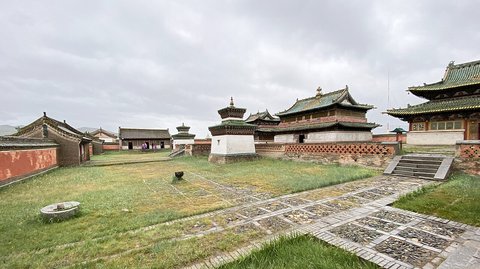
That is the more useful fact about the imperial capital than its dimensions. Ögedei walled the site and built a fixed palace in 1235, after the defeat of the Jin. Rubruck's city had four gates, a quarter for the "Saracens" and one for the "Cathai", twelve temples, two mosques and a Nestorian church. A good part of its skilled workforce had arrived the way Boucher did.
Excavation has since revised the site's own account of itself. Kiselyov's Soviet-Mongolian dig of 1948–49 identified a great hall as Ögedei's palace; the German-Mongolian expedition of 2000–2004 reidentified the same structure as a large stupa temple.
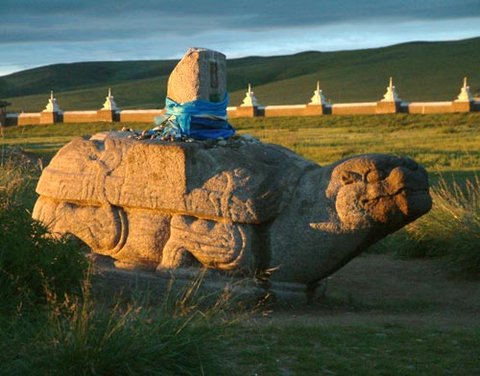
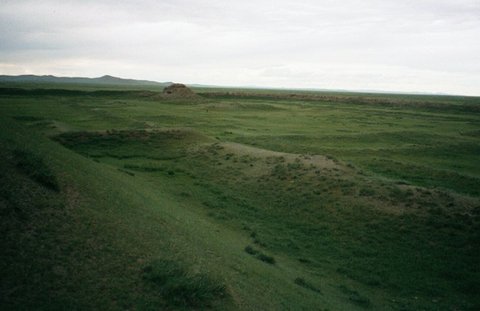
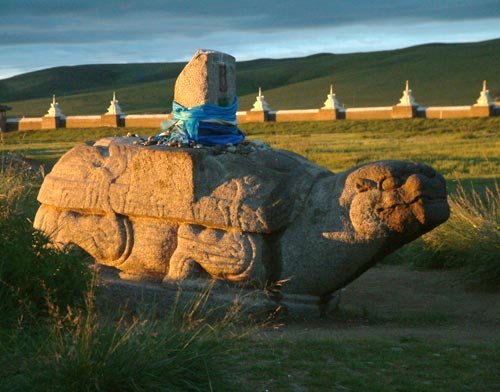
The walls are grass now. A granite tortoise — a bixi, the tortoise-shaped stele base of Chinese tradition — sits in the open ground beside Erdene Zuu, tied with offering scarves.
📸 Cover: The granite tortoise at Karakorum, with Erdene Zuu's wall of stupas behind, Frithjof Spangenberg, CC BY-SA 2.5 via Wikimedia Commons

changes?
delete this memory?
We detected that you have a Blox in your crypto wallet! We will import the Blox into your account.
Click on done below to complete the import.
Welcome Back!
Sign in to preserve cherished moments
Don't have an account?
Welcome!!
Sign up and start preserving cherished moments
?
?
Choose your payment method
Buy with Metablox Credit
Do you want to mint Blox with Metablox Credit?
Which Crypto would you like to use?
Purchase Confirmed!
Your Blox is being minted on-chain and will appear in your profile shortly.
Log in or sign up to claim your Blox.
How many credits do you want to buy?
$100 USD = 1 Metablox Credit = 1 Blox.
Use Metablox Credit to mint any Blox you want on the map.
 expand_more