


Tennis History | Peck and Snyder, 126 Nassau Street, New York — the association voted the American ball out twenty-four to seventeen, March 1886
· 1886-3
Unreviewed contributionBy kevin · · updated · Report an issue








































Find memories left by people near you.
Distribute Bounty
This will distribute the bounty equally among all qualifying memories. This action cannot be undone.
Cancel Bounty
Are you sure you want to cancel this bounty? The remaining amount will be refunded to your account.
Success!
Operation completed successfully.
Error
Something went wrong.


Tennis History | Peck and Snyder, 126 Nassau Street, New York — the association voted the American ball out twenty-four to seventeen, March 1886
kevin
The oldest document in this entry is a label for a dozen baseballs. It is pasted to the middle of a trademark registration sheet in the Library of Congress: a red ball with its seams drawn across it, the words PECK & SNYDER and DEAD RED BALL lettered over the face, and around the edges of the ball the two figures that identify what it is — five and a quarter ounces, nine and a quarter inches in circumference. Along the foot of the label is the address. 126 Nassau Street, New York.
Fifteen years later the United States National Lawn Tennis Association was playing its national championship with a ball made by the firm at that address, and a year after that its delegates voted the ball out, twenty-four to seventeen, and went back to the English one.
**A trade that existed before the sport reached it.**
Andrew Peck and W. Irving Snyder signed the 1870 sheet as proprietors, with R. H. Simpson and G. L. Dayton as witnesses. The numbering on it is not straightforward and this entry does not try to untangle it: the numeral 46 is printed at the head of the sheet and the Library files the item as TRADEMARKS, no. 46, while the printed block beneath gives a registration date of 1 November 1870 and, under the number 2,769, a reregistration on 20 July 1875. The label carries its own copyright line for 1870.
The firm's own catalogue of 1873, its encyclopaedia and price list of all out and indoor sports and games, is on the Internet Archive. The address appears in it seven times: on the title page, at the foot of the notice to customers, and at five further points inside. The title page advertises sporting goods of every description, and lists gymnasium apparatus, revolvers and guns, firemen's supplies, air guns, croquet, rowing and yachting — the scan sets rowing as BOWING — and fireworks. Croquet gets a section of its own, headed STANDARD FIELD CROQUET, and closes with a line offering prices for odd parts on application.
The machine-read text of that catalogue contains no occurrence of the word tennis.
That is the shape of the thing. Lawn tennis did not arrive in America accompanied by its own manufacturers. It arrived inside a trade that was already there, selling bats and balls and croquet sets to a country playing other games, and the firms that held that trade are the firms that supplied it.
**Why a governing body legislates an implement at all.**
The association was formed at the Fifth Avenue Hotel in New York on 21 May 1881, with thirty-three clubs represented, and its own account of its purposes puts uniformity of implements alongside uniformity of laws and rules. The account gives two reasons, and both of them are matches nobody could judge.
In the spring of 1880 James Dwight and R. D. Sears came from Boston to New York for the Beacon Park club to play Glyn and Rankin of the Staten Island club. The Boston men used a large ball and the Staten Island men a small one; neither pair could do itself justice with a ball it was not used to, and the match settled nothing. In October 1880 Rankin and Donald of the Staten Island club travelled to Philadelphia to play C. M. Clark and F. W. Taylor of the Young America Cricket Club. The visitors brought small balls, the home pair had been playing with larger ones, and on top of that one pair played to a net three feet six inches high at the centre and the other to a net three feet high.
So the association took the power to say which ball. Naming a particular manufacturer inside that power is a separate act, and it is the act this entry is about.
**When the American ball was adopted, which is in dispute.**
The New-York Tribune of 9 April 1884 reported that the committee of the national association had fixed the national tournament for Newport at the end of August and the beginning of September — the day figures are damaged in the scan — and that the ball the committee had adopted for use in all games of the association's clubs was the Peck and Snyder regulation ball, in place of the English one.
The association's own annual for 1893 dates it differently. Its history of the association says that the English regulation ball, F. H. Ayres, was adopted in 1881, 1882, 1883 and 1884; that efforts in support of several American balls succeeded in 1885, when the Peck and Snyder ball was adopted for that season; that in 1886 the association rejected the Peck and Snyder ball and adopted the English ball again; and that in 1887 it adopted the Wright and Ditson ball, which had been the regulation ball ever since.
Both are set down here because this entry cannot settle which is right. The newspaper is contemporaneous; the annual is the governing body's own. But Wright and Ditson printed and published that annual, and Wright and Ditson won the argument in 1887 and was still supplying the ball when the history appeared, so on this one question the publisher was a party. A third document, the meeting report below, has the association's president in March 1886 speaking of the Peck and Snyder ball as the regulation ball of the past season — which agrees with the annual's dating and not with the newspaper's.
**What the firm gave the association, and what its partner told the city.**
Two things from the summer of 1885, both from the tennis column of the New-York Tribune of 26 July.
The first is that Peck and Snyder had brought out an improved regulation ball; that satisfaction was being expressed on all hands with the firm for having done so; that the firm maintained the new ball was as good as the much-vaunted English Ayres ball if not better; and that the Newport tournament would certainly be played with it. The column also records a hope that there would now be no more grumbling about the ball, which is the clearest surviving indication that there had been plenty.
The second is that the president of the association had accepted, on the association's behalf, an offer from Peck and Snyder to supply it free of cost with poles, nets, balls and every other requisite for furnishing the courts at the coming tournament at the Newport Casino, beginning 18 August.
That is a manufacturer furnishing a national championship at its own expense in the season its ball was the regulation ball. It is not a cash payment and it is not a contract, and this entry claims to have found neither. It is also not evidence about any other firm: this platform's entry for Wright and Ditson at 344 Washington Street declares that no payment in either direction between that firm and the association has been established, and nothing here changes that. What this shows is that value moved from a supplier to the amateur governing body, in kind, and that a newspaper reported it as a generosity rather than as a difficulty.
The Tribune of 9 April 1884 carries the other half of the picture. The New York park commissioners had answered a petition to allow lawn tennis in Central Park by setting aside the North Meadow for it. A Mr. Snyder of Peck and Snyder — the paper gives no more of the name than that, and the 1870 sheet gives the partner as W. Irving Snyder, which is not the same as establishing that they were one man — told the paper that the commissioners should bear in mind that this was not a boy's game but the pastime of ladies and gentlemen, and that the regulations should be few and simple, on the model of those in Prospect Park.
A manufacturer telling a city how to run its public courts, and telling it who the players were. This platform pins the public-courts argument in San Francisco and in St. Louis. Here it is being made in New York by a man selling the equipment.
**12 March 1886, the Hoffman House.**
The annual meeting was held on the evening of 12 March 1886 at the Hoffman House in New York. The fullest account found for this entry ran four days later in the Morning Journal and Courier of New Haven, written for a local readership by someone who was in the room.
The president, whom the New Haven report names as Thomas K. Fraser and whom the Tribune of the previous July sets only as K. Fraser, called the delegates to order at 8.43 and began by explaining his own conduct over the use of the Peck and Snyder ball during the past season. He said he had considered only the association's interest, and he wanted it understood that he had no private interest of his own in the ball having been adopted. Nobody put the question to him. He raised it himself, first, before the roll was called.
Someone then moved to bring the ball question up the agenda so that it could be settled early in the evening. The motion failed, and the meeting went through its ordinary business first.
The roll showed forty-three clubs represented, twenty-six by delegate and seventeen by proxy, against thirteen delegates and five proxies the year before. Seventeen clubs had joined during the year, bringing the association to fifty. The treasurer reported a cash balance of $442.75 in March 1885 and an income since then of $705.73, made up of club assessments, entrance fees at tournaments, and two hundred dollars given by the people at Newport to have the annual tournament at the Newport Casino — a little over a quarter of the association's entire income for the year, paid by the town that wanted the event. The balance on the day of the meeting was $132.62. The figure for money paid out falls in a damaged part of the scan; the difference between the three surviving figures is $1,015.86, which is arithmetic done here and not a number the report prints.
On the secretary's recommendation the delegates voted unanimously for Fraser as president and instructed the secretary to cast a single ballot to that effect, and Fraser thanked them. They re-elected Berkeley Mostyn vice-president and Joseph S. Clark of the Young America club secretary and treasurer, and they elected four men to the executive committee: W. V. E. Perry of the Washington club, W. P. Williams of the Orange club, H. W. Slocum junior of Waterbury, and Livingston Beekman of the Country Club, whose initial the scan renders as a K and which is more probably an R.
Then the ball. The report says the Wright and Ditson ball had good support and the Peck and Snyder ball had strong advocates, but that the sentiment of those present favoured the old and well-tried Ayres ball, and that after much discussion the delegates adopted the Ayres ball as the regulation ball for the coming year by twenty-four votes to seventeen. Twenty-four and seventeen make forty-one, and forty-three clubs were represented. The report does not say what became of the other two, and this entry does not guess.
The meeting changed one playing rule. Where the server had been required to serve with one foot on the base line, it now read on or perpendicularly over the base line, which let the server raise the heel of the front foot. The delegates broke up at about a quarter to one in the morning.
An association with $132.62 in hand was deciding which manufacturer's ball a country would play with, and the manufacturers were a great deal larger than the association. That is the whole of the relationship in one evening.
**How the winner wrote it up.**
The 1893 annual's history does not stop at the sequence of adoptions. It says that through the contest over the ball the leading players of the country stood united behind the English ball until 1887, when they almost unanimously favoured Wright and Ditson, and that the Boston firm had held that support fairly steadily since. It then describes the men who had wanted an American ball before 1887 as the inferiors of those players in the field, and as more patriotic in the councils of the association than they were on it.
That is the governing body's official annual describing the losing side of a commercial argument as the worse players. The firm that won the argument printed it and sold it. It is reported here as what that publisher published.
**The register as a map of the trade.**
Three sheets from the same Library of Congress series, all opened and read for this entry, show who else was claiming the ground in the same years.
A. G. Spalding and Brothers registered number 11,956 on 17 February 1885, and the Library's record gives the business location on the label as Chicago. The printed heading reads LAWN TENNIS BATS. There is no drawing on the sheet at all. The mark is simply the words THE KENWOOD RACQUET, set large across the middle of an otherwise empty page, with the firm signed in as proprietors by its attorneys and two witnesses beside them.
That same Tribune tennis column of 26 July 1885 reports, a few paragraphs from the Peck and Snyder items, that the Kenwood lawn tennis tournament was still in progress at Chicago. No document consulted for this entry connects the tournament to the trademark. The two records sit side by side here for the same reason this platform's Wright and Ditson entry sets a racket named Campbell beside a champion named Campbell and refuses to join them: what the record contains is a manufacturer in one city registering a name that a tournament in that city was also using, and containing that is not the same as explaining it.
R. Slazenger of London registered number 15,098 on 10 January 1888, for bats for tennis, racket, cricket and other games. Pasted at its centre is a small label, stained pink across most of its surface, showing a horned and bat-winged demon's head with the words THE DEMON lettered across the face. Ralph Slazenger is signed in as proprietor through an attorney, with two witnesses at the left. The margins carry manuscript dates of 30 October 1887 and 16 December at the left, and 4 June 1883 at the foot right.
And Wright and Ditson registered number 19,186 on 17 March 1891, for tennis rackets, claiming the word Campbell. That sheet was not opened again for this entry; it is the second image on this platform's entry for 344 Washington Street, and the description here is that entry's.
One small thing runs through all of them. The United States Patent Office filed these objects under games and toys and described them on the printed sheets as bats — lawn tennis bats, bats for tennis. The manufacturers, in the same breath, called them racquets and rackets. The register took the older word longer to give up than the trade did.
**Amateur-era record.**
Every championship named here was played in a game closed to anyone who had been paid to play it, and belongs on the same footing as the other pre-1968 records pinned on this platform. As with the Boston entry, the point is not that the game was poor. In twelve months the association took two hundred dollars from Newport and a tournament's worth of nets, poles and balls from a manufacturer. It was the players who were not allowed to be paid.
**Gaps this entry declares.**
The association's minutes for 1884, 1885 and 1886 were not obtained, and they are what would settle both the date the American ball was adopted and what was actually said about the president's interest in it. No account of the 1886 vote other than the New Haven report was found in the searches made here, so the vote count rests on one newspaper. Nothing was established about what became of Peck and Snyder afterwards, and nothing is claimed. A newspaper advertisement of 1876 sets the firm's street number as 128 rather than 126; the firm's own catalogue and its own trademark label both say 126, and 126 is what is used here. No photograph of the store was found, and both images on this entry are documents rather than pictures of the place.
**Coordinate.** 40.710938, -74.006660, precision radius 200 m. This is 126 Nassau Street in the Financial District of Lower Manhattan, and it was fixed from three sources that do not share a database: the Census Bureau's TIGER geocoder at 40.710960, -74.006743; OpenStreetMap by way of Nominatim, which resolved the number along Nassau Street itself, way 1135577205, at 40.710926, -74.006742; and the Esri world geocoder, built on commercial road data, at 40.710928, -74.006496. The widest separation between any two is 21.1 m and the pin is set at their mean. The radius is far wider than that agreement, deliberately, for three reasons. All three results interpolate a house number along a street line rather than returning a building footprint. New York City's own address base, the Planning Department's geosearch, returns no 126 Nassau Street in Manhattan at all — it returns a Brooklyn one, and Manhattan numbers 8, 30 and 38. And whether the number stood in September 2026 where it stood in 1870 is not established. Brooklyn also carries a 126 Nassau Street, and the document settles that ambiguity rather than the geocoders: the 1870 label prints New York, and in 1870 Brooklyn was a separate city. A reverse lookup at the pin, run in September 2026, returns the Pace University library at 15 Beekman Street, which is what stands on the corner now.
**Cover.** Trademark registration by Peck and Snyder for the Dead Red Ball brand of game balls, 1870, Library of Congress Prints and Photographs Division, item 2020744417, call number TRADEMARKS no. 46, no known restrictions on publication, 694 x 1024 px. Following the standing check on this platform, the printed matter in the frame was read, and here it is legible and confirming. The numeral 46 heads the sheet, with Registered Nov 1 1870 beside it and No. 2,769, Reregistered July 20, 1875 on the line below. The pasted label reads ONE DOZEN above a red ball marked 5 1/4 OZ. across the top and 9 1/4 IN. CIRCUMFERENCE around the bottom, with PECK & SNYDER and DEAD RED BALL across the face and the words TRADE and MARK to either side; below the ball, PECK & SNYDER, MANUFACTURERS, 126 NASSAU STREET, NEW YORK, and under that a line entering it according to Act of Congress in 1870 in the office of the Librarian of Congress at Washington. Andrew Peck and W. Irving Snyder have signed as proprietors, R. H. Simpson and G. L. Dayton as witnesses. A purple office stamp at the top left reads TRADE MARK, Games & Toys, and a manuscript note across the top reads Game Balls. This is a registration document rather than a photograph, and the ball it shows is a baseball.
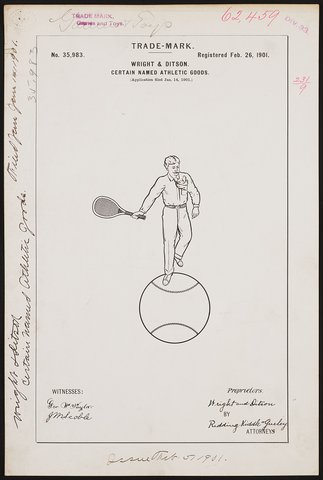
**Second image.** Trademark registration by A. G. Spalding and Brothers for the Kenwood Racquet brand of lawn tennis bats, 1885, Library of Congress Prints and Photographs Division, item 2022674013, call number TRADEMARKS no. 11,956, no known restrictions on publication, 693 x 1024 px. The printed block reads TRADE-MARK, A. G. SPALDING & BROTHERS, LAWN TENNIS BATS, No. 11,956, Registered Feb. 17, 1885, and the mark itself occupies the centre of the sheet as three lines of plain type, THE KENWOOD RACQUET, with no illustration of any kind. The firm is written in as proprietors, by its attorneys, with two witnesses at the left. The margins carry a clerk's manuscript notes, a red serial number, and a purple stamp reading TRADE-MARK, Games and Toys; in the lower margin are a January 1885 date at the left whose day figure is unclear and, at the right, a quoted March 1, 1884. It is here because it dates a second and much larger firm's arrival in the same category in the same year, and because of the Chicago question set out above, which it does not answer.
**Sourcing note.** Nothing on this page is quoted. Every passage above is attributed paraphrase, including both Tribune items, the New Haven report of the annual meeting, the 1893 annual's history and its remark about the losing side, and the printed matter on the registration sheets, which is described rather than quoted. The reason is the standard this platform applies: quotation marks require raw machine-read text and a second independent typesetting of the same copy, and none of these sources has one. The New Haven account was written for a New Haven readership and stops to note the local club's membership; by construction it was set once. The Tribune columns are staff copy. The registration sheets are unique documents. Where a sheet's printed wording is given in capitals above, it describes what the sheet shows and is not offered as a quotation.
**Sources.** Trademark registration, Library of Congress item 2020744417: https://www.loc.gov/item/2020744417/ . Trademark registration, Library of Congress item 2022674013: https://www.loc.gov/item/2022674013/ . Trademark registration, Library of Congress item 2020709050, R. Slazenger: https://www.loc.gov/item/2020709050/ . Peck & Snyder's encyclopaedia and price list of all out and indoor sports and games, 1873, read as machine-read text from the Internet Archive: https://archive.org/download/pecksnydersencyc00peck/pecksnydersencyc00peck_djvu.txt . New-York Tribune, 9 April 1884, page 2, for the adoption of the Peck and Snyder ball and for the Central Park North Meadow decision: https://www.loc.gov/resource/sn83030214/1884-04-09/ed-1/?sp=2 . New-York Tribune, 26 July 1885, page 10, for the improved ball, the free-of-cost offer accepted for the Newport tournament, and the Kenwood tournament at Chicago: https://www.loc.gov/resource/sn83030214/1885-07-26/ed-1/?sp=10 . Morning Journal and Courier, New Haven, 16 March 1886, page 2, for the annual meeting of 12 March 1886 at the Hoffman House, the president's statement, the treasurer's figures and the ball vote: https://www.loc.gov/resource/sn82015483/1886-03-16/ed-1/?sp=2 . The Wright and Ditson Officially Adopted Lawn Tennis Guide for 1893, for the association's founding, the two matches of 1880, the sequence of ball adoptions and the remark about the losing side, read as machine-read text from the Internet Archive: https://archive.org/download/wrightditsonoff20unkngoog/wrightditsonoff20unkngoog_djvu.txt . The Morning Herald, Wilmington, 26 June 1876, page 1, for the advertisement setting the street number as 128: https://www.loc.gov/resource/sn84038119/1876-06-26/ed-1/?sp=1 . Newspaper text was read through the Library of Congress full-text service. All three scanned print sources used here are damaged in places, and every reading above was taken from a legible passage.


changes?
delete this memory?
We detected that you have a Blox in your crypto wallet! We will import the Blox into your account.
Click on done below to complete the import.
Welcome Back!
Sign in to preserve cherished moments
Don't have an account?
Welcome!!
Sign up and start preserving cherished moments
?
?
Choose your payment method
Buy with Metablox Credit
Do you want to mint Blox with Metablox Credit?
Which Crypto would you like to use?
Purchase Confirmed!
Your Blox is being minted on-chain and will appear in your profile shortly.
Log in or sign up to claim your Blox.
How many credits do you want to buy?
$100 USD = 1 Metablox Credit = 1 Blox.
Use Metablox Credit to mint any Blox you want on the map.
 expand_more