Tennis History | Madison Square Garden, New York — professional tennis opened to a third-full house, 9 October 1926
volume_up
Listen
directions
Directions
The advance notices said the Garden would be packed.
A syndicated preview carried in the Milwaukee Leader of 10 October 1926 announced that Suzanne Lenglen, with Vincent Richards and Mary K. Browne, would make her professional debut at Madison Square Garden that night, and that the combination "has proven so great a drawing card that the indications are that the Garden will be packed to capacity."
The same notice named the officials. Alfred J. Gibney and Edward C. Conlin, "two of the most prominent officials of championship matches," would work the night as linesmen, referees and umpires. The amateur establishment umpired the birth of the paid game.
It was not packed.
A United News report filed from New York that night, printed the next morning in the South Bend News-Times, described "a somewhat distinguished crowd that filled a third of Madison Square Garden." More than 7,500 people came, and Garden officials put the receipts at about $40,000. Lenglen beat Browne 6-1, 6-1. The opening match had been Vincent Richards against Paul Féret of France, Richards winning 6-3, 6-4.
Bill Tilden, the ranking American amateur, took a front-row seat and got a big hand. The wire noted that he "has refused to turn professional."
It also recorded what the promoter made of his own gate. The crowd, it said, "was not so large as Pyle, who is making a specialty of luring amateur athletes to commercialize their talent, had hoped." After Lenglen and Browne left the court, C. C. Pyle sent out two more players "who had just turned professional" — Al Schacht and Nick Altrock, the baseball comedians.
That is the founding night of professional tennis: an arena a third full, an amateur referee, and a vaudeville act.
The reporter understood exactly what he was watching. The cheering, he wrote, "surely would have shocked officials of the United States Lawn Tennis association had it occurred at Forest Hills in an amateur tournament."
What it cost the players was the rest of the sport. Lenglen's contract with Pyle is generally reported at $50,000. Signing it ended her amateur standing, and with it her eligibility for the four major championships. That bar held for forty-two years, until those tournaments admitted professionals in 1968. She never entered one of them again.
This is why amateur-era title counts do not sit in the same series as later ones. Every player on this bill became, from this night, uncountable.
**Where the sources disagree, stated rather than resolved.** The contemporaneous wire gives more than 7,500 spectators and about $40,000. The modern secondary account most often repeated gives thirteen thousand and $34,000. One reference work dates the debut to 6 October rather than the 9th; the wire is datelined New York, 9 October, and describes the match as played that night. This memory follows the newspapers printed the next morning and names the alternatives.
**Sources for the quoted wording.** Advance notice: Milwaukee Leader, 10 October 1926, page 7 — https://www.loc.gov/resource/sn83045293/1926-10-10/ed-1/?sp=7 . Match report: South Bend News-Times, 10 October 1926, page 8 — https://www.loc.gov/resource/sn87055779/1926-10-10/ed-1/?sp=8 . Both digitised by the Library of Congress.
**Coordinate.** 40.762321, -73.987325, precision radius 200 m. The building is gone. This was the third Madison Square Garden, opened in 1925 to a design by Thomas W. Lamb and demolished in 1968; it occupied the block on Eighth Avenue between 49th and 50th Streets, well over three kilometres from Madison Square itself. Two independent sources: Wikidata's entity for the 1925 arena gives 40.7624, -73.9877, and the New York City Department of City Planning geocoder returns 40.762243, -73.986951 for 825 Eighth Avenue, the address of One Worldwide Plaza, built on the site in 1989 — about 65 m apart. The US Census Bureau TIGER geocoder corroborates at 40.762030, -73.986377, 119 m from the Wikidata point. The radius covers the block frontage rather than pretending to a point.
**Cover image.** "Mary Browne & Lenglen," George Grantham Bain Collection, Library of Congress, negative LC-B2-5119-15, digital ID ggbain.29993; no known restrictions on publication (https://www.loc.gov/item/2014710151/). Browne at the left, Lenglen at the right in the bandeau she made famous, shaking hands across the net. The negative's own handwritten caption is legible along the top of the frame.
**A date the archive and the picture disagree about.** The Library of Congress catalogues the negative as made "[between ca. 1915 and ca. 1920]" — a range taken from the position of the plate in the Bain sequence, not from the image. The image argues otherwise. The two women are indoors on a board floor, the gallery behind them is in overcoats and hats, and the setting is an arena rather than a lawn or a garden club: that is the professional tour of 1926-27, which played indoors in arenas, and not anything Browne and Lenglen could have contested in 1915. A Wikimedia Commons categorisation assigns it to 1926. Both positions are reported here, and no claim is made that this frame was taken at the Garden.
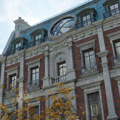
**Second image.** The corner of Eighth Avenue and 49th Street on 8 March 2018 — the base of One Worldwide Plaza, its name cut into the stone at the right, standing on the block where the arena was. Photograph by Tdorante10, CC BY-SA 4.0 via Wikimedia Commons.











































 expand_more