Tennis History | Milton Courts, Brisbane — the last major to open, and the reason was the calendar, January 1969
volume_up
Listen
directions
Directions
On Friday 28 December 1962, Rod Laver finished the Davis Cup challenge round on the grass at Milton, in Brisbane, and Australia beat Mexico 5–0. The Associated Press correspondent Will Grimsley, filing from Brisbane, put the significance of the afternoon in one flat sentence: it was "the last big time match as an amateur" for both Laver and Neale Fraser. Laver signed as a professional the following day.
Nothing about his tennis had changed overnight. What changed was that he could now be paid for it, and the four national championships — Australia, France, Britain and the United States — admitted only players who were not.
The rule had not been enforced with much conviction even that week. Four days before the tie, the same wire service reported a row in Brisbane over whether Laver should be permitted to play at all, given that a professional tour programme carrying his name had already been printed in Sydney. The officials of the Lawn Tennis Association of Australia, who would have had to act, "shrugged their shoulders and looked the other way." The amateur rule was applied when it was convenient and suspended when it was not. That is the arrangement the word shamateurism was coined to describe, and it was a rule about money before it was a rule about tennis: it decided who could afford to compete without being paid.
Laver did not enter an Australian championship again for six years, nor a Wimbledon, a French or a United States one. He had won all four in the calendar year of 1962 — the second man to do it, after Don Budge in 1938 — and that record needs its window stated. The draws he came through did not contain Lew Hoad, Ken Rosewall, Pancho Gonzales or any of the other professionals, because they were not eligible to be in them. The 1962 sweep was the best amateur in the world beating the other amateurs.
Then the door opened, and the Australian was the last of the four through it — for a reason that is arithmetic rather than reluctance. The International Lawn Tennis Federation voted to admit professionals on 30 March 1968 at a meeting in Paris. The 1968 Australian Championships had finished at Kooyong some ten weeks before that vote was taken. So Roland-Garros in May, Wimbledon in July and Forest Hills in September all held open events during 1968, while Australia's next available championship did not come round until January 1969. Its place at the head of the calendar, not its officials, put it last.
That championship was played at Milton from 20 to 27 January 1969, on grass, and Laver won it, beating the Spaniard Andrés Gimeno in the final. Margaret Court took the women's title from Billie Jean King. The compilations give Court's prize as $1,500 but do not say whether that is Australian or United States currency, and they do not print the men's figure beside it — so the comparison that would make the number mean anything cannot be made here, and the bare figure is worth little. Laver went on to win the other three majors that year as well: a second sweep of all four in one calendar year, and the only one of the open era. The two are not the same achievement, and the difference is the whole point of the seven years between them. In 1969 the professionals were free to enter the draw.
Milton had been the Queensland Lawn Tennis Association's ground since 1915. The State Library of Queensland records eight Australian Championships there, the 1969 open edition among them, and sixteen Davis Cup ties including three finals. The centre court seated about seven thousand, a figure the wire report of the 1962 tie against Mexico happens to confirm from the other direction: the opening-day crowd was put at 7,000. The wooden grandstands were declared unsafe in 1994. The centre closed in 1999, burned twice, and was demolished in 2002. Frew Park occupies the site now, with a six-court public facility named for Roy Emerson and a green named for Wendy Turnbull.
**A note on the sources.** The contemporaneous reports quoted above are read from newspaper pages digitised by the Library of Congress: the Brisbane row and the officials' shrug from the *Evening Star* of 24 December 1962, page 15 (https://www.loc.gov/resource/sn83045462/1962-12-24/ed-1/?sp=15); "the doubles will be played on Milton Courts here" from the *Evening Star* of 26 December 1962, page 49, which also carries the opening-day crowd figure (https://www.loc.gov/resource/sn83045462/1962-12-26/ed-1/?sp=49); Grimsley's line about the last amateur match from *The Key West Citizen* of 30 December 1962, page 10 (https://www.loc.gov/resource/sn83016244/1962-12-30/ed-1/?sp=10); and the 29 December signing date from the *Evening Star* of 16 January 1963, page 60 (https://www.loc.gov/resource/sn83045462/1963-01-16/ed-1/?sp=60). The optical character recognition of these pages garbles words and figures freely, and the quotations are given here in corrected spelling; the page images at those addresses carry the wording as printed.
The 1969 dates and the two singles results are weaker. They come from secondary compilations, and no contemporaneous report of the 1969 final could be reached in the session this was written; treat the scores and the exact dates as compiled rather than verified. The venue is not in doubt: both the State Library of Queensland and the Mapping Brisbane History project place the 1969 championship at Milton independently of one another.
**Status note, September 2026.** Rod Laver, Margaret Court and Billie Jean King were all living when this was written. Nothing here goes beyond what the cited reports recorded about the matches named.
**Coordinates.** The pin is the Milton courts site at 315 Milton Road, Milton, Queensland, now Frew Park. Two sources were used: the coordinate carried on the Wikipedia article for Milton Courts, and the Mapping Brisbane History project's entry for the site, which agree to about 45 metres. The Wikipedia point sits within a few metres of the modern Roy Emerson pavilion, so Mapping Brisbane History is the genuinely independent check of the two; OpenStreetMap corroborates within 90 metres, and a Nominatim lookup of the Roy Emerson Tennis Centre returns a point about 17 metres from the pin. Precision radius 250 metres. The ground was demolished in 2002, so the pin marks a site rather than a structure, and the vanished centre court's footprint was considerably larger than the public courts standing there today.
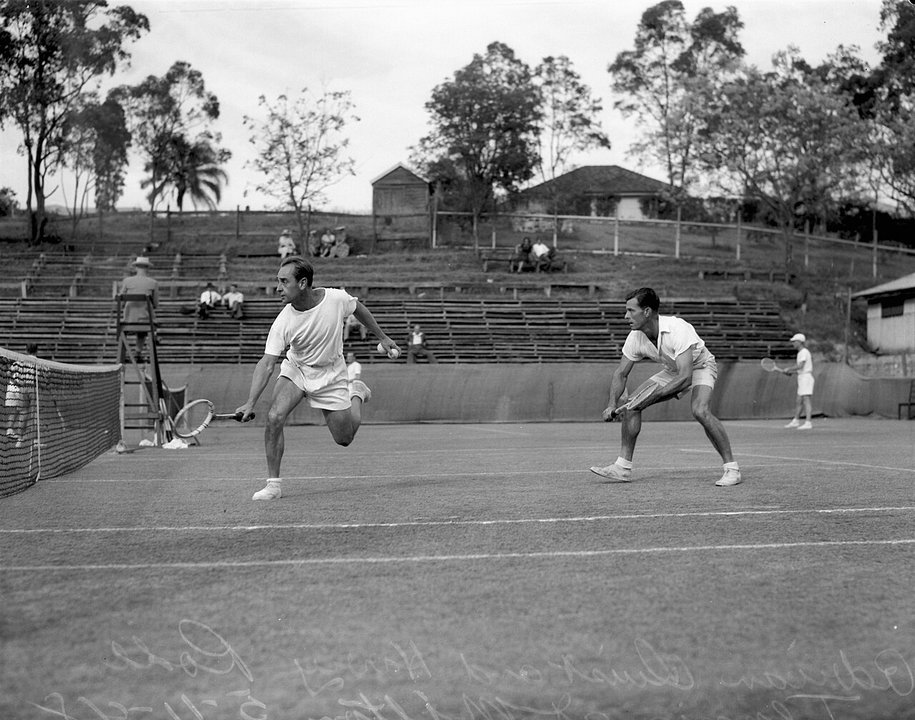
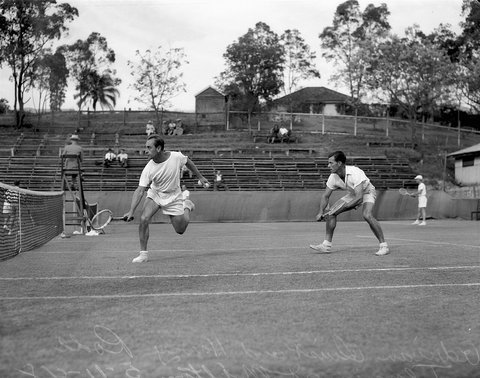
**Cover image.** Titled by the State Library of Queensland as *Adrian Quist and Harry Rode playing in a doubles tennis match at Milton courts, Brisbane, 1948*, from the Sunday Truth and Sunday Sun photographic negatives; no known copyright restrictions. Two things should be said about it. The library's own location field reads only "Queensland," so the identification of Milton rests on the title; and the title names two players where four figures are on court, with a handwritten annotation along the lower edge that reads in mirror because it was scratched into the negative. It is from 1948, twenty-one years before the tournament described here, and it is used because it shows the ground rather than the event: the grass, the banked timber terracing that was condemned in 1994, the umpire's chair, and the ridge of houses behind the fence.
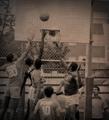
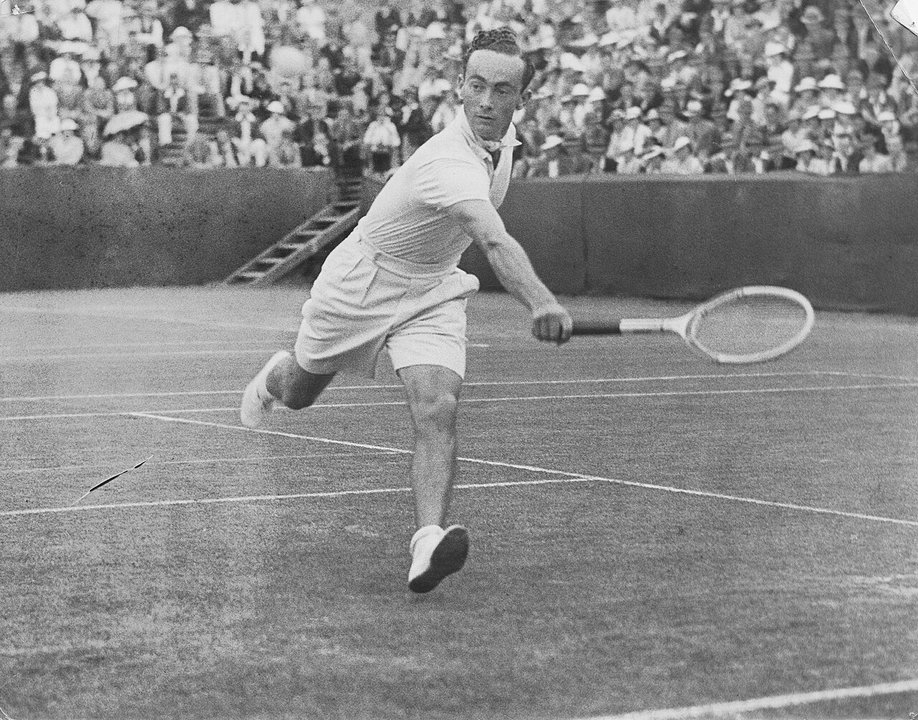
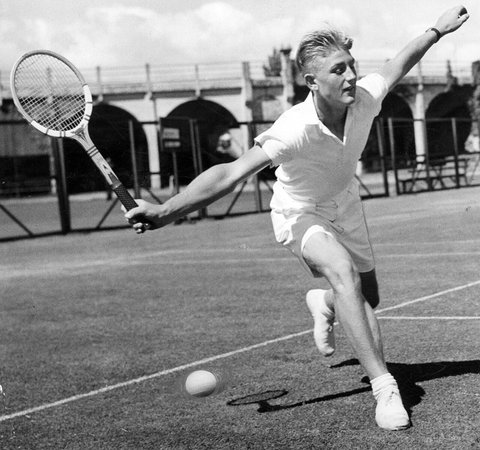
**Second image.** *Viv McGrath competing in the Queensland tennis finals, Milton, Brisbane*, photographed by George A. Jackman, State Library of Queensland, public domain, dated by the library to 1935 and captioned as McGrath's win over John Bromwich. It shows the main court with a full stand, which is the useful contrast with the cover's thinly occupied outer terracing. Neither photograph shows the 1969 championship.
























 expand_more