Tennis History | Place de la Concorde, 30 March 1968 — Twelve Tournaments Opened by Vote
volume_up
Listen
directions
Directions
The decision that opened tennis was taken in a motor club on the Place de la Concorde.
On 30 March 1968 the International Lawn Tennis Federation held a special general meeting at the Automobile Club de France, on the north side of the square. Eighty-six representatives of forty-seven national associations attended. They voted, without opposition, to sanction twelve open tournaments for that year — events in which amateurs and professionals could enter the same draw.
The federation had been asked this before and had said no. In 1960, also in Paris, the same proposal failed by five votes. What changed in between was not persuasion but a threat that could not be absorbed. In December 1967 the Lawn Tennis Association had voted unilaterally to abolish the distinction in British tournaments, the Championships included, from 1968. The ILTF's options were to expel one of its founding members and lose Wimbledon, or to make the rule general. In March it made the rule general.
That sequence is the reason to be careful with the usual story. The Grand Slam tournaments — the four events; the phrase also means winning all four in one calendar year, and the two senses should never be run together in one sentence — did not open tennis. They were opened, late, by a national association acting against its own federation, and then ratified in a room borrowed from a club for people who liked cars. The first of the twelve open tournaments was not a Slam at all. It was played at a seaside club in Dorset three weeks later.
What the vote actually did was narrower than "open tennis" and more interesting. It did not abolish amateurism; it created a sanctioned category of tournament where the distinction did not apply, twelve times in 1968, and left everything else in place. The full dismantling of player classification took years more and several further fights.
Name the actors, because the passive voice is doing work in most accounts of this. The associations that had kept professionals out were the same associations that voted them in, and they had spent decades paying nominally amateur players under the table while doing it. Shamateurism was not a secret. It was an accounting practice.
Coordinate. Pinned at the Automobile Club de France, 6-8 place de la Concorde, Paris 8e. Two independent sources: the French national address base (BAN, api-adresse.data.gouv.fr, IGN and DGFiP derived) returns 48.867147, 2.321611 for 6 place de la Concorde at a match score of 0.96; OpenStreetMap's entry for the club itself returns 48.8671176, 2.3215035. The two are about 9 m apart, which confirms they describe the same building. The BAN reading is used. Precision radius about 30 m. The pin is the building, not the room the meeting was held in, which this memory did not establish.
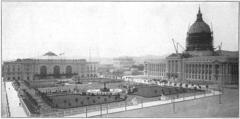
Cover image: the Automobile Club de France's roof-terrace garden, photographed in 1913 for the Agence Rol, from the Bibliothèque nationale de France, public domain via Wikimedia Commons. This is the right building and the wrong year — the picture predates the meeting by fifty-five years and shows an empty terrace of café tables around an ornamental pond, not a federation in session. It is included because it places the club: the glazed roof of the Grand Palais is visible at the right of the frame, west-south-west of the Place de la Concorde, which is how the vantage point was identified. The agency's negative number, ROL 30440 - K 148464, is written across the sky in the original and has not been retouched out.













































 expand_more