


Tennis History | Wright and Ditson, 344 Washington Street, Boston — the firm that printed the association's rules also made its only official ball, 1901
· 1901-2
Unreviewed contributionBy kevin · · updated · Report an issue












































Find memories left by people near you.
Distribute Bounty
This will distribute the bounty equally among all qualifying memories. This action cannot be undone.
Cancel Bounty
Are you sure you want to cancel this bounty? The remaining amount will be refunded to your account.
Success!
Operation completed successfully.
Error
Something went wrong.
Tennis History | Wright and Ditson, 344 Washington Street, Boston — the firm that printed the association's rules also made its only official ball, 1901
kevin
At the foot of a page of the laws of lawn tennis, in the rule book the United States National Lawn Tennis Association authorised and sold, there was a footnote. It did not describe how the game was played. It named a product, named the company that made it, and said that no other one could be used. The company that made it was the company that printed the rule book, and its Boston address was 344 Washington Street.
In a sport that would not let a player take money, this is where the money was.
**The two letters of February 1901.**
The association held its annual meeting in New York on 7 February 1901. Two letters went out from its secretary in Boston that month, both to the same firm a few streets from his own office, and the firm printed both of them in the book it published that spring.
The first is reproduced in the front of the volume, above the table of contents. Writing on the association's letterhead, the secretary advises Wright and Ditson that in accordance with a vote passed at that annual meeting they are authorised to print the constitution and by-laws of the association together with the official rules of the game for the season of 1901. The day of the month is damaged in the scan.
The second is reproduced a few hundred pages later, among the advertisements. Dated 15 February 1901, it tells the same firm that at the annual meeting of the association the Wright and Ditson Championship ball was adopted as the regulation ball for the season. The volume for 1903 carries the same letter for the following season, dated 28 February 1902, in the same form.
The officers who signed and served that year are printed in the same book. The president was James Dwight of the Longwood Cricket Club, Boston, and the Somerset Club. The secretary was Palmer E. Presbrey, also of Longwood, whose address is given as the National Bank of Redemption, Boston. The treasurer was Richard Stevens of the New York Athletic Club, at Hoboken. The executive committee for that year was O. S. Campbell of the Crescent Athletic Club, R. D. Wrenn, William A. Larned, Dwight F. Davis, J. P. Gardner, M. D. Whitman of the Longwood Cricket Club, and R. D. Little. One of those men, Dwight Davis, is attached to two pins elsewhere on this platform: St. Louis City Hall, and the ground at Pilgrim Road where the competition that carries his name began.
**The footnote, and what it says.**
The sentence appears in nine of the eighteen annual volumes read for this entry, and it is legible in full in eight of them. In the volumes for 1893 through 1901 it hangs from the fifth law. In the volumes for 1902 and 1903 it has moved, and hangs between the seventh law and the eighth. It reads:
"The Wright & Ditson "Championship" ball has been adopted by the Association, and is the only official ball to be used in all games played under these rules."
That is a quotation from more than one typesetting, which is what this platform requires before quotation marks are used, and the way in which it satisfies that condition needs stating precisely. Nine separate volumes were set in type in nine separate years, and the sentence does not differ by a word in any of the eight that are legible. It is set two ways: the volumes for 1893, 1895, 1897, 1898, 1899 and 1901 break the line after the words has been, and those for 1902 and 1903 break it after adopted by. The spacing inside the quotation marks around the word Championship is a compositor's choice rather than a machine reading, and it divides four to four: spaced in the volumes for 1893, 1899, 1902 and 1903, closed up in those for 1895, 1897, 1898 and 1901.
Every other difference between the settings is damage to the scans, and no two volumes are damaged the same way. The 1895 volume reads AssociatioD for Association. The 1897 and 1901 volumes read bail for ball, and Dltson for Ditson. The 1898 volume reads beem for been and the 1899 volume reads tho for the and ofiicial for official. The 1903 volume reads game for games with a stray mark. The 1902 volume prints a spurious full stop before the comma after Association. That every volume is corrupted differently, and none of them differently in a word, is the evidence that this is one sentence set nine times and not a machine invention.
What this is not is the independent-printer condition that a newspaper wire satisfies. All nine volumes were published by the firm the sentence names. A house error would carry across all of them, and the quotation is offered here on the narrower ground: nine typesettings across eleven years rule out a machine reading having produced the sentence, and they do not rule out the publisher having got its own claim wrong.
The 1894 volume carries the footnote too, at the fifth law, but its scan breaks apart in the middle of the sentence and it is not counted among the eight.
**Who won the ball question, and who wrote the account of it.**
The association did not begin by choosing this ball. The volume for 1893 carries a short history of the association which says that two questions were argued at every annual meeting and every executive committee meeting from the founding of the association down to and including the annual meeting of March 1887. One was where the championship tournament should be held, which is the argument pinned on this platform at Newport. The other was the adoption of the regulation ball.
That history sets out the sequence. From 1881 to 1884 the association adopted the English ball made by F. H. Ayres. In 1885 it adopted an American ball, Peck and Snyder's, for the season. In 1886 it rejected the Peck and Snyder ball and adopted the English ball again. In 1887 it adopted the Wright and Ditson ball, and the account states that the ball had continued to be the regulation ball ever since 1887 against little or no opposition, and had given very general satisfaction. It adds that the leading players of the country had backed the English ball until 1887 and then almost unanimously favoured Wright and Ditson.
The account may be accurate. It is also the winner's account of the contest it won, printed in the winner's own book, and the association's minutes for those meetings were not obtained for this entry. It is reported here as what the publisher printed, not as a finding.
**The name on the racket.**
Two trademark registration sheets held by the Library of Congress show what the firm was doing with the sport's names while the sport was refusing to pay them.
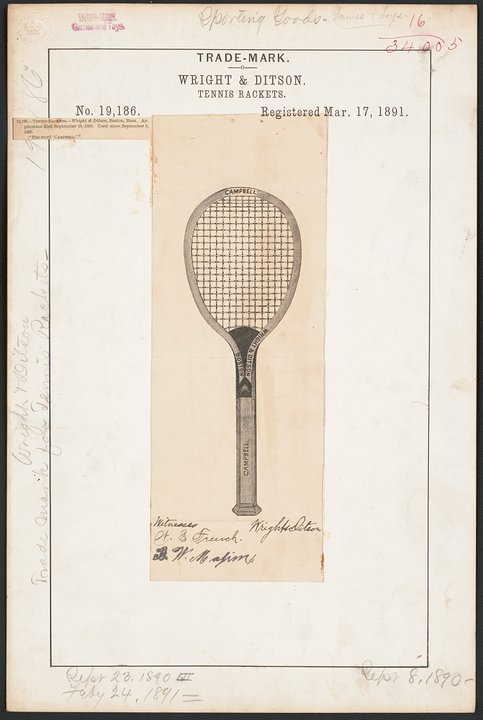
The earlier sheet is trademark number 19,186, registered on 17 March 1891, for tennis rackets. A printed slip on it records that the application was filed on 19 September 1890 and that the mark had been used since 8 September 1890, and that what is claimed is the word Campbell. The drawing is a racket with the word CAMPBELL across the head and again on the butt of the handle.
O. S. Campbell of the Crescent Athletic Club of Brooklyn is in these volumes twice over. The champions list gives him the association's singles championship for 1890 and 1891, and the 1893 volume's account of the previous season records him defending it again. The officers pages list him on the association's executive committee in the volumes for 1893, 1899 and 1901, at 18 Remsen Street, Brooklyn.
No document consulted for this entry connects the racket to the player. The registration claims the word and nothing else. Whether Campbell knew, agreed, was paid or objected is not established here, and the point of setting the two records side by side is not to assert a link but to show what the record does and does not contain. What it contains is a manufacturer registering a champion's surname as a trademark in the same season that champion first won, and that champion sitting on the committee of the association whose rules named that manufacturer's ball.
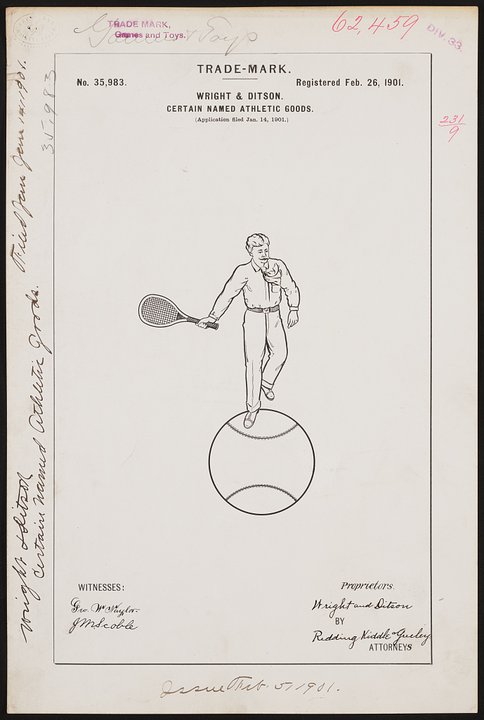
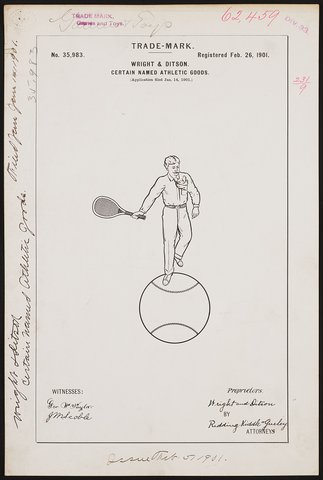
The later sheet is trademark number 35,983, registered on 26 February 1901, eleven days after the secretary's letter about the ball, on an application filed on 14 January that year. It covers certain named athletic goods and its drawing is a man in shirt and tie balanced on a tennis ball with a racket in his hand. The Library holds four more Wright and Ditson registrations from 1906 and 1907, which its own titles describe as a man with a tennis racket standing on a tennis ball, a man holding a racket, a man with a racket on a tennis ball and a man with a paddle on a ball, covering clothing, knit garments and footwear. Those four sheets were not opened for this entry and nothing here describes them beyond the Library's titles. The business locations recorded on the 1891 sheet are Boston; on the later sheets, Jersey City and Boston.
**The founder in the association's own membership list.**
The volumes for 1907 and 1908 print a list of members and club representatives. It contains the line: Wright, George, 344 Washington Street, Boston, Mass. He appears again as the representative of the New Castle Outing and Tennis Club of New Castle, New Hampshire, with the same business address given as his contact.
The same list, a line or two above, gives Wright, Beals C., of Dorchester. The association's champions list in the 1908 volume records Beals C. Wright as its singles champion for 1905, and as one half of the doubles championship of that year with Holcombe Ward. The encyclopaedia article on the firm states that Beals Wright was George Wright's son; the guides themselves do not say so, and the relationship is reported here on that weaker footing.
**What ended it.**
The footnote is not in the volume for 1905. The laws in that volume run from the fifth through the eighth without it. Nine volumes printed after 1903 were searched for the sentence and none of them returned it: those for 1905, 1907, 1908, 1909, 1911, 1912, 1913, 1916 and 1921. Three of the nine, the volumes for 1905, 1909 and 1916, were also read at the laws themselves rather than only searched, and the footnote is absent from the text as well as from the search.
What replaced it can be read in the volume for 1921, under the heading of balls officially approved. By a resolution adopted on 11 December 1920, the association's executive committee approved a list of balls for use during the 1921 season, and the list runs to nine names: the Pennsylvania Handmade Championship, in stitched and stitchless forms, Reach Paramount, Slazenger, Spalding Championship, Seamless Rubber Company, Truflite, Alex Taylor, Wilson official and Wright and Ditson Championship. A separate sentence assigns the Wright and Ditson hard court ball to the national singles and doubles championships and the Spalding hard court ball to the clay court championships.
A single supplier named inside the laws had become a list of nine, and the championships themselves were divided between two of them. When exactly the footnote came out, and whether anyone in the association argued about it, is not established here.
**Amateur-era record.**
Every championship named above was won in a game closed to anyone who had been paid to play it, and belongs on the same footing as the other pre-1968 records pinned on this platform. The point of this entry is that the closure did not make the game unpaid. It made it unpaid for the players.
**Gaps this entry declares.**
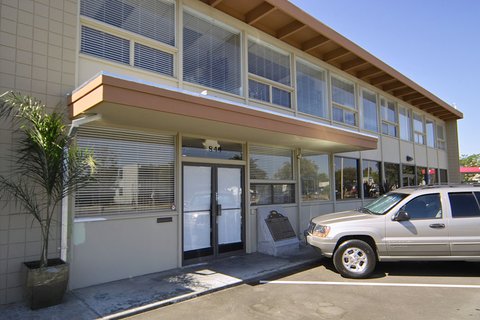
Whether any money passed between the firm and the association is not established, and no source consulted here shows a payment, a royalty or a contract in either direction. The association's minutes are what would settle it and they were not obtained. The 1915 volume's text file failed to download and that volume was not read. Whether the building standing at 344 Washington Street when this entry was written, in September 2026, is the one the firm occupied is not established either. No photograph of the store was found for this entry.
**Coordinate.** 42.356679, -71.058989, precision radius 150 m. This is 344 Washington Street in the Downtown Crossing district of Boston, and it was fixed from three sources that do not share a database: the Census Bureau's TIGER geocoder at 42.356679, -71.059004; OpenStreetMap by way of Nominatim, building way 8640674, at 42.356695, -71.058939; and the Esri world geocoder, which is built on commercial road data, at 42.356662, -71.059023. The widest separation between any two of the three is 7.8 m and the pin is set at their mean. Three addresses in Boston carried the number 344 Washington Street when the three geocoders were queried for this entry in September 2026, one in Downtown Crossing, one in Dorchester and one in Brighton, and all three geocoders returned all three. The downtown one is taken here because the firm's advertising pairs the number with its retail catalogue and the volume for 1908 lists it first among four branches, ahead of New York, Chicago and Providence; no source consulted here states the district outright. The radius covers the block rather than a doorway, for the reason given above.
**Cover.** Trademark registration by Wright and Ditson for the man-with-racket-on-ball logo, brand certain named athletic goods, 1901, Library of Congress Prints and Photographs Division, item 2024646180, no known restrictions on publication, 689 x 1024 px. Following the standing check on this platform, the printed matter in the frame was read, and here it is legible and confirming. The printed block reads TRADE-MARK, No. 35,983, Registered Feb. 26, 1901, WRIGHT & DITSON, CERTAIN NAMED ATHLETIC GOODS, application filed Jan. 14, 1901. Below it a line drawing shows a man in shirt, tie and belted trousers standing balanced on a large seamed tennis ball, a racket held out in his right hand. The lower corners carry the signatures of two witnesses and, under the word Proprietors, the firm's name signed by its attorneys. The margins carry a clerk's manuscript notes and a purple office stamp reading trade mark, games and toys, together with a note reading Issue Feb. 5, 1901, which is not interpreted here. This is a registration document rather than a photograph, and it is offered as the record of what the firm was selling and under what name.
**Second image.** Trademark registration by Wright and Ditson for Campbell brand tennis rackets, 1891, Library of Congress Prints and Photographs Division, item 2020713114, no known restrictions on publication, 687 x 1024 px. The printed block reads TRADE-MARK, WRIGHT & DITSON, TENNIS RACKETS, No. 19,186, Registered Mar. 17, 1891. Pasted into the centre of the sheet is a printed illustration of a racket of the period, its head slightly lopsided rather than symmetrical, the strings drawn square, the word CAMPBELL printed across the top of the head and again across the butt of the handle, and the firm's name running down the throat. A printed slip at the left margin carries the filing and use dates and the claim to the word. Two witnesses have signed beneath the illustration and the firm's name is written beside them.
**Sourcing note.** One passage is quoted above, and it is the footnote. Its evidentiary basis is nine typesettings by one publisher across eleven years, which is the narrower of the two grounds this platform recognises, and the reasons are set out in full in the section above rather than hidden here. Everything else on this page is attributed paraphrase, including both February letters, the 1893 history of the ball question, the 1921 approval resolution and every line taken from the membership and champions lists. The letters and the resolution each survive in a single setting and are therefore not quoted.
**Sources.** The Wright and Ditson Officially Adopted Lawn Tennis Guide, read as machine-read text from the Internet Archive, in the volumes for 1893, 1894, 1895, 1897, 1898, 1899, 1901, 1902, 1903, 1905, 1907, 1908, 1909, 1911, 1912, 1913, 1916 and 1921. The identifiers take the form wrightditsonoffNNunkngoog and the number does not track the year. The volumes carrying the footnote and quoted above are 1893 (identifier ...20): https://archive.org/download/wrightditsonoff20unkngoog/wrightditsonoff20unkngoog_djvu.txt ; 1895 (...02): https://archive.org/download/wrightditsonoff02unkngoog/wrightditsonoff02unkngoog_djvu.txt ; 1897 (...11): https://archive.org/download/wrightditsonoff11unkngoog/wrightditsonoff11unkngoog_djvu.txt ; 1898 (...05): https://archive.org/download/wrightditsonoff05unkngoog/wrightditsonoff05unkngoog_djvu.txt ; 1899 (...16): https://archive.org/download/wrightditsonoff16unkngoog/wrightditsonoff16unkngoog_djvu.txt ; 1901 (...10), which also carries both February letters: https://archive.org/download/wrightditsonoff10unkngoog/wrightditsonoff10unkngoog_djvu.txt ; 1902 (...03): https://archive.org/download/wrightditsonoff03unkngoog/wrightditsonoff03unkngoog_djvu.txt ; and 1903 (...07), which carries the 1902 letter: https://archive.org/download/wrightditsonoff07unkngoog/wrightditsonoff07unkngoog_djvu.txt . The volume for 1905 (...09), checked at the same passage and carrying no footnote: https://archive.org/download/wrightditsonoff09unkngoog/wrightditsonoff09unkngoog_djvu.txt . The volume for 1908 (...18), for the membership list, the branch addresses and the champions list: https://archive.org/download/wrightditsonoff18unkngoog/wrightditsonoff18unkngoog_djvu.txt . The volume for 1921 (...08), for the approval resolution: https://archive.org/download/wrightditsonoff08unkngoog/wrightditsonoff08unkngoog_djvu.txt . Trademark registration, Library of Congress item 2024646180: https://www.loc.gov/item/2024646180/ . Trademark registration, Library of Congress item 2020713114: https://www.loc.gov/item/2020713114/ . The relationship between George Wright and Beals Wright from the encyclopaedia article on the firm; where the encyclopaedia and the contemporaneous volumes differ, the volumes are followed.


changes?
delete this memory?
We detected that you have a Blox in your crypto wallet! We will import the Blox into your account.
Click on done below to complete the import.
Welcome Back!
Sign in to preserve cherished moments
Don't have an account?
Welcome!!
Sign up and start preserving cherished moments
?
?
Choose your payment method
Buy with Metablox Credit
Do you want to mint Blox with Metablox Credit?
Which Crypto would you like to use?
Purchase Confirmed!
Your Blox is being minted on-chain and will appear in your profile shortly.
Log in or sign up to claim your Blox.
How many credits do you want to buy?
$100 USD = 1 Metablox Credit = 1 Blox.
Use Metablox Credit to mint any Blox you want on the map.
 expand_more