


Tennis History | The Madras Club, Mount Road — a 1903 plate names three players and calls the fourth the marker
· 1903
Personal memoryBy kevin · · updated · Report an issue
































Find memories left by people near you.
Distribute Bounty
This will distribute the bounty equally among all qualifying memories. This action cannot be undone.
Cancel Bounty
Are you sure you want to cancel this bounty? The remaining amount will be refunded to your account.
Success!
Operation completed successfully.
Error
Something went wrong.
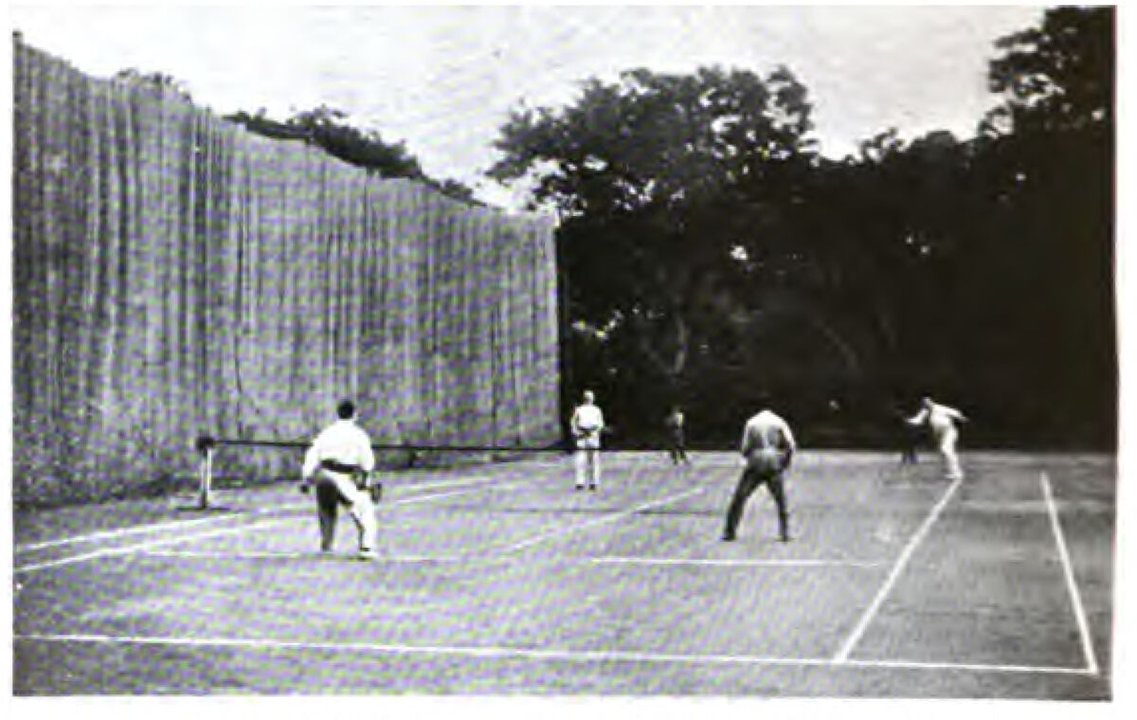
Tennis History | The Madras Club, Mount Road — a 1903 plate names three players and calls the fourth the marker
kevin
**A block off Mount Road in Chennai, bounded by Whites Road and General Patters Road, carries a shopping mall, an apartment development and an access road that is still called Club House Road. The club it was named for left in the 1940s. In 1903 a London-published book printed two photographs taken on its tennis courts, and the captions under them are the reason this pin exists.**
## What the two plates show
*Lawn Tennis at Home and Abroad*, edited by A. Wallis Myers and published in 1903, gave its tenth chapter to India. The author signs himself P. G. Pearson; the portrait facing the chapter's first page captions him "Champion of Bengal, 1902."
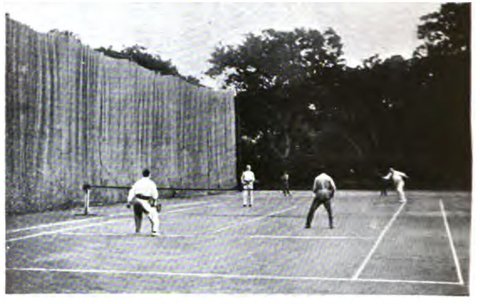
Three pages into the chapter, on printed page 312, is a halftone captioned **PLAYING ON THE MADRAS COURTS**. It shows a doubles rally on a marked court. Down the left-hand side stands a very tall screen of dark matting, hung on posts and reaching roughly twice the height of the players — the "indigo blue screens" the text describes a few lines further down the same page. Trees close in behind the far baseline. Four men in whites are in play, one of them at the top of a service action on the right. A fifth figure, in darker clothing and not in a playing posture, stands well back near the screen.
Under the picture, in small capitals, run four names in a row:
> C. H. MARTIN. ALLEN. NATIVE MARKER. HALL.
Three men are given an initial and a surname. The fourth is given a job and a race.
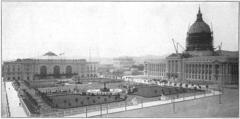
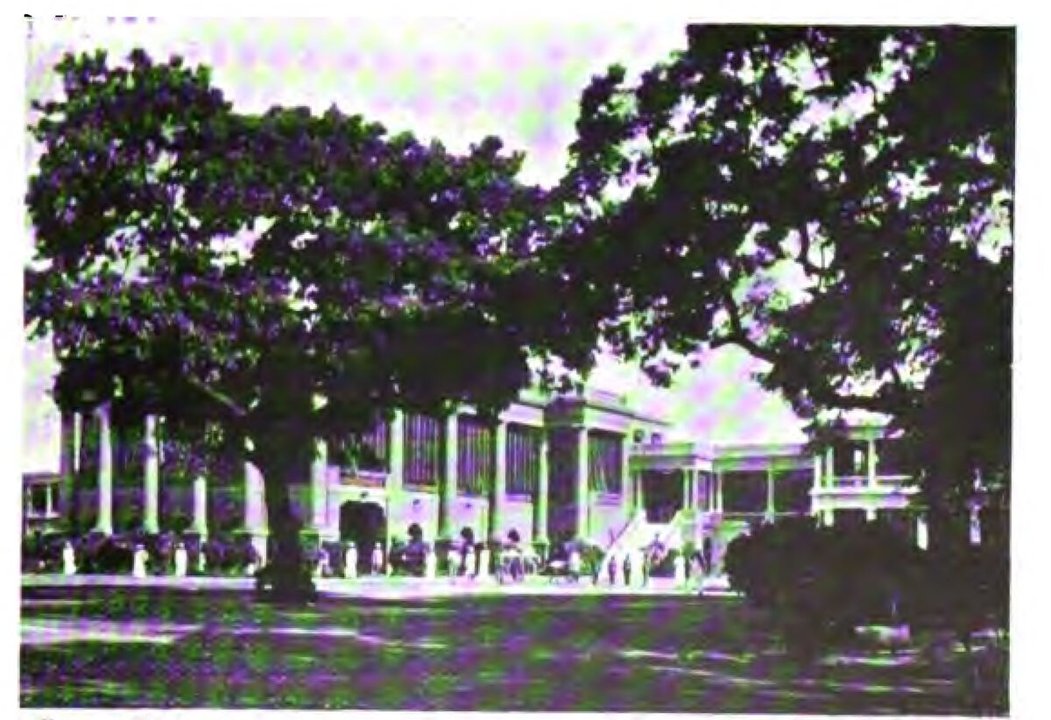
On the facing page, printed page 313, is a second plate: **THE MADRAS CLUB FROM THE TENNIS COURTS**, with a parenthesis beneath it — *(Native Ball-Boys on the Right.)* The view is taken from the courts across open grass towards a long single-storeyed classical building with a deep colonnaded verandah, half-hidden by an enormous spreading tree. People are sitting in chairs on the terrace under the columns. At the right of the frame, where the caption points, are small standing figures, too indistinct in the halftone to describe further.
The captions are the argument. The photographs are of a tennis club, and the club's Indian staff are in both of them: one on the court, doing the marker's job of calling and scoring; several at the edge of the lawn, fetching balls. They are in the frame and they are in the caption. They are not in the names.
## Who the chapter says was playing
Pearson is explicit, on his first page, about the social base of the game he is describing. He writes that "most players in India are members of one or other of the services, and are therefore obliged to go, and stay, where duty calls them," and adds that "the man of leisure is a practically unknown phenomenon."
The services — civil, military, police, railway, forest — were the machinery of British administration. A chapter about lawn tennis in India written from inside them is a chapter about lawn tennis among perhaps a few thousand Europeans distributed across a subcontinent, which is exactly why Pearson opens by apologising for distance: he says he once travelled 1,500 miles to play in a tournament and intends shortly to repeat the journey for a single match.
The chapter names its leading players — Fleming, Gamble, Davies, Kidd, Hechle, Nelson Wright — and ranks them. Pearson writes that Fleming took the Championship of Bengal six times and won the cup outright in 1901, and that an Anglo-Indian pair, Davies and Gamble, reached the doubles semi-final at Wimbledon in 1901. Those are Pearson's claims, printed in 1903; nothing here verifies them against the tournament's own records, and the pages carrying them scan badly.
No Indian player is named anywhere in the chapter. That absence is not evidence that no Indian played tennis in 1903 — it is evidence of what a chapter written from inside the services could see, and of who the clubs it was written about admitted.
## The courts themselves
The same page as the first plate is the best short description of Indian court-building in the period. Pearson writes that "grass courts are unfortunately few and far between," and that "the usual station courts are 'kutcha,' of caked mud, of loose — very loose — gravel, or else asphalt, and are by no means easy for a player unused to them." He rates the grass at Allahabad best, with Agra and Calcutta close behind, and thinks the Calcutta courts a trifle slow, which he blames on over-watering.
Elsewhere in the chapter: play does not start before four o'clock except in the hills, because of the glare; a five-set match in that heat is reckoned equivalent to seven sets at home; and men sometimes turn out in shorts, with bare knees, as at football, which he offers as a measure of the temperature rather than of fashion.
The caption to the Madras plate does not say what the court is made of, and this entry does not guess. The surface in the picture reads as smooth and uniform with painted lines, and Madras is not on Pearson's short list of good grass. That is an observation about a halftone, not a finding.
## The club and its ground
The Madras Club dates its founding to 15 May 1832. Its own published history says the club house bought just before that opening date was a garden house of seven acres just off Mount Road, between Whites Road and General Patters Road. That is the block this memory is pinned to.
The club's membership was European. *Madras Musings*, the Chennai heritage fortnightly, describes the club as operating for more than a century on that Mount Road property, and attributes its post-Independence decline to what it calls the club's "whites-only policy." No rule book has been consulted for this entry; the membership rule is reported here as the club's own history and a heritage publication describe it, and the specific wording, dates and committee decisions behind it are not established here.
That distinction matters more than it looks. Nobody had to write a tennis rule to keep Indians off these courts. The courts sat inside a private club, and the club's membership list did the work — which is the same mechanism that ran at Wimbledon, at the Croix-Catelan and at Forest Hills in the same decades, operating through subscriptions and proposers rather than through anything a governing body ever had to publish. What is unusual about the Madras plates is not the mechanism. It is that the mechanism was photographed, captioned and printed, and the caption survives to be read.
## Where the club went, and what disagrees
The club left Mount Road in the 1940s. Its own history says it moved into a second home, Branson Bagh, opposite Church Park School, and was ready to receive members from April 1948. *Madras Musings* describes the second home differently — as being on the opposite side of Mount Road, on a property marked today by Khivraj Motors and the compound of the former Safire Theatre. The two accounts are printed here as they stand; this entry does not resolve which building the club actually occupied between leaving Mount Road and 1963, and a reader should treat the second-home question as open.
Both accounts agree on what came next. After protracted negotiation, the Madras Club and the Adyar Club merged in 1963, and the merged club moved to Mowbrays Cupola in Adyar, where it remains. The historian Sriram V, writing on the Adyar Club, records that by 1958 that club's finances had made it clear that Indians had to be admitted, and that even doing so did not arrest the decline. The chronology is worth stating plainly: the two European clubs of Madras admitted Indians when their balance sheets required it, not before.
The Mount Road property became known as Express Estates, after the newspaper group that occupied it. As of 2026 the block carries the Express Avenue shopping centre and a residential development, and the road running into it from Mount Road — now Anna Salai — is still Club House Road. The club has been gone from the site for around eighty years and the street sign has outlasted it.
## What this entry does not claim
The identification of the building in the second plate rests entirely on the book's own caption. Madras had more than one European sporting club — the Madras Cricket Club at Chepauk and the Madras Gymkhana among them — with grounds elsewhere in the city, and no independent identification of the building has been made here.
Both plates are undated. The book was published in 1903 and the memory is dated to that year, which is the publication date and not the date the shutter opened.
The position of the courts within the seven acres is not established. The pin is the block, not a court. Pearson's chapter does not say how many courts the club had or where in the grounds they lay, and no plan of the club's Mount Road premises has been consulted for this entry.
This is, as far as the platform's own records show, the first tennis history memory here pinned anywhere in Asia. That is a statement about this collection's coverage, not about the history.
## Coordinate
13.058640 N, 80.264091 E, with a precision radius of **300 metres**.
Two independent readings were taken for the modern building standing on the old club estate. Wikidata's coordinate statement for Express Avenue gives 13.058606, 80.264153. The mean of four separately geotagged photographs of the same building on Wikimedia Commons, whose coordinates come from the photographers rather than from Wikidata, gives 13.058673, 80.264029. The two agree to within about 15 metres, and the published pin is their midpoint.
The 300-metre radius is not the accuracy of that midpoint; it is an honest envelope for the club's seven-acre grounds as its own history describes them — off Mount Road, between Whites Road and General Patters Road — within which the courts photographed in 1903 stood at an unknown point. Anyone standing at the pin is inside the old estate and not on the old court.
## Sources
- P. G. Pearson, "Lawn Tennis in India," Chapter X of *Lawn Tennis at Home and Abroad*, ed. A. Wallis Myers (1903). Chapter opening and portrait caption: https://archive.org/details/lawntennisathom00myergoog/page/n329/mode/1up · the Madras court plate and the kutcha passage, printed p. 312: https://archive.org/details/lawntennisathom00myergoog/page/n333/mode/1up · the club plate, printed p. 313: https://archive.org/details/lawntennisathom00myergoog/page/n334/mode/1up
- The Madras Club's own history: https://www.madrasclub.org/Aboutus
- "Lost Landmarks of Chennai," *Madras Musings*: https://madrasmusings.com/vol-34-no-5/lost-landmarks-of-chennai-107/
- Sriram V, "The Adyar Club — remembered by a Gate": https://sriramv.com/2024/07/03/the-adyar-club-remembered-by-a-gate/
## Images
**Cover.** *Playing on the Madras Courts*, halftone plate at printed page 312 of *Lawn Tennis at Home and Abroad* (1903), reproduced from the Internet Archive scan of the volume, leaf n333. Public domain by age. The plate is unattributed to a photographer in the book. Shown as printed, cropped to the plate border; the caption line beneath it in the book reads "C. H. Martin. Allen. Native Marker. Hall."
**Second image.** *The Madras Club from the Tennis Courts*, halftone plate at printed page 313 of the same volume, leaf n334, credited in the book only as "From a Photo." Public domain by age. The scan carries a strong colour cast in the halftone screen, which is an artefact of the digitisation and not of the original plate. The building shown is the club's Mount Road premises as the book's caption identifies it; the club left that site in the 1940s and the block now carries later development.


changes?
delete this memory?
We detected that you have a Blox in your crypto wallet! We will import the Blox into your account.
Click on done below to complete the import.
Welcome Back!
Sign in to preserve cherished moments
Don't have an account?
Welcome!!
Sign up and start preserving cherished moments
?
?
Choose your payment method
Buy with Metablox Credit
Do you want to mint Blox with Metablox Credit?
Which Crypto would you like to use?
Purchase Confirmed!
Your Blox is being minted on-chain and will appear in your profile shortly.
Log in or sign up to claim your Blox.
How many credits do you want to buy?
$100 USD = 1 Metablox Credit = 1 Blox.
Use Metablox Credit to mint any Blox you want on the map.
 expand_more