


Tennis History | Coronation Park, Delhi — a tournament was advertised for the Durbar programme and never played, January 1903
· 1903-1
Personal memoryBy kevin · · Report an issue


































Find memories left by people near you.
Distribute Bounty
This will distribute the bounty equally among all qualifying memories. This action cannot be undone.
Cancel Bounty
Are you sure you want to cancel this bounty? The remaining amount will be refunded to your account.
Success!
Operation completed successfully.
Error
Something went wrong.

.jpg?width=1280)
Tennis History | Coronation Park, Delhi — a tournament was advertised for the Durbar programme and never played, January 1903
kevin
On the plain north of Delhi, on 1 January 1903, the Government of India staged a durbar to proclaim the accession of Edward VII as Emperor. It was Lord Curzon's production, and it was enormous. The programme ran roughly ten days from 29 December; something over a hundred thousand people attended; thirty-four thousand troops were reviewed; there was an exhibition of Indian arts and crafts, an investiture, a state ball, and a state entry into the city on elephants. That programme summary is from the King's College London archives exhibition on the 1903 durbar. The ground it was held on is now Coronation Park, a fenced fifty-two-acre rectangle off Bhai Parmanand Marg with an obelisk, some empty plinths, and a row of colonial statues moved here after independence.
Among the events advertised for that programme was an international lawn tennis tournament. It was not played.
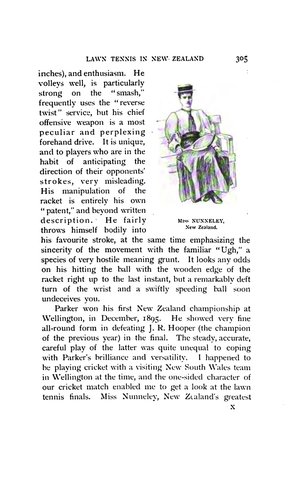
The source for that is a chapter in A. Wallis Myers's survey volume "Lawn Tennis at Home and Abroad", published in London in 1903. Chapter X, "Lawn Tennis in India", is signed by P. G. Pearson. Pearson ranks the four best players in the country — Fleming, Gamble, Davies and Kidd — and leaves himself out, and the editor puts him back in a footnote on printed page 316: "EDITOR'S NOTE.—Mr. Pearson modestly refrains from mentioning his own name. As winner last year of the Championship of Bengal, he would certainly be included in the first four." (https://archive.org/download/lawntennisathom00myergoog/page/n337_w1280.jpg)
Writing a few months after the durbar, Pearson states that no competition in India carried the title of champion of India; that the great international tournament which had been advertised to form part of the durbar programme had looked like a step towards one; and that it was abandoned because there was so much else to do.
That is a paraphrase and not a quotation, deliberately. The passage sits on printed page 320, and the only copy of this volume on the Internet Archive carries a bleached bitonal scan of that leaf: the left third of nearly every line has been thresholded away, and the automatic transcript of it is nonsense. The leaf is at https://archive.org/download/lawntennisathom00myergoog/page/n341_w1280.jpg and a reader can judge it. Pages 316 and 319 of the same chapter came through clean and are quoted here directly; page 320 did not, so it is reported rather than quoted.
What India had instead of a national championship was a set of provincial ones, and they were not young. The Punjab championships had been played since 1885, on grass, usually in December, at the club in Lawrence Gardens, Lahore. The Bengal championships had been played since 1887, on grass, at the Calcutta Cricket Club. Both were older than most tournaments anywhere. Neither was national, and — this is Pearson's point, and it is a sharp one — in 1902 the two of them were played in the same week. The country's two principal tournaments, sixteen hundred kilometres apart by rail, collided on the calendar, and Pearson reads that as evidence that the constituency for lawn tennis in India was not large.
A word on "championship", because the word is doing quiet work. In this chapter it means a provincial title and nothing wider: champion of Bengal, champion of the Punjab. It is not a claim about India, and it has nothing to do with the four European and American tournaments that later became the majors. Pearson's own phrasing keeps the distinction; modern lists of these events sometimes do not.
The national championship of India was first played in 1923, at the Calcutta South Club — a club that did not exist until 1920. Thirty-eight years after the Punjab championship began, and twenty years after the durbar at which a tournament of national reach was advertised and dropped.
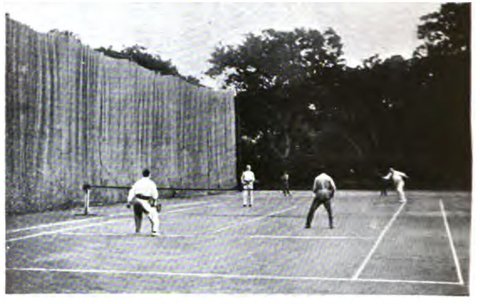
Pearson is also clear about who was playing. Most players in India, he writes, were members of one or other of the services and were obliged to go and stay where duty called them; he had himself travelled fifteen hundred miles to play in a tournament and expected to make the same journey again to play one match. Grass courts were few; the ordinary station court was "kutcha", of caked mud, of loose gravel, or of asphalt. This is the amateur game's class rule in an imperial register — the sport followed the postings of an administrative service, and the men who could play were the men that service had placed somewhere with a court.
On women the chapter is more specific and less defensible. Printed page 319 gives the reason the leading Indian tournaments carried no ladies' singles: "For one thing the heat, except in the hills, is too great for ladies' Singles, and there are not usually enough ladies to form ladies' Doubles." It then names the best-known women players in the country — Mrs. Lamond Walker, Miss Warburton, Mrs. Grimston, Mrs. Mawdsley, and the Misses Martin — which is more women than several of the events had entrants for. Note what the sentence does and does not supply: a reason, and no decision-maker. No document read for this memory records who set the entry lists or on what stated grounds, and the honest thing is to say that the actors are unidentified rather than to leave the passive voice standing in for them. (https://archive.org/download/lawntennisathom00myergoog/page/n340_w1280.jpg)
The players named in the chapter are British officials and officers. The published record of the Bengal championships gives the first Indian winner of its men's singles as N. S. Nyer, in 1917 — thirty years after the tournament began.
This entry sits beside two others on the platform: the Madras Club in 1903, where the same volume's plate names three players and calls the fourth the marker; and the Association Ground at Moore Park in 1896, where an Australian writer of the same decade explained that all-Australian championships did not exist either. Two colonies, two sets of strong provincial championships, and no national tournament in either — arrived at independently, on the same argument.
COORDINATE. 28.723019, 77.196856, precision radius 400 metres. Two independent readings: Wikidata Q5172223 (Coronation Park) gives 28.723006, 77.196892, and OpenStreetMap node 1232326552, tagged historic=memorial as "Coronation Memorial" and carrying no wikidata tag, gives 28.7230313, 77.196820 — about 7.5 metres apart. The park polygon in OpenStreetMap (way 290620874) does carry the Wikidata identifier and was therefore not counted as a second source. Photographs geotagged at the obelisk by two separate contributors fall within about 80 metres of the pin. The radius covers the preserved park; the durbar's camps and its amphitheatre spread well beyond it across the plain, and no attempt is made here to locate the 1903 amphitheatre within that ground.
COVER. "The Obelsik marking the Durbar of King George V at Coronation Park, Delhi.2JPG.jpg" by Wikimedia Commons contributor Nvvchar, 2009, CC BY-SA 3.0. It shows a sandstone obelisk on a stepped plinth with a bronze plaque, weeds coming up between the steps and nothing else in frame. Read the caption carefully: this obelisk marks the durbar of 1911, not the one described here. The 1903 durbar was held on the same ground, and the park commemorates all three durbars staged on this plain; the monument itself is a marker for the later one.
SECOND IMAGE. "1903 DELHI DURBAR PARADE (22317678808).jpg" by Roderick MacKenzie, painted 1907, held by Bristol Museums, Galleries and Archives, public domain. It is a painting made four years after the event, not a photograph, and it shows the state entry procession passing the Jama Masjid in the city — Lord and Lady Curzon on the leading elephant — and not the durbar ground pinned here.
NOT ATTACHED. The 1903 volume carries a photographic plate captioned only "TYPICAL HILL COURTS, INDIA", showing a flat oval terrace laid out with courts in a wooded hill bowl above a station. It is the only contemporaneous photograph of Indian courts located for this entry. It is not attached because the book prints it sideways and this account has no way to rotate an image before ingestion; and because the caption names no place, so no station can be claimed for it. https://archive.org/download/lawntennisathom00myergoog/page/n330_w1280.jpg
SOURCES. Primary: A. Wallis Myers (ed.), "Lawn Tennis at Home and Abroad" (London, 1903), chapter X, "Lawn Tennis in India", by P. G. Pearson — printed pages 309-320, read as page images from the Internet Archive copy lawntennisathom00myergoog. Secondary, for the durbar programme: the King's College London archives exhibition page on the Delhi Durbar of 1903 (kingscollections.org). Secondary, for the founding dates and venues of the Punjab and Bengal championships and for the 1923 national championship at the Calcutta South Club: the English Wikipedia articles on the Punjab Lawn Tennis Championships, the Bengal Championships, and the national lawn tennis championships of India. Those last are compilations, not archives, and are used here only for dates and venues that Pearson's chapter independently corroborates in substance; where they and Pearson differ in emphasis, Pearson is followed and said to be followed.



changes?
delete this memory?
We detected that you have a Blox in your crypto wallet! We will import the Blox into your account.
Click on done below to complete the import.
Welcome Back!
Sign in to preserve cherished moments
Don't have an account?
Welcome!!
Sign up and start preserving cherished moments
?
?
Choose your payment method
Buy with Metablox Credit
Do you want to mint Blox with Metablox Credit?
Which Crypto would you like to use?
Purchase Confirmed!
Your Blox is being minted on-chain and will appear in your profile shortly.
Log in or sign up to claim your Blox.
How many credits do you want to buy?
$100 USD = 1 Metablox Credit = 1 Blox.
Use Metablox Credit to mint any Blox you want on the map.
 expand_more