Tennis History | Church Road, Wimbledon — the ground the club bought for the crowd, June 1922
volume_up
Listen
directions
Directions
The All England Lawn Tennis and Croquet Club left Worple Road because it could not fit the people who wanted to come. The old ground, four acres of meadowland between Worple Road and the railway, held about eight thousand, and that ceiling had been obvious since before the First World War. Attempts to buy adjoining land failed. In 1920 the club bought a forty-two acre site off Church Road instead, and built.
The Championships opened on the new ground on Monday 26 June 1922. It rained. The New York Herald's cabled report from Wimbledon that day, by the veteran internationalist Stanley N. Doust, describes the opening as a washout: "Owing to almost continuous rain play in the tennis championships to-day was possible only between showers and in the center court, which was covered by a huge tarpaulin. Only two matches were decided." The same column records who struck the first ball on the new ground and what he did with it afterwards: "The privilege of hitting the first ball fell to Godfree, who with it won the first point when Kingscote netted. Godfree thereupon pocketed the ball, which he undoubtedly will treasure as a souvenir." Doust also reports the King and Queen attending, braving rain and mud, at the new amphitheatre where the first matches were played; that passage survives only in damaged newsprint and is paraphrased here rather than quoted. (https://www.loc.gov/resource/sn83045774/1922-06-27/ed-1/?sp=12)
Two days earlier the same paper's London bureau had put the move plainly enough — "Monday will inaugurate the new Wimbledon" — and counted 128 entries in the men's singles, with William Tilden the conspicuous absentee. (https://www.loc.gov/resource/sn83045774/1922-06-25/ed-1/?sp=50) A date discrepancy is worth flagging: at least one venue database gives 22 June 1922 as the day King George V opened the ground. The contemporaneous cables place the King and Queen at the first day's play on Monday 26 June. Both are recorded here; neither is dismissed.
The rain did not stop. It pushed the finals into a third week, and on Saturday 8 July the Philadelphia Evening Public Ledger ran the scene on its front page under the headline "Royalty Waits in Stands as Shower Prevents Start of Wimbledon Final." Its account is the club's capacity argument proved on the club's first attempt: "Every seat was taken in the huge stadium, and thousands were unable to gain admission." The queue outside the ground had formed by four in the morning, and the paper reports seats being offered for $22.50. (https://www.loc.gov/resource/sn83045211/1922-07-08/ed-1/?sp=1) Suzanne Lenglen beat Molla Mallory for the title; Gerald Patterson won the men's singles.
The move cost the club roughly £140,000, a figure it took some years to look comfortable, and the new Centre Court was built to seat about fourteen thousand — the eight-thousand problem answered with a number nearly twice as large. Reference accounts describe the ground as financed partly out of accumulated club reserves and partly by an issue of debenture bonds, a mechanism the club still uses for capital works.
One other thing changed in 1922, and it changed the shape of the tournament more than the address did. The challenge round was abolished. Until then the previous year's champion sat out the whole event and met the winner of the all-comers' draw in a single final match. From 1922 the holders played through from the first round like everybody else. Any comparison of pre-1922 and post-1922 title records is therefore comparing two different competitions, and any count that runs straight through the change is making an argument rather than reporting a number. It is worth noting that the French championship still used a challenge round that same summer.
Coordinate. The pin is the All England Club's Church Road ground, Wimbledon, London SW19, taken as the midpoint of two independently maintained sources: the Wikidata entity for the All England Lawn Tennis and Croquet Club (Q815369, 51.434494 N, 0.214447 W) and the Office for National Statistics postcode centroid for SW19 5AG, the nearest unit postcode to the ground, supplied through postcodes.io (51.436193 N, 0.215256 W). They lie 197 m apart across a site of roughly seventeen hectares. Precision radius 400 m. The pin is the ground rather than a court. A separate memory on this site pins Centre Court for an event of August 1967; this one is about the move and the ground as a whole, and the two are deliberately distinct.
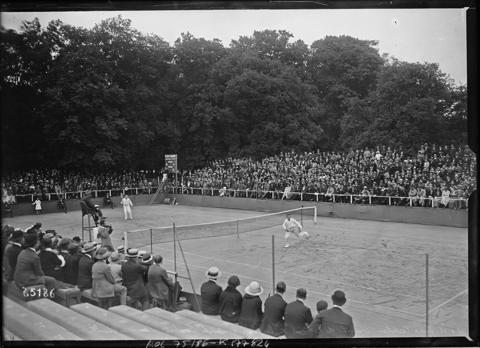
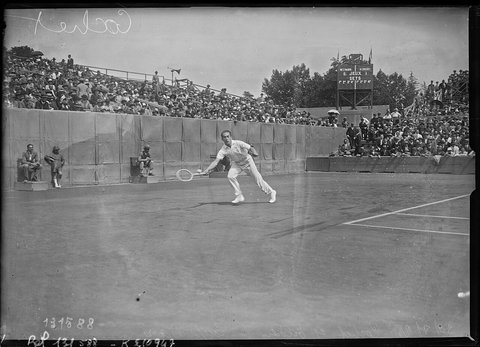
Cover image: "Mlle Lenglen et P. O'Hara Wood contre Mme Mallory et Dean Mathey (double mixte, troisième tour, Wimbledon 1922)", Agence Rol, 1922, glass negative held by the Bibliothèque nationale de France (btv1b53087058r), public domain, via Wikimedia Commons. It shows Suzanne Lenglen and Pat O'Hara Wood on grass in the mixed doubles third round, with a packed two-tier stand behind them and the fretwork balustrade of the new Centre Court's upper gallery visible along the top of the frame. The plate carries the negative number 16401 and the agency's name along the left edge. This is a French press agency's photograph, not the club's.













































 expand_more