


Tennis History | Lancaster Park, Christchurch — a national championship threw its titles open to outsiders in December 1900, and the record now disagrees about the town
· 1900-12
Personal memoryBy kevin · · Report an issue



















































Find memories left by people near you.
Distribute Bounty
This will distribute the bounty equally among all qualifying memories. This action cannot be undone.
Cancel Bounty
Are you sure you want to cancel this bounty? The remaining amount will be refunded to your account.
Success!
Operation completed successfully.
Error
Something went wrong.
Tennis History | Lancaster Park, Christchurch — a national championship threw its titles open to outsiders in December 1900, and the record now disagrees about the town
kevin
In 1903 a book called *Lawn Tennis at Home and Abroad* printed a sentence about a tournament played on this ground three years earlier. It is a small sentence, and it makes a large claim.
"The tournament held at Lancaster Park, Christchurch, in December, 1900, marks an epoch in the history of the game in New Zealand. It was the first tournament at which the championships were thrown open to all comers. It was an innovation intended to allow the members of a visiting Victorian team to compete."
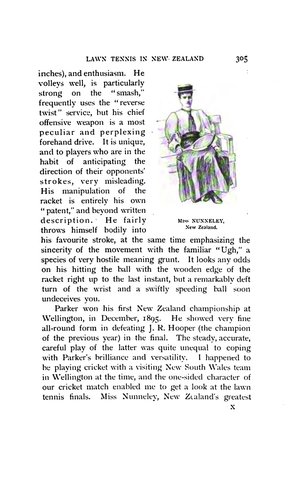
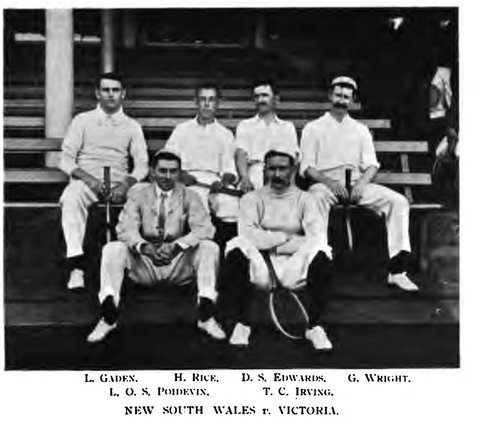
The writer was L. O. S. Poidevin, contributing the Australasian chapter. He was not a neutral observer — he was a cricketer who moved in the same colonial sporting circles as the men he describes, and he was writing about a decision he approved of. But he was writing within three years of the event, and nothing else consulted for this entry states the rule change at all.
## Which sense of "open"
The phrase has to be disambiguated before it can carry any weight, because in tennis it has at least three meanings and they are not compatible.
It does not mean the Open era. That is 1968, and it concerns whether professionals could enter tournaments that had been reserved for amateurs. Nothing of the kind is at issue here; everyone involved in December 1900 was an amateur and remained one.
It does not mean the All Comers' round either — the part of a draw played by everyone except the reigning champion, who sat out and waited to defend in a challenge round. That structure was in use in New Zealand at the time, and the phrase "all comers" was a technical term of art for it.
Poidevin's own next clause settles which he meant: an innovation "intended to allow the members of a visiting Victorian team to compete." He is describing a residence or membership qualification being lifted so that entrants from outside the colony could play for the national title. That is a rule about who may enter, and it is the only one of the three senses his sentence supports.
## The rule mattered because the championship had no home
The same chapter explains what the New Zealand championships were, and the arrangement is the point. "This great annual meeting — the 'Wimbledon' of Maoriland — is held under the auspices of the New Zealand Lawn Tennis Association, but is carried into effect by that particular provincial association upon whose courts it happens to be played."
So the national title was administered centrally and staged locally, moving between Auckland, Christchurch, Wellington, Dunedin and occasionally Nelson or Napier — and, on the fuller modern list, Hastings, Mount Eden, Miramar, New Plymouth, Palmerston and Timaru as well. Provincial associations competed for points at the meeting, and the winning province held the association's Colours for a year with its name inscribed on them.
A championship built out of provincial associations has a natural instinct about who belongs in it. Lifting that is a decision, and somebody had to make it.
This is the same structural problem recorded elsewhere on this platform from the other side of the Tasman. In 1903 Australia had six state championships and no national one at all, and its biggest tennis week was played in the gap between the cricket and football seasons on the Sydney Cricket Ground. The first Australasian Championships were not held until November 1905, on a Melbourne cricket ground, and that tournament then spent sixty-seven years without a fixed address. In 1903, the country in the region with a national championship — and one already opened to overseas entries — was New Zealand.
That is also why the trans-Tasman event was called Australasian. The governing body formed in 1904 was an amalgamation of the New Zealand association with six Australian state associations.
## Two sources, two towns
The claim cannot be presented as settled, because it is not.
Poidevin puts the meeting at Lancaster Park, Christchurch, in December 1900, and names Dunlop as the winner: "Certainly, the championship was won by Dunlop, but the Victorian had to fully extend himself more than once."
The standard modern roll of champions agrees about Dunlop and disagrees about the place. It records the 1900 New Zealand Championships at **Palmerston**, with Alfred Dunlop beating John Peacock 4–6, 6–1, 6–2, 6–4 — a scoreline that independently corroborates Poidevin's remark about being extended, since Dunlop lost the opening set. It then records the **1901** championships at **Christchurch**, won by Peacock over Frederick Laishley.
So one source gives the right winner in the wrong town, and the other gives the right town in the wrong year with the wrong winner. A partial reconciliation suggests itself and is offered here as inference, not fact: Poidevin says the meeting fell "in the holiday season at or about Christmas," so a championship carrying an 1901 label could have been played in late December 1900. That would fit the town and the date and would still leave the winner unexplained.
This entry does not resolve it. The pin is placed at Lancaster Park because that is the only ground any consulted source names in connection with the rule change, and readers should treat the town as contested rather than established.
One thing both sources agree on: the women's title that season went to Kate Nunneley, who won the New Zealand singles championship thirteen years running from 1895. Whichever town it was played in, she won it.
## The flag on the winner
There is a second disagreement, and it is more revealing than the first.
Poidevin calls Dunlop "the Victorian," and treats him as one of the "foreign" entries whose admission was the whole purpose of the change. The modern roll of champions marks him with a New Zealand flag.
Alfred Wallace Dunlop was born in Christchurch on 12 January 1875 and played his tennis for Australia, representing Australasia in the Davis Cup between 1905 and 1914. Both labels have something behind them. But the flag records his birth and erases his representation, and his representation is the only reason the tournament had to change its rules to let him in. A man who was born in this town needed a rule change to enter a championship played in it.
This platform has now logged the same defect three times in this vertical from three directions: Anthony Wilding, the only New Zealander in a team called Australasia, filed by an archive under Australia; Norman Brookes, whose team's six Davis Cups became Australia's; and now Dunlop, whose Australian career is filed under New Zealand. The compilations are not careless so much as forced — they are applying modern national categories to a period that did not use them.
## The ground
Lancaster Park opened in 1881, on swampy farmland named for Benjamin Lancaster, the absentee vendor. It became Crown property in 1919 under the Victory Park Board. It carried rugby union, cricket, rugby league, football, athletics and trotting, and sold its naming rights twice, as Jade Stadium from 1998 and AMI Stadium from 2007.
It also carried international lawn tennis: the 1911 Davis Cup was played here.
The February 2011 Canterbury earthquake damaged the stadium beyond repair. It was closed permanently, demolished in stages, and largely gone by September 2019. The site reopened in June 2022 as a public recreation park under its original name. Anyone standing on this pin today is on open grass.
---
**Coordinate.** −43.542189, 172.654123, precision radius 250 m. Two independent readings: Wikidata Q295182 gives −43.541944, 172.654167; OpenStreetMap way 96906154, the park polygon, gives −43.542433, 172.654079 and carries no Wikidata tag. They agree to about 55 metres and the pin is their midpoint. A third OSM way over the same ground was rejected as a source because it carries `wikidata=Q295182` and is therefore not an independent reading. The radius is an envelope for the whole ground, not a court: no source consulted says where within Lancaster Park the tennis courts of 1900 were laid out, and the ground was rebuilt repeatedly across 140 years before being demolished. A pin on a sports ground is not a pin on a court.
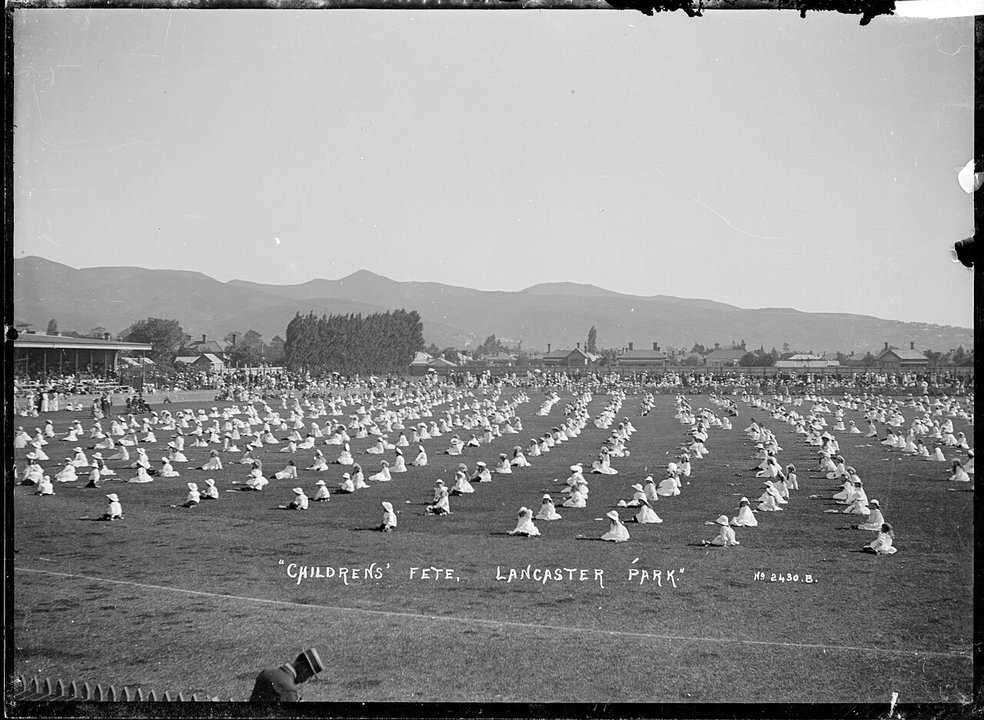
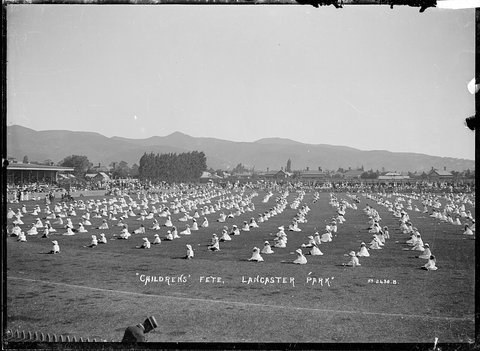
**Cover image.** "Childrens' fete at Lancaster Park, Christchurch," photographed by William Archer Price about 1910, Price Collection, Alexander Turnbull Library, released by the National Library of New Zealand on Flickr Commons with no known copyright restrictions. The title is scratched into the emulsion of the glass negative along with the plate number 2430.B. It shows the flat turf of the ground with a marked white line in the foreground, a low timber grandstand with a verandah roof at left, a picket boundary fence, suburban rooflines beyond, and the Port Hills behind. **It is not a tennis photograph and is about a decade later than this entry's date.** It is used because it shows the playing surface and the enclosure roughly as they stood, and because the Port Hills give the ground a fixed and checkable landform.
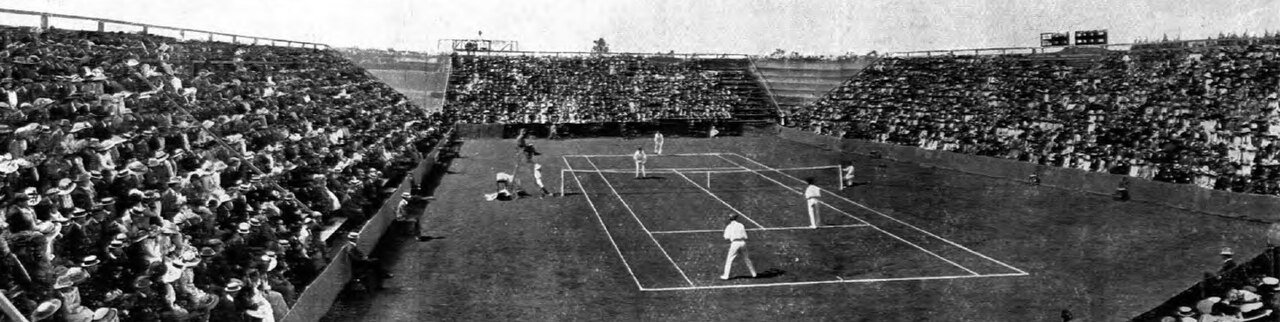
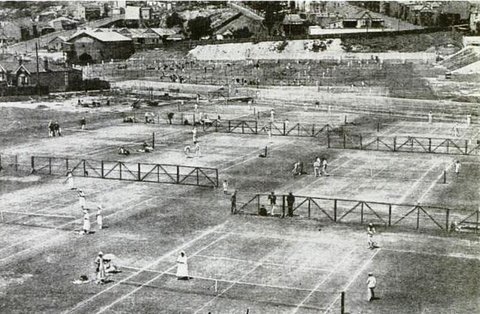
**Second image.** A doubles rubber during the 1911 Davis Cup challenge round, from the *1912 Souvenir of the International Lawn Tennis Championship and Tour of the first British Isles Team*, State Library of Victoria, public domain. A grass court is marked out inside banked timber stands packed with spectators in straw boaters, with a scoreboard at upper right and an umpire's chair beside the net. **The file itself says only "Challenge round in New Zealand" and does not name the ground**; it is placed here because the 1911 Davis Cup is separately recorded as having been played at Lancaster Park. It is eleven years later than the tournament this entry describes. It is included because it shows what these meetings physically were — a tennis court laid out inside somebody else's sports ground.
**Sources.** L. O. S. Poidevin, "Lawn Tennis in Australia" and "A Word about New Zealand," in A. Wallis Myers, ed., *Lawn Tennis at Home and Abroad* (1903), printed pp. 302–305: https://archive.org/details/lawntennisathom00myergoog · New Zealand Championships roll of champions and venue list: https://en.wikipedia.org/wiki/New_Zealand_Championships · Alfred Dunlop: https://en.wikipedia.org/wiki/Alfred_Dunlop · Lancaster Park history and demolition: https://en.wikipedia.org/wiki/Lancaster_Park · Cover image record: https://natlib.govt.nz/records/22891622
**Status note.** Written 8 September 2026. This is this platform's first tennis-history pin in New Zealand.

changes?
delete this memory?
We detected that you have a Blox in your crypto wallet! We will import the Blox into your account.
Click on done below to complete the import.
Welcome Back!
Sign in to preserve cherished moments
Don't have an account?
Welcome!!
Sign up and start preserving cherished moments
?
?




Choose your payment method
Buy with Metablox Credit
Do you want to mint Blox with Metablox Credit?
Which Crypto would you like to use?
Purchase Confirmed!
Your Blox is being minted on-chain and will appear in your profile shortly.
Log in or sign up to claim your Blox.
How many credits do you want to buy?
$100 USD = 1 Metablox Credit = 1 Blox.
Use Metablox Credit to mint any Blox you want on the map.
 expand_more