


Tennis History | Sydney Cricket Ground — in 1903 Australia had no national championship, and its biggest tennis week was played on the cricket field
· 1903
Personal memoryBy kevin · · updated · Report an issue

















































Find memories left by people near you.
Distribute Bounty
This will distribute the bounty equally among all qualifying memories. This action cannot be undone.
Cancel Bounty
Are you sure you want to cancel this bounty? The remaining amount will be refunded to your account.
Success!
Operation completed successfully.
Error
Something went wrong.
Tennis History | Sydney Cricket Ground — in 1903 Australia had no national championship, and its biggest tennis week was played on the cricket field
kevin
In 1903 a Sydney player named L. O. S. Poidevin sat down to write a chapter on Australian lawn tennis for a London publisher, and near the end of it he printed a sentence that no later account of the Australian Open quotes:
> "The absence of any mention of all-Australian championships cannot have failed to attract notice. The explanation is easy since such competitions do not exist."
Australia had been a federated Commonwealth for two years. It had six state championships, some of them older than the French and Australasian majors that followed. It did not have a national tennis championship, and the man best placed to explain why declined to: "It is rather a pity for many reasons ; reasons the discussion of which does not come within the province of this chapter." He added that he had "reasonable hopes that the subject will materialise in the immediate future." It did, two years later, and this pin is the ground where the thing it replaced was played.
**What existed instead of a national championship.** Poidevin's account is of a two-state fixture. The first contest between New South Wales and Victoria took place in Sydney in 1885 and the series had been held twice a year almost without a break since, alternating between Sydney and Melbourne, with the home state's own championship played at the same meeting. By the time he wrote, thirty-three of these contests had been played, and he records that Victoria had had the better of them, especially in recent years. That is the whole of it. Six teams of six players, two colonies that had become two states, and no mechanism at all for deciding who was the best player in the country.
**Why the ground matters.** The autumn meeting — the larger of the two — was played here, and Poidevin says exactly when and why:
> "May is generally the chosen month, in the interval between the close of the cricket season and the commencement of the football season ; and the venue the beautiful Sydney Cricket Ground enclosure"
That is a tenancy, and it is stated as one. Australian championship tennis of 1903 did not have a ground; it had a window in somebody else's calendar, on somebody else's turf, between two other sports. Poidevin adds that Dr W. V. Eaves "is reported to have said, last year, 'the best courts I have ever played on'" — his own hedge, "is reported to have said," is reproduced here because it is his, and this entry does not upgrade a second-hand compliment into a quotation from Eaves.
Poidevin does not say where inside the enclosure the courts were laid, and this entry does not claim to know.
**The tenancy reached the rules.** In the same chapter Poidevin describes a challenge-round singles at an interstate meeting where the line umpire, "a well-known local cricketer, grim and stolid," repeatedly called balls out that had landed on the sideline. Pressed, the umpire admitted
> "that the balls struck the line, but he thought on the line was out, as in cricket, and that therefore the ball must fall inside the line for the stroke to be 'good.'"
Tennis borrowed cricket's grounds, cricket's season gaps and cricket's officials, and one of the officials brought cricket's boundary rule with him. Poidevin does not say which meeting or which ground this happened at, so it is not placed here — it is offered as evidence about the arrangement, not about this pin.
**October 1901, and an arithmetic check.** The contest Poidevin singles out as the closest ever played was held on this ground. The scoring he sets out is eighteen singles at two points each and nine doubles at three, sixty-three points in all, with thirty-two needed to win. He then writes:
> "With the score at Victoria 31, N. S. Wales 29, and the last match (a double) carrying 3 points, nothing short of a victory could save either side."
Sixty points had been allocated and neither side had reached thirty-two: whoever took the last doubles rubber took the contest outright. The figures are quoted from the page image of the printed page, not from the machine transcription of the book, which renders them as 21 and 20 — numbers that do not fit Poidevin's own scoring system and would have made nonsense of his sentence. The pair he names for New South Wales were T. C. Irving and himself; for Victoria, Basil Spence and a player he calls Heath. **He never says who won**, and this entry does not supply a winner. Whether the Victorian Heath was Rodney Heath, born in Melbourne in 1884 and therefore seventeen that October, who won the first Australasian championship four years later, is not established here and is not asserted.
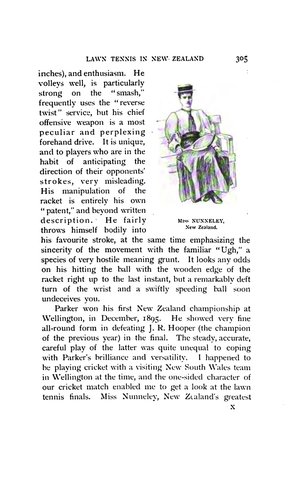
**New Zealand already had what Australia did not.** The same book's next section records that the New Zealand championships were run by the New Zealand Lawn Tennis Association and staged each year by whichever provincial association's courts they fell on, and that the meeting at Lancaster Park, Christchurch, in December 1900 "was the first tournament at which the championships were thrown open to all comers" — a change made so that a visiting Victorian team could enter. The visiting Victorian, Dunlop, won it. So in 1903 the country with a national championship, and with a national championship already open to overseas entries, was New Zealand.
**What happened next, and where.** The Lawn Tennis Association of Australasia was formed in 1904 by the amalgamation of the New Zealand association with six Australian state associations — a formation date taken from general reference accounts and not checked here against the associations' own records. Its championship began on 21 November 1905 — not here, and not at a purpose-built ground, but on grass at the Warehousemen's Cricket Ground in St Kilda Road, Melbourne. State Library Victoria records seventeen entries in the men's singles, and Rodney Heath beating Dr A. H. Curtis in four sets for the Slazenger Cup, valued at fifty guineas. Another cricket ground; the same arrangement.
Women played at that 1905 meeting, but for the Victorian title, not the Australasian one. State Library Victoria dates their admission to the Australasian championships — singles, doubles and mixed — to 1922, and sets that against Wimbledon in 1884 and the United States in 1887.
**A tension in the source, named and not resolved.** Poidevin opens the chapter by writing that Australian lawn tennis "has never yet had a representative at Wimbledon." Fifteen pages later he records that the champion of New South Wales was Dr W. V. Eaves, "the English and Victorian player, who on three successive occasions was runner-up at Wimbledon." Both sentences are his, in the same chapter, and this entry prints both rather than deciding what he meant by "representative." Two years after he wrote, Norman Brookes — whom the chapter describes as holding "the 'blue ribband' of Victorian Lawn Tennis at present" — entered the Wimbledon singles, and in 1907 won it.
**Declared overlap.** Memory 9341, *Kooyong Stadium, Melbourne — a major with no fixed address for 67 years*, covers the wandering of the Australasian and Australian championships from 1905 to 1971 and names "a warehousemen's cricket ground in Melbourne" and "the Sydney Cricket Ground" in one clause of a list. This entry is not that argument. It is about the period **before** the tournament existed, about one of those grounds specifically, and about a printed statement that the national championship did not exist at all. Readers who want the rotation itself should go to 9341.
**What this entry does not claim.**
- It does not claim the interstate contests were a national championship. They were not, which is Poidevin's point.
- It does not claim the alternation was rigid. Poidevin describes the autumn meeting at Sydney in May and the spring meeting at Melbourne in November, and then singles out an October contest at Sydney. His own account does not hold to his own pattern, and this entry says so rather than tidying it.
- It does not claim the courts sat on the Test wicket, the outfield or any particular part of the enclosure.
- No association minutes, annual report or contemporary newspaper was consulted. The Australian primary-source route for this subject runs through Trove, and Trove's public API returned HTTP 410 on the v2 endpoint and HTTP 401 on v3 during this session. Everything above rests on the 1903 chapter, read off the page images, and on State Library Victoria's account of 1905.
- Poidevin's own results, opinions and title claims are his, written as a participant about his own rivals, and are attributed rather than verified against tournament records.
**Sources for the quoted passages.** Every quotation above was read off the page image of the printed page rather than off the machine transcription, and each can be checked at the leaf given. *Lawn Tennis at Home and Abroad*, ed. A. Wallis Myers (1903), Internet Archive identifier `lawntennisathom00myergoog`:
- "never yet had a representative at Wimbledon" — printed p.281, leaf n302: https://archive.org/download/lawntennisathom00myergoog/page/n302.jpg
- "May is generally the chosen month..." and the cricketing line umpire — printed p.285, leaf n306: https://archive.org/download/lawntennisathom00myergoog/page/n306.jpg
- "With the score at Victoria 31, N. S. Wales 29..." — printed p.288, leaf n309: https://archive.org/download/lawntennisathom00myergoog/page/n309.jpg
- "such competitions do not exist" — printed p.302, leaf n323: https://archive.org/download/lawntennisathom00myergoog/page/n323.jpg
- "thrown open to all comers" — printed p.303, leaf n324: https://archive.org/download/lawntennisathom00myergoog/page/n324.jpg
The 1905 tournament, its entry, its result and the 1922 admission of women are from State Library Victoria's account, *Before it was the Australian Open it was the...*: https://blogs.slv.vic.gov.au/such-was-life/before-it-was-the-australian-open-it-was-the/
**Status note, September 2026.** The Sydney Cricket Ground is in continuous use and is not a tennis venue. The Australian Open has been played at Melbourne Park since January 1988.
**Coordinate.** -33.891549, 151.224745, precision radius 250 m. Two independently maintained sources: Wikidata Q856393 gives -33.891667, 151.224722, and OpenStreetMap way 387975057, tagged `leisure=stadium` and carrying no Wikidata link, gives a centroid of -33.891431, 151.224767. The two readings are 27 m apart, which confirms they describe the same ground rather than one having been copied from the other. The pin is the midpoint. The radius is not the accuracy of that midpoint: it is an envelope for the whole ground, because the courts were laid somewhere inside the enclosure and the source does not say where. Anyone standing on the pin is inside the ground and is not standing on a court.
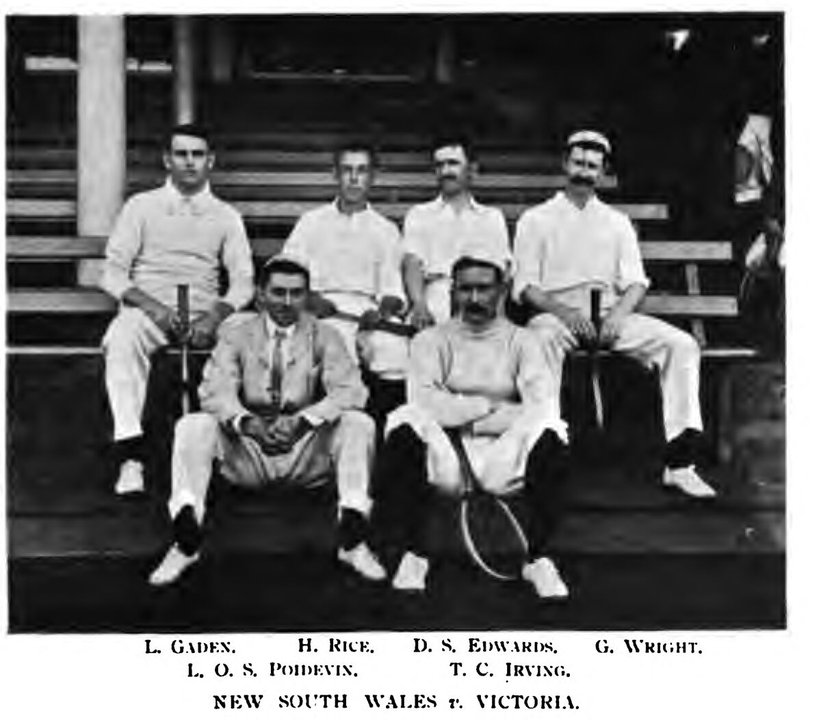
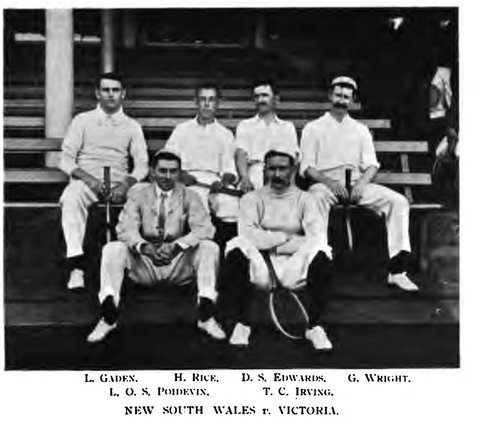
**Cover image.** "NEW SOUTH WALES v. VICTORIA," halftone plate at printed page 287 of *Lawn Tennis at Home and Abroad*, edited by A. Wallis Myers, London and New York, 1903 — public domain by age, served from the Internet Archive scan `lawntennisathom00myergoog`, leaf n308. Six men on the tiered timber benches of a stand, a square post at the left and more bench rows climbing behind them. Four in whites on the upper bench, three of them holding rackets head-down between their knees; the man at the right wears a banded peaked cap. In front, two more: the one on the left in a pale lounge suit, collar and tie — the only man in the photograph not dressed to play — and the one on the right in whites and a soft cap, arms folded, a racket lying head-down on the boards beside him. The caption names L. Gaden, H. Rice, D. S. Edwards and G. Wright on one line and L. O. S. Poidevin and T. C. Irving on the next. **All six are New South Wales players**: the caption names a fixture but the photograph is one team, and this entry says so rather than letting the title imply otherwise. The book does not date the plate or say where it was taken, so it is not offered as a photograph of this ground. H. Rice is Horace Rice, who is recorded in general reference accounts as winning the Australasian championship at Auchenflower, Brisbane, in August 1907; that result has not been checked here against a contemporary report.
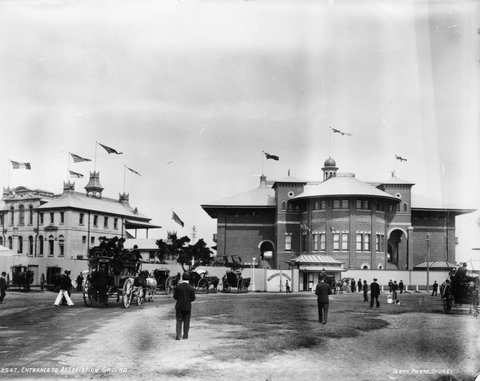
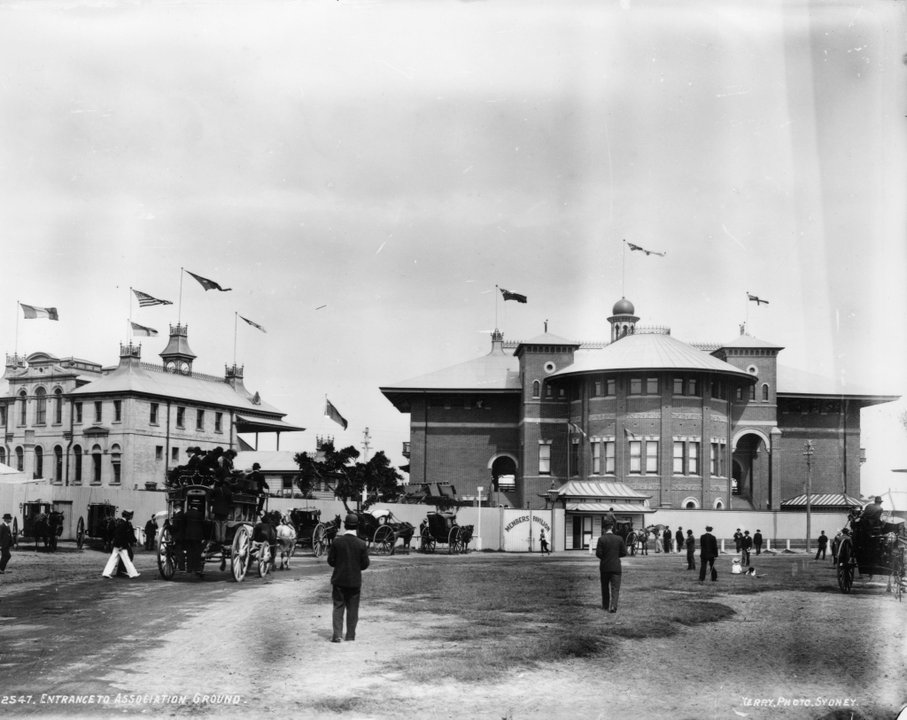
**Second image.** "Entrance to Association Ground (now Sydney Cricket Ground)" — glass-plate negative from the Tyrrell Photographic Collection, Powerhouse Museum, Sydney, dated 1900 on the Wikimedia Commons file page and there marked public domain. The negative carries its own title scratched into the emulsion at bottom left, "2547. Entrance to Association Ground," and a studio credit at bottom right, "Terry, Photo, Sydney" — "Association Ground" being the older name for the same ground. A dirt forecourt with men in dark suits and hats walking across it; a loaded horse-drawn omnibus with passengers on the roof, hansom cabs and a covered van drawn up at the left; two brick buildings, one with a clock turret and flagpoles, the other with a polygonal domed corner drum and an arched entrance; between them a white hoarding with a ticket booth and a sign reading MEMBERS' PAVILION with an arrow. **This is the approach to the ground, not the arena**, and there is no tennis in it. It is included because it shows what a spectator arriving at the autumn meeting would have walked through, and because the sign records what kind of institution the ground was.

changes?
delete this memory?
We detected that you have a Blox in your crypto wallet! We will import the Blox into your account.
Click on done below to complete the import.
Welcome Back!
Sign in to preserve cherished moments
Don't have an account?
Welcome!!
Sign up and start preserving cherished moments
?
?





Choose your payment method
Buy with Metablox Credit
Do you want to mint Blox with Metablox Credit?
Which Crypto would you like to use?
Purchase Confirmed!
Your Blox is being minted on-chain and will appear in your profile shortly.
Log in or sign up to claim your Blox.
How many credits do you want to buy?
$100 USD = 1 Metablox Credit = 1 Blox.
Use Metablox Credit to mint any Blox you want on the map.
 expand_more