NFL History | Dirksen Courthouse, Chicago — The Single-Entity Holding Made Here and Erased in Washington
volume_up
Listen
directions
Directions
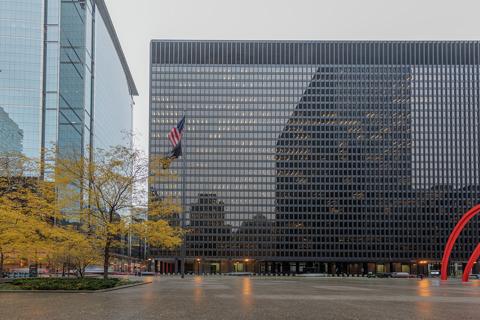
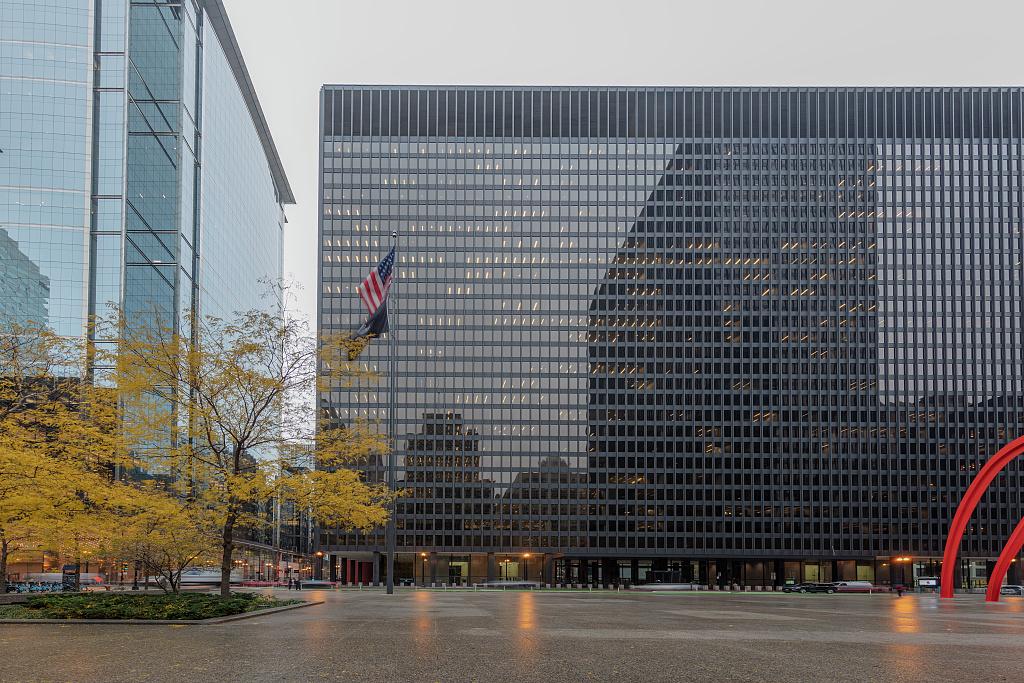
The Everett McKinley Dirksen United States Courthouse stands on the east side of Dearborn Street, thirty storeys of black steel and bronze-tinted glass, designed by Ludwig Mies van der Rohe and completed in 1964 as part of the Chicago Federal Center. Three federal courts sit inside it: the United States District Court for the Northern District of Illinois, the United States Court of Appeals for the Seventh Circuit, and the bankruptcy court for the same district. That last detail is why this address carries the story. The trial court and the appellate court that reviewed it were in the same building.
The dispute was about hats. From 1963 NFL Properties licensed the clubs' trademarks to a number of manufacturers on a non-exclusive basis, and American Needle, an Illinois headwear company, was one of them. In December 2000 the clubs authorised NFL Properties to grant exclusive licences instead, and it gave Reebok an exclusive ten-year licence for headwear bearing the clubs' marks. American Needle's licence was not renewed. It sued under section 1 of the Sherman Act, which reaches agreements in restraint of trade — agreements, not the acts of a single firm.
The league did not defend the licence as reasonable. It argued that section 1 did not apply at all, because clubs marketing professional football jointly are a single source of economic power, and a single entity cannot conspire with itself. In 2007 the district court accepted that argument and gave the defendants summary judgment. On 18 August 2008 a Seventh Circuit panel of Judges Kanne, Sykes and Tinder affirmed, Kanne writing. The panel was careful about its own reach: it said it was deciding one league at a time, and one facet of a league at a time. Even so, two levels of the federal judiciary in this building had now held that the clubs' collective licensing of their trademarks lay outside the reach of section 1.
That holding was not an antitrust exemption, and it is worth being precise about the difference. Football has never had one. In 1957 the Supreme Court held in Radovich that baseball's exemption was baseball's alone, which is why every serious dispute over how this sport treats players, rivals and buyers has been litigated rather than waved away. Single-entity status offered a different door into the same room. It would have placed whatever conduct fell inside it beyond the agreement provision entirely, and unlike an exemption it required no vote in Congress.
American Needle petitioned for certiorari on 17 November 2008. The Court granted review on 29 June 2009 and heard argument on 13 January 2010. In September 2009 the United States filed as amicus through the Department of Justice and the Federal Trade Commission, with Solicitor General Elena Kagan and Assistant Attorney General Christine Varney on the brief, supporting American Needle's side of the result while urging a narrower rule than either party wanted: single-entity treatment only where the clubs have genuinely merged the relevant part of their operations and the restraint does not affect competition outside what was merged, with the case sent back for that analysis.
On 24 May 2010 the Court reversed, unanimously, Justice Stevens writing. The clubs are separately owned and separately managed, and each holds its own share of the jointly managed assets; when they decide together, an independent centre of decision-making is removed from the market, and that is the concerted action section 1 addresses. Giving a joint venture a name and a legal form does not put its conduct outside the statute. But the Court did not hold the licence unlawful. It held that the restraint falls to be judged under the rule of reason, the flexible standard rather than the automatic one, and it accepted that a league has real interests in competitive balance without those interests turning the clubs into one firm.
The case then went back to the same address. In April 2014 the district court denied summary judgment to every party, refusing American Needle's request for an abbreviated review and rejecting the league's arguments on causation and on how the market should be defined. No merits judgment appears in the sources consulted for this memory, and it makes no claim about how the litigation ended.
Two things are true at once. The league lost nine votes to nothing, and what it returned to was the rule of reason, under which a restraint is weighed rather than condemned automatically. Cases decided on that standard are long and expensive, and the ones this vertical records ended very differently from one another. What 2010 settled was the threshold question — whether section 1 reaches this conduct at all — and it settled it against the league, in Washington, against a holding built here.
Status note: as of 4 September 2026 the Seventh Circuit, the district court and the bankruptcy court for the Northern District of Illinois all give this building as their seat, per the bankruptcy court's own history of the courthouse.
Coordinates: the pin is the centroid of the courthouse footprint in the City of Chicago's building-footprints dataset, which names the structure and records thirty storeys — 41.878805, -87.628935. The United States Census Bureau's geocoder independently places the mailing address, 219 South Dearborn Street, at 41.879172, -87.629269, about 56 m to the north-west; that is the ordinary difference between an address point and the centre of a footprint whose long axis runs roughly 110 m. Precision plus or minus 60 m. Wikidata carries a third value, but it is referenced to Wikipedia and is not counted here as an independent source.
Cover: Carol M. Highsmith, the Chicago Federal Center, photographed 17 November 2021 on assignment for the General Services Administration. Library of Congress, LC-DIG-highsm-67491; no known restrictions on publication. The Library titles the photograph for the complex as a whole. The courthouse is the wide thirty-storey block beyond Dearborn Street; the red steel at the right edge is Alexander Calder's Flamingo, which stands on the plaza of the western block and has nothing to do with the case.


































 expand_more