


NFL History | Tottenham Hotspur Stadium, London — The League Got Its Own Field by Putting It Under Someone Else's
· 2019-10
Personal memoryBy kevin · · Report an issue





















































Find memories left by people near you.
Distribute Bounty
This will distribute the bounty equally among all qualifying memories. This action cannot be undone.
Cancel Bounty
Are you sure you want to cancel this bounty? The remaining amount will be refunded to your account.
Success!
Operation completed successfully.
Error
Something went wrong.
NFL History | Tottenham Hotspur Stadium, London — The League Got Its Own Field by Putting It Under Someone Else's
kevin
On 6 October 2019 the Oakland Raiders beat the Chicago Bears 24-21 in this building, in front of 60,463 people, in three hours and eight minutes. Pro-Football-Reference files it under Tottenham Stadium, London. It was the first National Football League game played here, and it is worth recording not for anything that happened in it but for what had to exist underneath the players before it could be played at all.
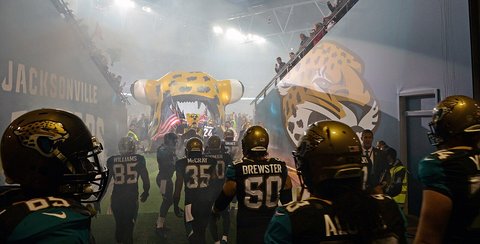
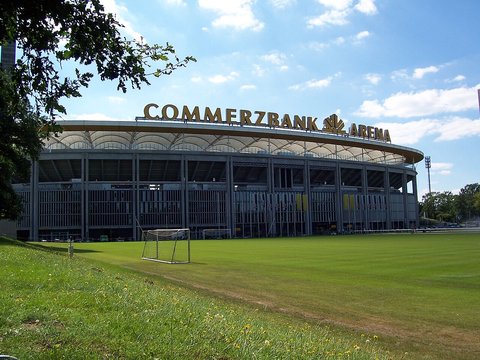
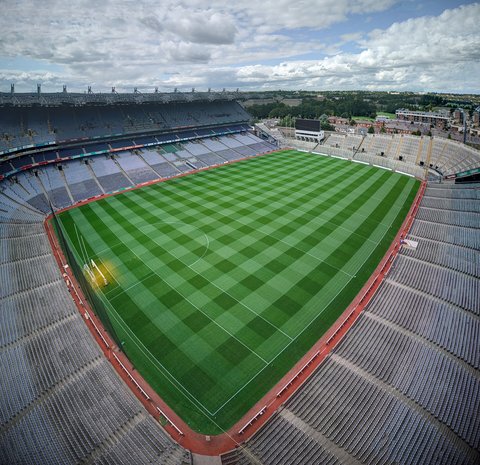
The league had been sending regular-season games abroad since 2007, and every one of them had been a tenancy. Wembley, the Estadio Azteca, the Waldstadion in Frankfurt, Croke Park in Dublin: buildings put up for other sports by other people, borrowed for an afternoon, marked out with temporary lines and handed back. This entry exists because at this address the arrangement inverted. A football club building itself a new ground took the league's requirements into the design brief and built them in permanently, in exchange for a guaranteed anchor tenant. The league stopped renting a field and acquired one. What it did not acquire was the top of it.
The agreement came first. On 8 July 2015, with the new stadium still unbuilt, Tottenham Hotspur and the league announced a ten-year partnership under which the new stadium would stage a minimum of two regular-season games a year. Sports Illustrated reported the terms that day: a 61,000-seat building, opening for the 2018-19 English season, with a retractable grass pitch for association football and an artificial surface underneath it for the American game. Daniel Levy, the club chairman, described the ambition as bringing the two codes together in one venue; Roger Goodell said the league wanted to host its games in world-class buildings. The commercial logic is plain enough on both sides. The engineering is the interesting part.
The pitch that has to move is not a carpet. Ingenia, the Royal Academy of Engineering's magazine, published the specification. The grass sits in three sections, each one built from 33 metal trays welded together out of steel plate 16 millimetres thick, each section weighing over 3,000 tonnes and the assembly over 9,000 tonnes, which the magazine notes is heavier than the Eiffel Tower. The playing surface it carries is 118 metres long. It rides 1.6 metres above solid ground on 598 wheels running on three rails per section. Sixty-eight electric motors drive every second tray, at a top speed of seven metres per minute. Thirty-two hydraulic cylinders in the steelwork help the outer sections track inward. The wheels on the centre rail are flanged and the outer wheels run free, because the steel expands and contracts by as much as 45 millimetres and something has to give. Two people can roll the pitch away in 25 minutes, and the full changeover between codes takes about four hours.
Grass parked under a stand dies unless someone stops it. So the stored pitch sits under a 120-tonne moving lighting rig carrying 864 individual lights over 6,525 square metres, with ventilation pushed across it and an irrigation and drainage system that disconnects when the trays move.
All of that exists to get the grass out of the way. That is the sentence worth sitting with, because it reverses the usual relationship between a football field and everything else. The venue puts it plainly in its own description: an artificial field underneath the retractable grass pitch means the league also has its own playing surface. Alongside it are dedicated dressing rooms for players, officials and cheerleaders, and separate broadcast, media and medical facilities. The club calls the building the first purpose-built NFL stadium outside the United States, and the claim is worth stating precisely rather than repeating: other overseas venues have hosted more games and hosted them earlier, but they were adapted for the day, and here the requirements were in the drawings before the concrete.
The technology has a documented ancestor in this series. Brady Spencer, a senior architect at Populous, which designed the building, described the moving-tray system to Football Stadium Digest as a new iteration of the field-tray technology at State Farm Stadium in Glendale, Arizona, which is pinned elsewhere in this series under its earlier name. The comparison rewards a moment's attention, because the two buildings use the same idea for opposite purposes. In Glendale the grass rolls out into the sunlight so the building can be used for something else. In London the grass rolls away so the building can be used for football of the other kind. The default in Arizona is the American game and the grass is the exception; here the grass is the default and the American game lives underneath it.
The building missed its own opening. On 13 August 2018 the club announced that the stadium would not be ready, citing problems with critical safety systems found during testing and commissioning, and said a revised timetable would follow once retesting was complete. Two Premier League fixtures went to Wembley, and so did the league game scheduled here for 14 October 2018 between the Raiders and the Seattle Seahawks. The purpose-built home for the overseas game spent its first season sending its fixtures back to the rented building it had been designed to replace. The ground opened in April 2019, and the Raiders finally played here that October.
Which brings the argument to the surface itself, and to the part of this history that is not settled.
On 9 October 2022, after a game here between the New York Giants and the Green Bay Packers, questions were raised about seams in the artificial field and dips near them. The league's response is the document worth keeping, because of what it describes rather than what it concludes. The field, the league said, is prepared and maintained by its own field managers, who specialise in both artificial and natural surfaces; it had been inspected by those managers, by an independent field inspector, and by a field consultant for the National Football League Players Association; and all requirements as agreed between the league and the union had been met and were in compliance with the league's mandatory standards and practices. Read carefully, that is not a statement that the field is good. It is a statement that the field passed a test the two sides wrote together. The certification is a bargained term, jointly administered, exactly like the appeal clause litigated over another game in this series.
Then it was tested again. ESPN, surveying the league's surface dispute in late 2023, reported that the field here had been changed before the 2023 season, the earlier installation having been a slit-film product of the kind the union had objected to elsewhere. On 8 October 2023 the Buffalo Bills lost 25-20 to the Jacksonville Jaguars in this stadium and several Bills players attacked the surface publicly afterwards, one of them saying it was terrible, that it should be taken out, and that grass should be used where grass is possible; another likening it to cement. What makes those complaints structurally interesting rather than merely loud is the sequence: they came after the replacement, on the certified surface, from players who had flown across an ocean to reach it. Several players were injured in that game. No published finding attributes any of those injuries to the surface, and this entry does not suggest one.
The mechanism underneath the disagreement is a measurement problem, and it is the finding this entry exists to record. Fields are certified for hardness with an impact test. ESPN reported that a survey run by the league's own engineering committee in 2022 produced results that ran inverse to what players described: surfaces that measured hard were reported as feeling soft, and surfaces that measured soft were reported as feeling hard, with no agreed biomechanical metric linking the instrument to the experience. A number exists. A procedure for taking it exists. What is missing is evidence that the number measures the thing being complained about. That is the same shape as the ball-pressure rule that had a figure and no way to check it during a game, and it is a more useful way to think about surface disputes than an argument about preferences.
The injury statistics are contested and both sides should be printed. ESPN records the league citing the 2021 season, when lower-extremity injury rates were effectively level at 0.042 per 100 plays on artificial surfaces and 0.041 on grass, and the union citing 2022, when the same measure ran 0.048 on artificial surfaces against 0.035 on grass. ESPN also notes that the rate has been higher on artificial surfaces in each of the preceding eleven years, while observing that the 2021 gap was minimal. In September 2023, after an injury at another stadium, the union's executive director Lloyd Howell called on the clubs to convert every stadium to grass. That call has not been met, and this entry does not resolve which reading of the data is right. It records that the building at this address was designed on the assumption that the question would stay open, and that the league's permanent field in Europe is the artificial one.
Status as read on 8 September 2026. The original ten-year agreement has been superseded: the club and the league have announced an expanded partnership running through the 2029-30 season, with the stadium designated the Home of the NFL in the United Kingdom and the minimum of two regular-season games a year retained. On 13 May 2026 the venue confirmed its two games for this season, Indianapolis against Washington on 4 October and Philadelphia against Jacksonville on 11 October, both kicking off at half past two in the afternoon. A reader arriving later should check whether the partnership has been extended again and whether the surface under the grass is still artificial.
One note on the two London pins in this series. The entry for Wembley Stadium sits about 15.7 kilometres west-north-west of this one. They are two different buildings in the same city, and the distance between the pins is not uncertainty about either.
Coordinate. The pin is at 51.604177 north, 0.066235 west, with a precision radius of 40 metres, at the centre of the stadium footprint rather than at a gate or the address on the High Road. The primary value was computed here as the shoelace centroid of OpenStreetMap way 538300255 from all 75 of its nodes, retrieved from the OpenStreetMap raw API; the way is tagged as a stadium with the sports given as soccer and american football and a start date of 2019, and the footprint it encloses measures about 242 metres north to south and 207 metres east to west. The independent leg is Wikimedia Commons geosearch: 40 geotagged files within 250 metres carry 16 distinct coordinate values from separate contributors, and their median falls at 51.604193 north, 0.066203 west, about 3 metres from the computed centroid, which is a genuine convergence of two separately produced values rather than one published figure copied between files. Wikidata's coordinate for the stadium lies 31.6 metres away, but the OpenStreetMap way carries the Wikidata identifier Q55074091, so the two are a linked pair and count as one method rather than two; it is reported here as a check only. The Office for National Statistics centroid for the postcode N17 0BX, obtained through the postcodes.io interface, falls about 175 metres north of the footprint, which is the expected behaviour of a postcode-unit centroid rather than a structure position, and it is disclosed rather than averaged in.
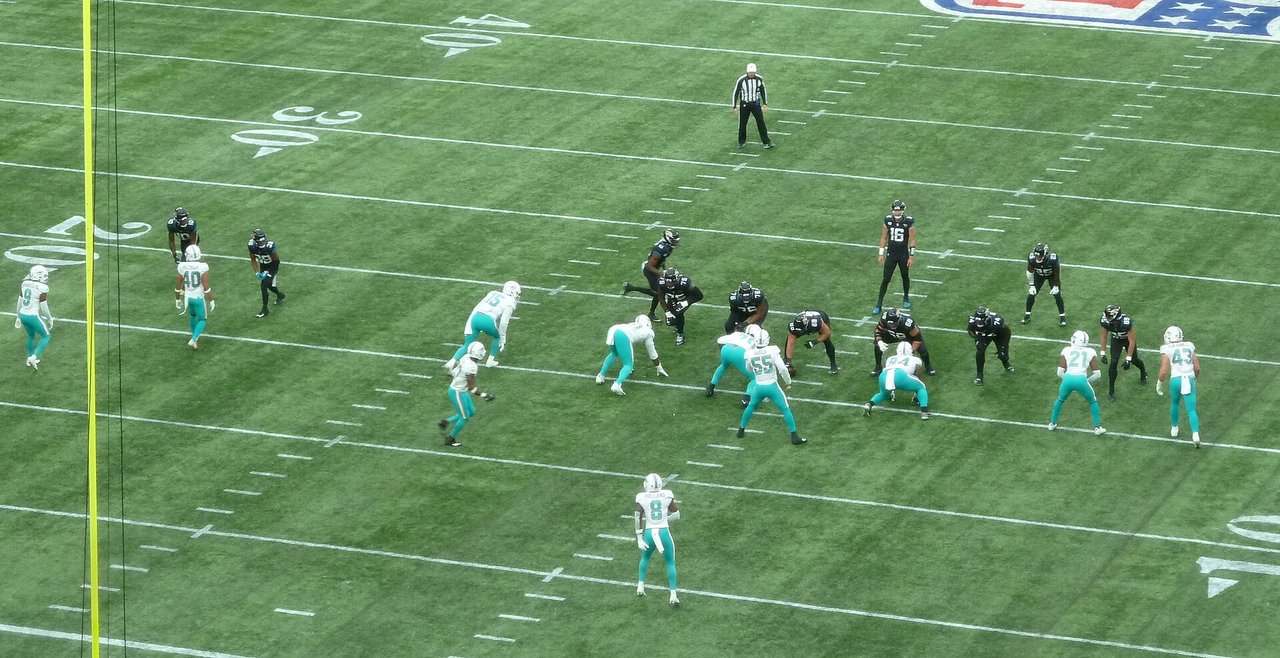
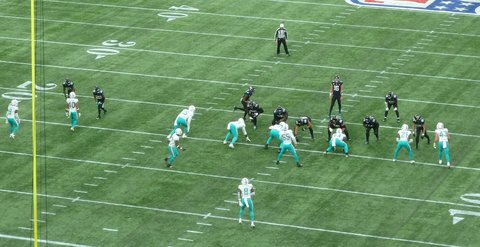
Cover image: a play from scrimmage during Miami at Jacksonville in this stadium, photographed on 17 October 2021 by Tony Hisgett, Creative Commons Attribution 2.0, via Wikimedia Commons. The file was opened and examined. It is not the 2019 game this entry is anchored to. It is used because it shows the thing the entry is about: the league's own field inside a football ground, with the shield painted in the end zone, the yard numbers and hash marks laid out across a surface banded in light and dark stripes in imitation of mown grass. Pro-Football-Reference records that game as a 23-20 Jacksonville win before 60,784 people, settled by a field goal as time expired, which matches the photographer's own description of it.
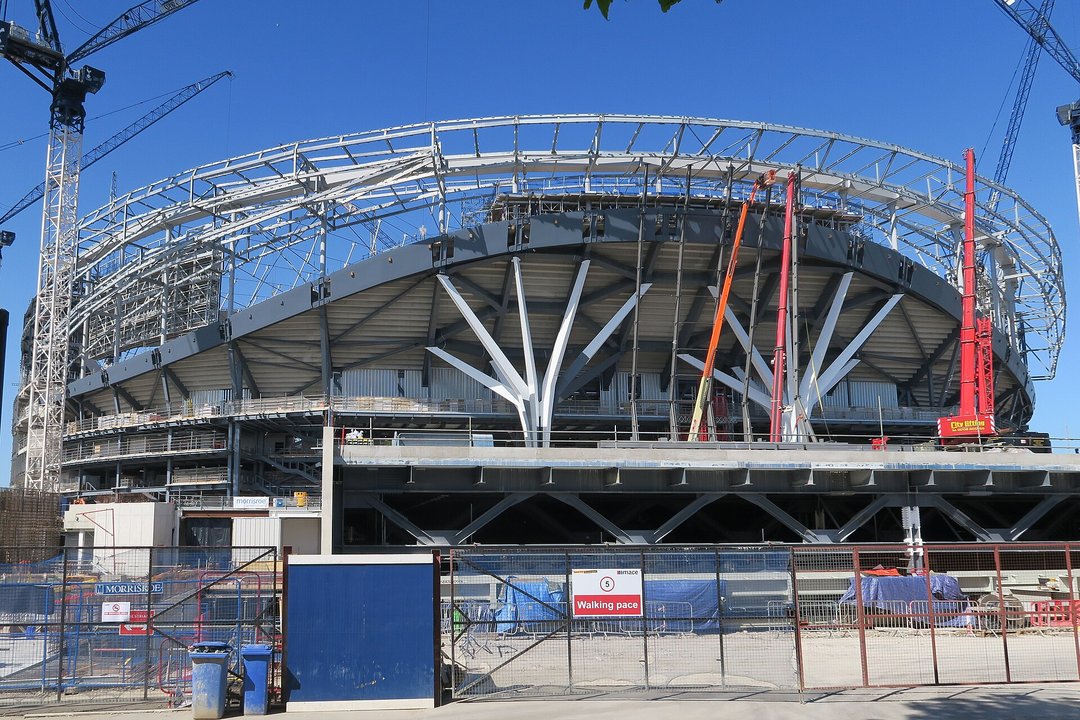
Second image: the stadium under construction seen from Park Lane, photographed on 5 May 2018 by the contributor Hzh, Creative Commons Attribution-ShareAlike 4.0, via Wikimedia Commons. It was opened and examined. It shows the roof steelwork and the upper bowl incomplete, tower cranes still standing, and in the foreground the south podium, beneath which the retractable pitch is stored; the photographer's own description on Commons identifies that structure. The picture was taken three months before the club announced that the building would miss its opening.

changes?
delete this memory?
We detected that you have a Blox in your crypto wallet! We will import the Blox into your account.
Click on done below to complete the import.
Welcome Back!
Sign in to preserve cherished moments
Don't have an account?
Welcome!!
Sign up and start preserving cherished moments
?
?


Choose your payment method
Buy with Metablox Credit
Do you want to mint Blox with Metablox Credit?
Which Crypto would you like to use?
Purchase Confirmed!
Your Blox is being minted on-chain and will appear in your profile shortly.
Log in or sign up to claim your Blox.
How many credits do you want to buy?
$100 USD = 1 Metablox Credit = 1 Blox.
Use Metablox Credit to mint any Blox you want on the map.
 expand_more