NFL History | Wembley Stadium, London — The Year the League Stopped Growing the Game and Started Selling It
volume_up
Listen
directions
Directions
On 28 October 2007 the New York Giants beat the Miami Dolphins 13–10 here, in front of 81,176 people and in steady rain, on a pitch that had been chewed to mud by the fourth quarter. It was the first regular-season National Football League game played outside North America — a narrower claim than it sounds, and the right one: Mexico City had already taken the first outside the United States two years earlier (memory 7099).
The football was dreadful and everyone said so. The two sides managed 483 yards between them and 168 of those through the air; Eli Manning threw for 59 yards and scored the only touchdown with his legs; Brandon Jacobs ran for 131. Miami's kicker, after an onside kick went out of bounds, said the field was like ice. The Giants knelt out the last three plays and were booed by a crowd that had wanted more. Those Giants went on to win the Super Bowl; those Dolphins won one game all season.
Here is the mechanism, and it is a decision taken four months earlier rather than anything that happened on the field. **On 29 June 2007 the league shut down NFL Europa** after fifteen seasons and announced that its international strategy would instead be built on staging regular-season games abroad. The developmental model — clubs in German cities, a competition of its own, a slow cultivation of local players and local support — was abandoned, and the export model replaced it. World Bowl XV had been played in Frankfurt that June in front of 48,125 people. Four months later, 81,176 paid to stand in the rain in north-west London and watch two American clubs play badly.
The league had concluded that what an overseas audience wanted was not a league of its own but the genuine article, shipped in. That is a judgement about product rather than development, and everything since has followed it.
What the mud exposed was the same problem this collection keeps returning to: abroad, the league is a tenant and a tenant does not control the surface. The answer took twelve years and somebody else's money. Under a partnership agreed in 2015, Tottenham Hotspur built a stadium whose grass pitch sits in three steel trays of more than 3,000 tonnes each and retracts under the south stand in about twenty-five minutes, revealing a synthetic American football field laid 1.6 metres below. It opened in 2019, and its architects and the club describe it as the first purpose-built NFL venue outside the United States. The deal guarantees a minimum of two games a year and has been extended through the 2029 season, with the ground given formal status as the league's home in Britain.
So the arc that starts in this stadium's mud ends with a Premier League club constructing a second, hidden pitch to specification. The league did not solve its tenancy problem by buying a building. It found a landlord willing to build one, and the landlord's chairman was explicit that recurring revenue to reinvest in his own football club was the point.
Wembley did not lose the games. It has continued to stage them alongside Tottenham, and the two grounds have shared London fixtures since 2019.
Coordinate: 51.555556, -0.279444, from Wikidata's P625 for the stadium. OpenStreetMap's entry gives 51.556070, -0.279603, about 57 m away, and the two are independently maintained. A second OSM record for an access way carries the same name and sits some 400 m south-west; it is not the bowl. Precision ±150 m.
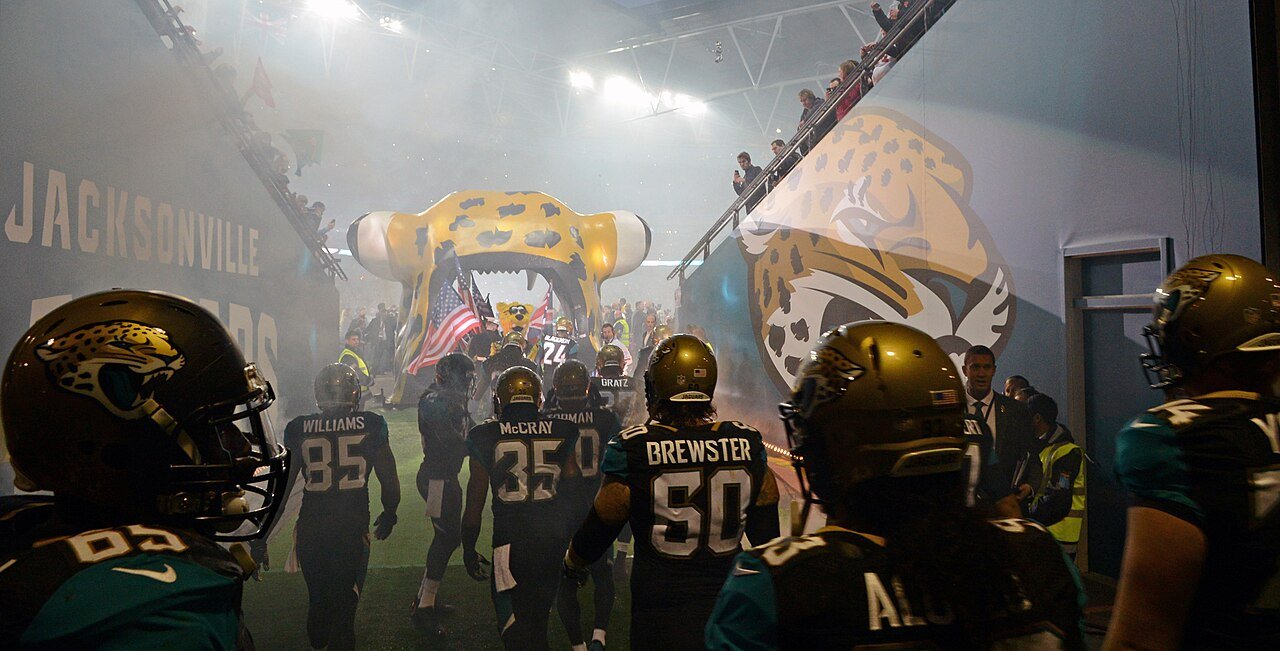
Cover: the Jacksonville Jaguars coming out of the tunnel at Wembley, photographed by Senior Airman Christine Griffiths, United States Air Force, public domain via Wikimedia Commons. This is **27 October 2013**, not the 2007 game described above — no free photograph of that afternoon was found — and it is used because it shows what a London fixture became: an inflatable club mascot head, a smoke machine and a full house, six years after the mud.
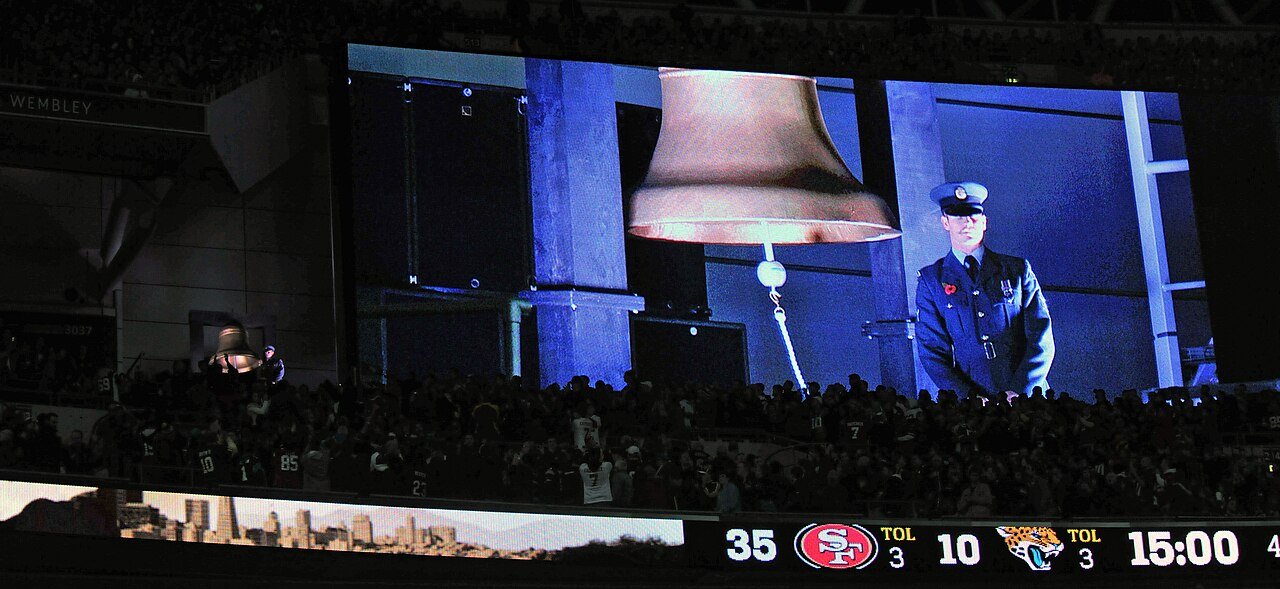
Second image: the Wembley video screen during the same 2013 fixture, showing a Royal Air Force airman ringing the bell, with the scoreboard reading 49ers 35, Jaguars 10. Same photographer, same public domain source. It is a photograph of a screen rather than of the field, and it is here for what it records about the hybrid the London games became.






 expand_more