


NFL History | Croke Park, Dublin — The Famous Vote Was Not the One That Let the Game In
· 2025-9
Personal memoryBy kevin · · updated · Report an issue






















































Find memories left by people near you.
Distribute Bounty
This will distribute the bounty equally among all qualifying memories. This action cannot be undone.
Cancel Bounty
Are you sure you want to cancel this bounty? The remaining amount will be refunded to your account.
Success!
Operation completed successfully.
Error
Something went wrong.
NFL History | Croke Park, Dublin — The Famous Vote Was Not the One That Let the Game In
kevin
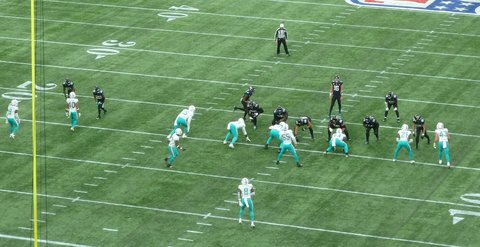
On Sunday 28 September 2025 the Pittsburgh Steelers beat the Minnesota Vikings twenty-four to twenty-one at Croke Park in Dublin, before an announced crowd of 74,512. The league's own account calls it the first regular-season fixture played in Ireland, and the figure is corroborated in Irish reporting of the government spending that helped bring it. What makes the game worth pinning is not the result. It is that the ground belonged to an organisation whose written rules had for most of a century excluded exactly this, and that the rule change everybody credits for opening Croke Park is not the rule the game was actually played under.
Two prohibitions, and only one of them is famous.
The Gaelic Athletic Association's Rule 27, generally called the Ban, dated from 1905 and prohibited members of the Association from playing or attending soccer, rugby, cricket and hockey. The GAA's own account of the rule is careful on one point: the word foreign never appeared in it, and the sports were simply named. It was deleted at the Annual Congress hosted by Queen's University Belfast at Easter 1971. The Association's account of that day is that there was scarcely a debate, because a plebiscite of clubs had already left a majority of county boards mandated to vote for deletion, and Rules 28 and 29, which had provided for vigilance committees and for a prohibition on non-Irish dancing in GAA halls, went with it.
That rule governed people. A different rule governed ground, and it survived. Rule 42, since renumbered 5.1, provided that property owned or controlled by units of the Association was to be used only for the games the Association controls and for such other purposes, accordant with its aims, as the Central Council might sanction. Removing the Ban in 1971 did not touch it. It stood for another thirty-four years, which is the single most misunderstood fact in this story: a member of the GAA was free to attend a rugby international from 1971 onward, and the rugby international still could not be held on the Association's ground.
The reason the ground was treated differently from the sport is not commercial, and an entry about a professional football fixture cannot honestly skip it. The GAA's own Bloody Sunday record states that on 21 November 1920, during a Dublin against Tipperary football match, more than a dozen trucks carrying RIC, Black and Tans and Auxiliary police arrived at the ground, that firing began from the canal bridge at 15.26, that it lasted about ninety seconds, and that fourteen people were killed. Among them were William Robinson, aged eleven, and Michael Hogan, a Tipperary player. The Dictionary of Irish Biography records Hogan as born on 27 October 1896 at Grangemockler, twenty-four years old that afternoon, shot while crawling for cover after the firing began, and states that the Association commemorated him by naming the main stand at Croke Park after him; the entry does not date the naming. The 2025 game was played in front of that stand. A rule reserving this particular ground to its own members' games was not only about competition for spectators.
The famous vote came on 16 April 2005, at the GAA's Annual Congress. Seán Kelly, then the Association's president, records the result as 227 in favour and 97 against, and states in a later interview that it passed by the necessary two-thirds majority. Working from those two figures: 324 votes were cast, two-thirds of which is 216, so the motion carried with eleven votes to spare, at 70.1 per cent. That arithmetic is this entry's own.
What the 2005 motion actually did is narrower than its reputation, and the GAA's own summary is the plainest statement of it: Congress voted to allow the use of Croke Park on a temporary basis by the Ireland national rugby team and the Republic of Ireland soccer team while Lansdowne Road was being redeveloped. Two named national teams, one sport each, for as long as a building four kilometres away was a construction site. The Irish Times has reported that the change was deliberately confined to Croke Park alone, because those promoting it believed delegates would reject anything broader. Nothing in that motion reaches an American professional league twenty years later.
The rule that does reach it was passed five years afterwards and is almost never named. The Association's policy document Use of GAA Property 2019, approved by Ard Chomhairle on 23 March 2019, sets out the sequence in its own words. In 2010 Congress voted to allow Central Council to consider applications for the use of Croke Park only, by other sports, on a case-by-case basis. In 2012 it extended the same discretion to Croke Park and other grounds for a Rugby World Cup, should the 2023 or 2027 tournaments be staged in Ireland. In 2018 it did so for GAA grounds outside Ireland. In 2019 it did so for county grounds, a change carried at Congress in Wexford on 23 February 2019 as Motion 19, with 91 per cent support according to the Irish Times.
So the 2005 vote is the one with the anniversary articles and the placards, and the 2010 vote is the one the Steelers and the Vikings played under: not a temporary suspension for two named teams, but a standing, permanent, case-by-case power vested in the Central Council over one building. The current rule text in that same document keeps the general prohibition in 5.1(a) and gives Central Council authority in 5.1(b) to permit other activities in exceptional circumstances, in accordance with policy the Council itself adopts. This entry did not locate a published Central Council minute sanctioning the 2025 fixture specifically, and does not assert that it has seen one; what it can show is which clause the sanction would have had to come from, and when that clause was written.
Fitting a gridiron into the building cost it seats, and the seats it cost are the point. The stadium operator's own website gives the capacity as 82,300 in its text and 83,200 in the page's own summary description, so the two figures are published side by side by the same body; OpenStreetMap's tag for the stadium carries 82,300. The Irish Examiner reported before the game that capacity would come down to roughly 76,000, for two reasons: Hill 16, the standing terrace at the railway end, had to be converted to seating, and the crowded sidelines an NFL fixture requires interfere with sightlines. The announced attendance of 74,512 sits below even that reduced figure.
The terrace that had to be seated over carries a disputed name, and both versions are in wide circulation. RTÉ's Century Ireland project records that the mound was built during the ground's redevelopment between December 1913 and late 1915, and that it became known as Hill 60 around the time of the 1915 finals, after the Gallipoli battle then filling Dublin newspapers and soldiers' letters home. At a Central Council meeting in September 1931 Dan McCarthy objected to a name drawn from a battle fought in a foreign country by a foreign army, proposed Hill 16 instead, and the Association adopted it. The far more commonly told story, that the mound was raised from rubble carted from the 1916 Rising, is contradicted by that chronology, since the mound was finished the year before the Rising; Century Ireland traces the rubble story to letters and speeches of the late 1930s that hardened into fact through repetition. The dates are the reason to prefer the first account, and the second is repeated often enough that saying so is worth the sentence.
Money has been attached to every one of these exceptions, which is the least sentimental way to read the sequence. The Irish Times has put the GAA's rental income from rugby and soccer at Croke Park between 2007 and 2010 at roughly 37 million euro. For the 2025 fixture the Irish Examiner reported close to 10 million euro from the State and from Dublin city, covering a licence fee, security, transport and associated venue costs. On 23 February 2026 the sports minister, Patrick O'Donovan, said the decision had been vindicated, citing a total economic value of 104.5 million euro, of which 76.8 million was direct spending and 27.7 million indirect and induced, a return of 2.24 euro in tax receipts for every euro invested, 37 per cent of the crowd travelling from the United States, and 9.2 million American television viewers. Those are a government's figures for its own spending decision, reported here as such and not adopted.
Status as read on 7 September 2026. There is no Dublin fixture on the league's 2026 international schedule, which runs to nine games across Australia, Brazil, the United Kingdom, France, Spain, Germany and Mexico, with Pittsburgh instead playing New Orleans at the Stade de France on 25 October. In February 2026 Croke Park's stadium director, Peter McKenna, told the Irish Times that conversations with the league were positive and that he expected a return in 2027, and Irish government officials said separately that funding had not been the reason for the absence. Nothing beyond that was confirmed at the time of writing, and a reader arriving later should check whether a Dublin date has been scheduled.
Set against what this platform already holds, the overseas entries all turn on the same weakness: abroad the league is a tenant, and a tenant does not control the surface it plays on or the date it is given. Dublin is a different relation and worth distinguishing. The landlord here was not a stadium company or a national federation that wanted the business. It was an amateur association whose own constitution excluded the tenant by category, on a ground it holds for reasons that are not about sport at all, and admission had to be voted through by that association's own delegates. They did it twice, five years apart, and the vote that is remembered is not the vote that counted.
Coordinate. The pin is at 53.360426 north, 6.251145 west, with a precision radius of 60 metres, and it is placed at the centre of the playing field rather than at a gate. The primary value was computed here as the polygon centroid of OpenStreetMap way 564099741, the stadium footprint, from the coordinates of its 59 constituent nodes retrieved from the OpenStreetMap raw API; that way is tagged as a stadium operated by the GAA with a capacity of 82,300 and a start date of 1913. Two further readings were taken and both are reported rather than averaged in. Wikidata's coordinate property for the stadium gives 53.360833, minus 6.251111, which lies 45 metres from the computed centroid; that entity is cross-referenced from the OpenStreetMap way, so it is a consistency check rather than a fully independent source. The independent third reading is the median of photographer-supplied positions on 40 Wikimedia Commons files found by a 250-metre geographic search around the centroid, at 53.360731, minus 6.251930, which lies 62 metres away. All three readings fall inside the stadium's own footprint, whose bounding box spans about 330 metres north to south and 360 metres east to west, and the 60-metre radius is taken from the spread between them rather than from the number of decimal places available.
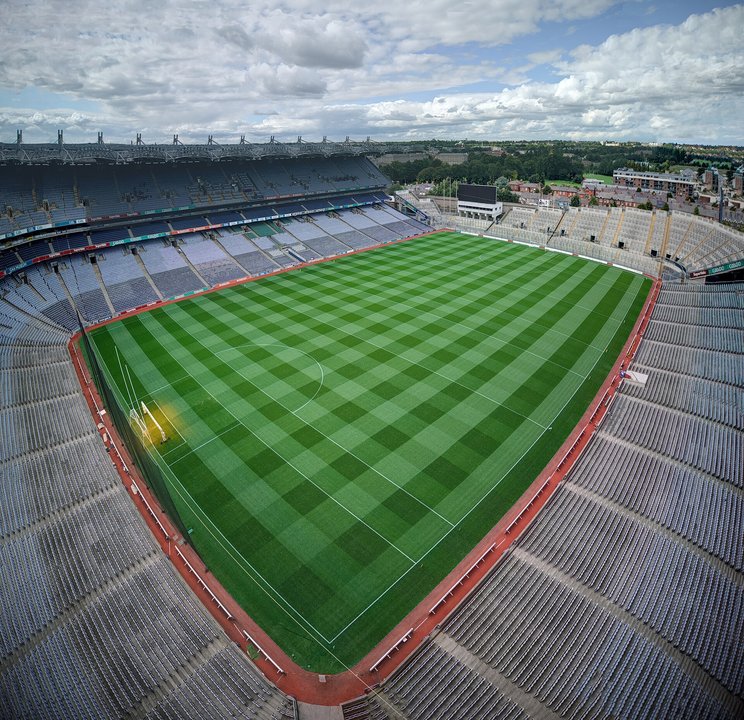
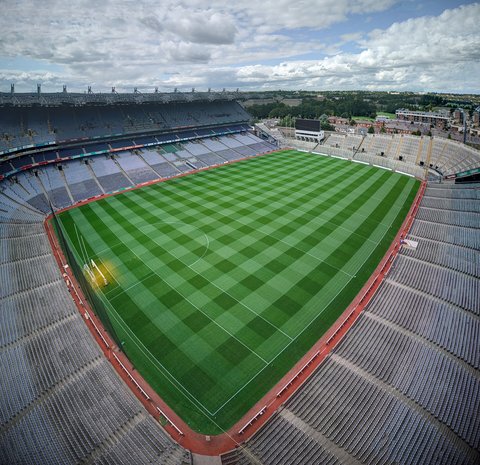
Cover image: Croke Park panorama, photographed by Rob Hurson on 24 August 2014 and released under the Creative Commons Attribution-ShareAlike 2.0 licence via Wikimedia Commons. The file was opened and examined. It is a stitched panorama taken from high in one corner, so the pitch reads as a trapezoid on the page; it is not one, and the distortion is the camera work rather than the ground. What it shows is the argument of this entry in one frame: an enormous rectangular playing surface, which the photographer's own note gives as 144 metres by 86 metres, ringed by a red running surface; three tiers of covered seating around two and a half sides; H-shaped goalposts with nets at the near end, lit by growing lamps; and, along the far side, a shallow open bank of terracing beneath a plain black scoreboard, with the low roofs of Dublin and a wooded ridge beyond. An American football field, at 120 yards by 53 and a third, would occupy well under half that grass.
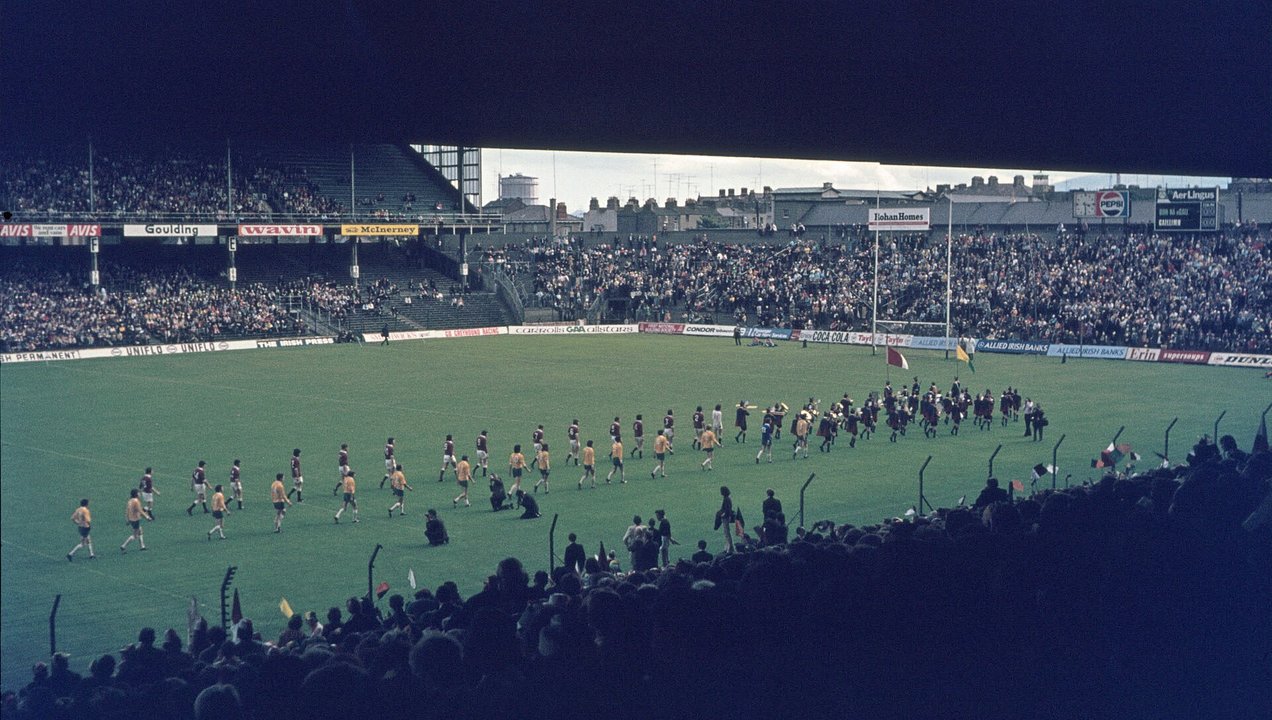
Second image: Croke Park Stadium 1974, photographed by Klaus Liphard on 18 August 1974, contributed through Geograph Britain and Ireland and released under the Creative Commons Attribution-ShareAlike 2.0 licence via Wikimedia Commons. It was opened and examined, and it is offered as the same ground under the rule described above rather than as a picture of anything the memory narrates. Two county teams, one in maroon and one in amber, are parading behind a band across a pitch ringed by hoardings for airlines, banks, newspapers and tyre companies; the stands are low, part-covered and packed to the rails; spectators stand at the perimeter fence in the foreground; and beyond the far terrace there is nothing taller than a Dublin chimney pot. The date is the photographer's own record as filed with the image, and the teams are not identified here because this entry did not verify which match it was.


changes?
delete this memory?
We detected that you have a Blox in your crypto wallet! We will import the Blox into your account.
Click on done below to complete the import.
Welcome Back!
Sign in to preserve cherished moments
Don't have an account?
Welcome!!
Sign up and start preserving cherished moments
?
?






Choose your payment method
Buy with Metablox Credit
Do you want to mint Blox with Metablox Credit?
Which Crypto would you like to use?
Purchase Confirmed!
Your Blox is being minted on-chain and will appear in your profile shortly.
Log in or sign up to claim your Blox.
How many credits do you want to buy?
$100 USD = 1 Metablox Credit = 1 Blox.
Use Metablox Credit to mint any Blox you want on the map.
 expand_more