NFL History | Peace Bridge, Buffalo — The Rule Was Drawn in Miles and Undone at a Border
volume_up
Listen
directions
Directions
On 9 September 1990 the Buffalo Bills beat the Indianapolis Colts 26-10 at Rich Stadium in Orchard Park, and the people who lived nearest the ground could not watch it, because the game was not carried in their own market. Several hundred of them drove here instead and left the country in order to see a home game played about eleven miles behind them.
United Press International reported on 12 September 1990 that league rules barred the televising of a home game within a seventy-five-mile radius of the stadium unless it had sold out seventy-two hours before kickoff. Stadiums of Pro Football records that Rich Stadium's capacity had been raised to 80,290 in 1984. The opener did not sell out in time, and the picture was withheld from the market nearest the stadium.
This plaza, the American end of the Peace Bridge, is about 10.8 miles from the stadium, well inside that radius. Fort Erie, Ontario, at the far end of the bridge, is a ten-minute drive in UPI's description, and it is inside the radius too. What it is not inside is the jurisdiction.
UPI counted about 140 people watching at the Penalty Box restaurant in Fort Erie and about 500 at Don Cherry's Sports Bar. The second number is the one worth keeping, because those five hundred did not see the game either.
The signal decided it, not the border. Noel Dill, manager of Intertech Satellite Inc., told UPI that the game would normally have gone out on the C band, but that this one was carried on the Ku band, which needs receiving equipment most installed dishes did not have. Don Cherry's did not have it. Its manager, Sam Siffledeen, said that many of the five hundred left early, a number of them without paying, and that the bar lost a great deal of money. None of the sources consulted explains why the band was different that weekend, and this memory does not guess.
It is worth being exact about which rule was doing the work, because there were three of them, drawn at different distances by different authorities.
Congress legislated on this once. Public Law 93-107, passed in 1973, barred a league from blacking out a home game that had sold out seventy-two hours before kickoff and was being televised elsewhere under a league contract. The Federal Communications Commission, in the rulemaking that eventually abolished its own rule, records that the statute was a limited experiment, that it expired by its own terms on 31 December 1975, and that it was not renewed.
The Commission adopted its own rule in 1975, codified at 47 C.F.R. 76.67 and later renumbered 76.111. That rule bound cable operators rather than the league, and the zone it protected was generally thirty-five miles around the reference point of the broadcast station's community of license. Thirty-five, not seventy-five.
So the seventy-five miles UPI reported in 1990 was the league's own figure, carried in its contracts with the networks, and it outlived the statute that had briefly constrained it. Memory 6790, at the United States Capitol, is about the two-page 1961 law that let the league sell those contracts jointly in the first place. Memory 9492, at Franklin Field, is about a championship blacked out in Philadelphia in 1960, before any of this was written down. Memory 9558, at the Oakland Coliseum, is about the same habit from the other side: after a network cut away from a game in 1968, the fix was not an apology but contract language requiring the game to be carried to its conclusion. The league does not ask a broadcaster to use its judgement. It writes the obligation down, and then the obligation has a shape on a map.
The federal layer ended on 30 September 2014, when the Commission eliminated the sports blackout rules in MB Docket No. 12-3, FCC 14-141. The order is careful about what it is doing: it removes regulatory reinforcement, and it says leagues remain free to continue private blackout policies by contract. The same rulemaking records that the league had modified its own policy in 2012 to let each club set a threshold anywhere between 85 and 100 per cent of tickets sold. This memory makes no claim about what that policy is today.
The game itself is well recorded. Pro-Football-Reference records Jim Kelly completing 28 of 37 passes for 283 yards, Thurman Thomas scoring on a six-yard run, and Scott Norwood kicking four field goals, the longest from 47 yards. That was the opening afternoon of the season that ended on 27 January 1991 at Tampa Stadium, the subject of memory 9540, where by the New York Giants' own account Norwood attempted a 47-yard field goal in the closing seconds and missed. The same distance, the same kicker, four and a half months apart; the one that went over was the one Buffalo was not shown.
Two other memories sit close to this crossing: 6722, at the War Memorial Stadium site about 2.3 miles east, and 9513, at Rich Stadium itself, where in January 1993 a substitute quarterback brought the club back from thirty-two points down, a recovery whose standing among the largest in the league's history 9513 leaves openly disputed.
No attendance figure appears above. None of the sources consulted supplied one for 9 September 1990, and its absence here is deliberate rather than an oversight.
The coordinate is the American plaza at the eastern end of the bridge, established from two independently maintained sources. The United States Census Bureau's TIGER geocoder returns 42.906140, -78.900523 for 1 Peace Bridge Plaza, Buffalo, New York 14213. The Library of Congress record for Historic American Engineering Record survey NY-550, which documents this bridge, carries 42.90639, -78.90194. The two lie 119 metres apart. A third value on Wikidata, 42.9069, -78.9056, sits about 420 metres west of the Census point; it is referenced to an encyclopaedia article rather than to a survey, and it locates the middle of the crossing rather than its American end, which is a reasonable thing to do with a structure the HAER record measures at 5,800 feet. The precision radius adopted here is 150 metres, wide enough to contain both federal values.
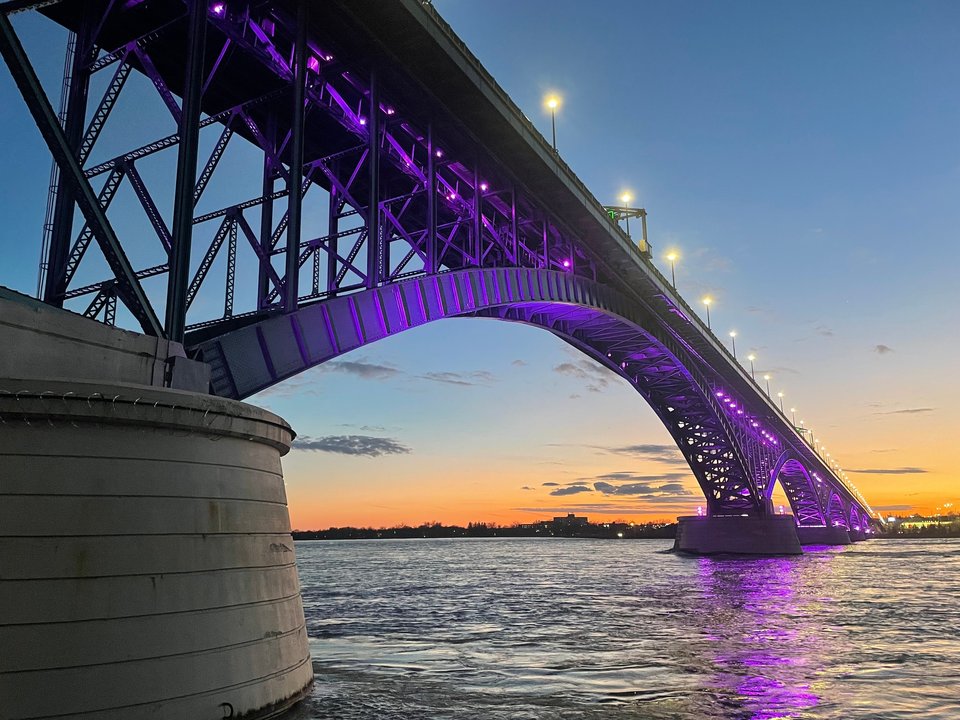
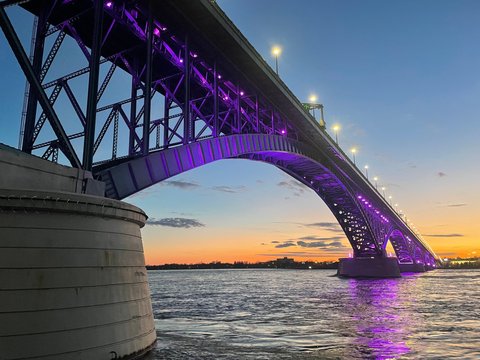
Cover: the Peace Bridge illuminated in purple on 15 April 2024 to mark the Month of the Military Child, photographed by Senior Master Sgt. Andrew Caya, United States Air Force, and released through DVIDS as a work of the United States government. The frame shows the bridge from the shoreline, looking along the spans across the Niagara River. It was made thirty-four years after the game described here, and the lighting has nothing to do with football.
Three photographs of this bridge by Jet Lowe, made in 1992 for HAER NY-550 and in the public domain, are catalogued at the Library of Congress; the first of them looks west-north-west toward Fort Erie, which is the direction the drivers in this memory took. They are not reproduced here because no retrievable file for them could be reached.




































 expand_more