NFL History | First Street Courthouse, Los Angeles — The Verdict That Lasted Five Weeks
volume_up
Listen
directions
Directions
On 27 June 2024 a jury of five men and three women in this building found that the National Football League had violated the Sherman Act in the way it sold Sunday afternoon games to viewers outside the competing clubs' markets. It awarded $4,610,331,671.74 to the residential class and $96,928,272.90 to the commercial class. Trebled under the antitrust laws, that judgment would have been $14,121,779,833.92. Five weeks later it did not exist.
On 1 August 2024 Judge Philip S. Gutierrez granted the league judgment as a matter of law in a sixteen-page ruling. He held that the plaintiffs' two economists, Daniel Rascher and John Zona, should never have reached the jury. Rascher's models of the market as it would have been without the challenged arrangement were built from college football broadcasting, and the court held it was not sound economic method to assume the professional market would have arrived at the same place — the expert needed to explain how out-of-market telecasts would have been available without a separate subscription, and had not. Without that testimony, the ruling concluded, no reasonable jury could have found class-wide injury or calculated damages. Gutierrez added that had he not entered judgment outright he would have vacated the damages and conditionally ordered a new trial, on the ground that the jury's figures looked closer to speculation than to inference drawn from evidence. Commentators noted that none of the models actually presented produced the number the jury reached.
Here is the mechanism, and it is why this memory belongs beside Minneapolis. Liability was never the hard part. The jury found the violation, and Gutierrez did not disturb that finding — he dismantled the proof of what it had cost anyone. In McNeil (memory 6918) a jury found that all eight plaintiffs had suffered antitrust injury and then awarded money to four of them. The pattern across four decades is consistent: against this league, plaintiffs win on liability and lose on damages. The choke point is expert evidence about a market that has never existed, because the counterfactual — clubs selling their own out-of-market rights in competition — has to be modelled rather than observed.
The case exists at all because of the width of a 1961 statute. The Sports Broadcasting Act (memory 6790) exempts the pooled sale of rights to the sponsored telecasting of games, meaning advertiser-supported broadcast, and courts have held it does not reach cable, satellite or streaming. Every game remains free to air in the markets of the two clubs playing, which is the ground the exemption covers. The out-of-market package is sold by subscription, which is the ground it does not. The class ran to more than 2.4 million households and some 48,000 businesses, mostly bars and restaurants, that bought the package on DirecTV between 17 June 2011 and 7 February 2023; it has since moved to YouTube.
The road to that jury was nine years long. The suit was filed in 2015 and dismissed in 2017 by Judge Beverly Reid O'Connell, who held that the package did not reduce the number of games available and that inflated prices alone were not harm to competition. The Ninth Circuit reinstated it two to one in 2019 (933 F.3d 1136), finding the interlocking agreements plausibly pleaded as designed to maintain market power. Gutierrez certified the class on 7 February 2023 and the trial ran in June 2024, with Roger Goodell among those who testified.
Status as of 23 August 2026, and worth checking before anyone relies on it. The plaintiffs appealed, and a Ninth Circuit panel of Holly Thomas, Anthony Johnstone and Joan Lefkow heard argument on 9 March 2026, with Paul Clement appearing for the league. Sportico's account of that hearing has the panel pressing the league on whether the trial judge had taken too much away from the jury. No decision had issued as of this writing. The court can affirm the judgment, reinstate the verdict, or return the case for a new trial confined to damages, and whichever it does, further appeals are likely. No prediction is offered here.
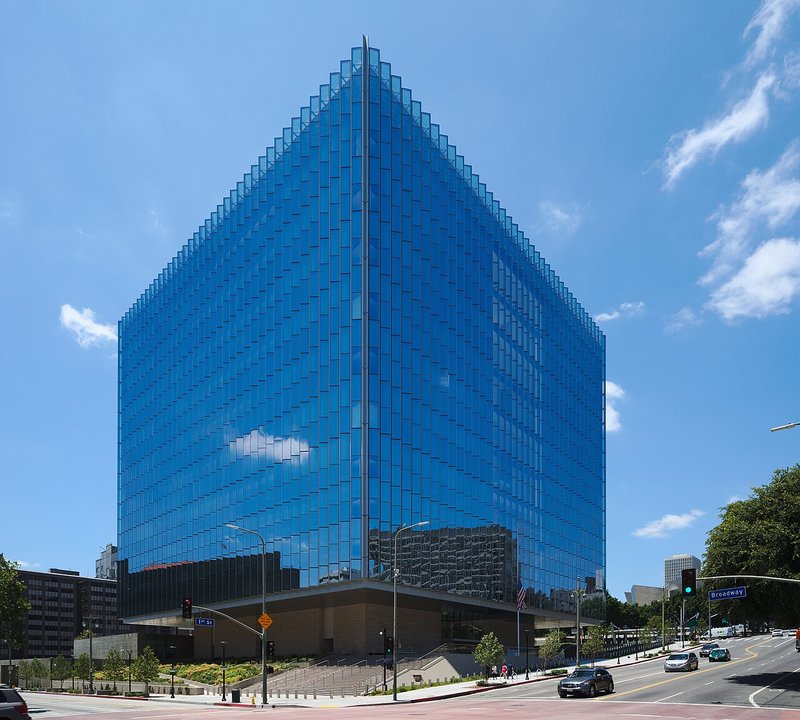
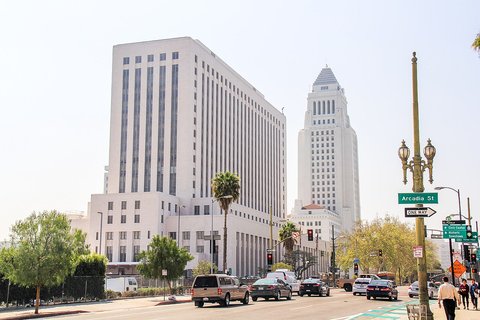
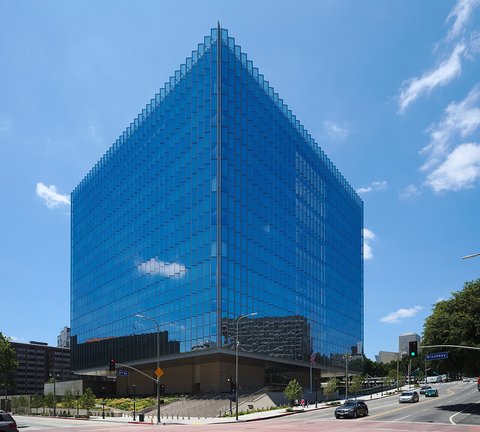
A note on the building, because the league's Los Angeles history now has two courthouses in it. This is the First Street Courthouse, opened in 2016 — the cube of pleated glass at First Street and Broadway. The building where a jury found against the league in the Raiders relocation case in 1982 (memory 6890) stands about half a kilometre north on Spring Street, and served the same Central District of California until the courts moved here. Two juries in the same district, forty-two years apart, found against the same defendant; only one of those verdicts has so far survived the judge.
Coordinate: 34.053519, -118.246517, from OpenStreetMap's entry for the courthouse at 350 West First Street. The Census TIGER address point for the same address falls about 68 m to the north-east, and the two are independently maintained. The GPS attached to the cover photograph is close to both but is a camera position across Broadway rather than the building itself. Precision ±80 m, which covers the block the courthouse occupies.
Cover: the Los Angeles Federal Courthouse seen from the corner of First Street and Broadway, photographed by Daniel L. Lu in May 2017, CC BY-SA 4.0 via Wikimedia Commons. The street signs for First Street and Broadway are visible at the lower edge of the frame, which is what confirms the corner.



 expand_more