NFL History | 110 South Fourth Street, Minneapolis — What the One-Dollar Verdict Was Worth
volume_up
Listen
directions
Directions
On 10 September 1992 a jury in this building found that Plan B, the National Football League's system of restricting veteran free agents, violated section 1 of the Sherman Act. Eight players had sued, their contracts having expired on 1 February 1990. The trial ran thirty-six days across three months. The jury deliberated about fourteen hours over two days and returned a special verdict holding that Plan B did serve competitive balance, but was more restrictive than it needed to be and had a significantly harmful effect on the market for players.
The damages are the second half of the story, and the more instructive half. The jury found that all eight plaintiffs had suffered antitrust injury, then awarded money to only four of them, $543,000 in total before trebling. Freeman McNeil, whose name is on the case, received nothing, as did Don Majkowski, Niko Noga and Tim McDonald. Judge David Doty, who presided, wrote the following year while approving the class settlement that the case had made plain how hard these damages are to prove: the plaintiffs had put substantial evidence behind their claims and most of them still recovered nothing.
Here is the mechanism, and it reaches back six years and about a thousand miles. Before the trial began, Doty held the league collaterally estopped from disputing two findings it had lost to the United States Football League in Manhattan in 1986: that major league professional football in the United States is a relevant market, and that the NFL possessed monopoly power within it (790 F. Supp. 871). The league argued that the USFL jury's award of one dollar had left it no incentive to appeal those findings. The court rejected that — the USFL had been seeking around $1.7 billion in trebled damages, so the incentive to litigate had been ample, and the league had chosen not to appeal. The verdict that paid a dollar (memory 6892) handed the players their market definition. That is what the dollar turned out to be worth.
What followed came quickly. The class action White v. NFL was filed on 21 September 1992, eleven days after the verdict. In Jackson v. National Football League, 802 F. Supp. 226, the court put a group of players onto the open market by injunction, observing that many of the injuries professional footballers allege may simply be impossible to quantify in money — a difficulty the McNeil verdict had just confirmed. A global settlement approved by Doty in 1993 produced the collective bargaining agreement that established unrestricted free agency alongside a salary cap, which is broadly the system the sport still runs on. UPI reported the players' association's Gene Upshaw declaring on the day of the verdict that Plan B was finished and the draft would be next.
The route here ran through a failed strike. The 1987 stoppage ended with nothing conceded (memory 6893), the union decertified in 1989, and the dispute moved into antitrust litigation because that was the forum where the players could actually win. Radovich (memory 6738) is why the door was open at all.
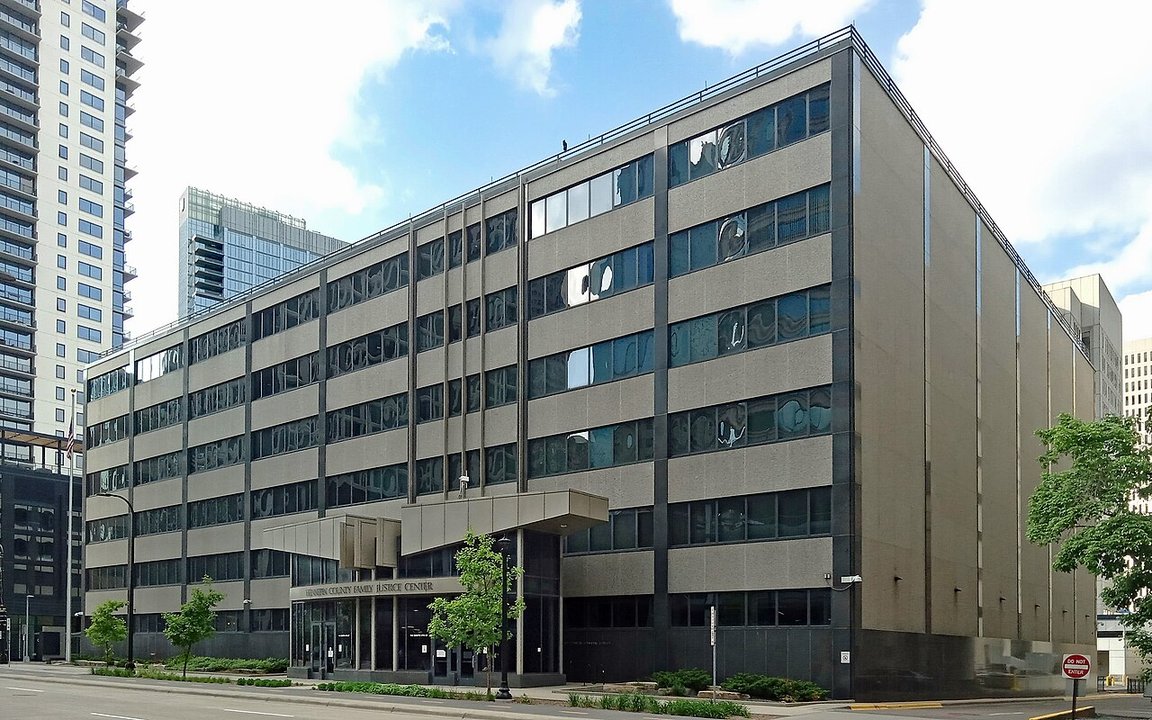
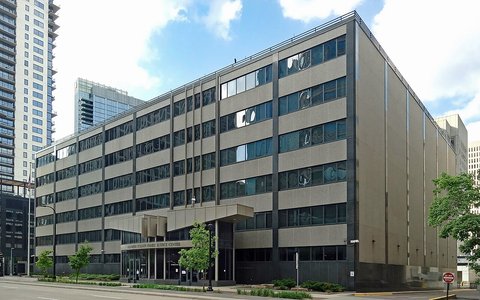
A note on the building. In 1992 this was the Federal Building and United States Courthouse at 110 South Fourth Street, a block-filling government building completed in 1960 and listed by the FBI's own field-office history under that name when its Minneapolis division moved in during 1961. It was the district's Minneapolis home until the Diana E. Murphy United States Courthouse at 300 South Fourth Street opened in 1997, a date the District of Minnesota's own published history confirms. It now holds Hennepin County's Family Justice Center. No source consulted here places the McNeil trial in this building by name, let alone in a numbered courtroom; the identification rests on which building the district occupied in 1992 and is stated as an inference rather than a documented fact.
Coordinate: 44.979177, -93.268213, from the Census TIGER geocoder for 110 South Fourth Street. OpenStreetMap's entry for the Family Justice Center gives 44.979343, -93.267718, about 45 m away, and the two are independently maintained. Precision ±60 m, which covers a building occupying the numbers 100 to 116 on the block.
Cover: the Hennepin County Family Justice Center, photographed by McGhiever in May 2024, CC BY 4.0 via Wikimedia Commons, viewed from the south. The name over the entrance is the county's; the federal courts left in 1997, and nothing on the façade records what was decided inside in 1992.







 expand_more