NFL History | United States Court House, Foley Square — The Monopoly Verdict That Paid One Dollar
volume_up
Listen
directions
Directions
On 29 July 1986, after forty-eight days of trial and a transcript running to nearly seven thousand pages, a six-person jury in the Southern District of New York found that the National Football League had wilfully acquired and maintained monopoly power in professional football, and that this had injured the United States Football League. It then set the damages at one dollar. Trebled under 15 U.S.C. § 15, the judgment came to three.
The USFL had asked for $567 million, which trebled would have been $1.701 billion. The claims it lost were the ones the case had been built on. The jury found no monopolisation or attempted monopolisation of a television submarket, no overt act in furtherance of a conspiracy to monopolise, no conspiracy in restraint of trade, no unreasonable restraint in the league's network contracts, no control of access to the three networks, and no interference with the USFL's spring or autumn television deals. Judge Peter K. Leisure denied the motions for judgment notwithstanding the verdict, and the Second Circuit affirmed on 10 March 1988 in a 105-page opinion (842 F.2d 1335).
The reasoning matters more than the dollar. The USFL had played three spring seasons from 1983 to 1985 and then voted to move to the autumn and meet the established league head-on. As the appellate record describes the jury's view, the USFL had abandoned its original plan of building support slowly while containing costs, and the losses that followed traced to that decision rather than to the defendants' conduct. A jury can find a monopoly and still price the harm at nothing, and that is what it did here.
Set beside the Los Angeles verdict of four years earlier, in which the same defendants paid around $49 million in trebled damages to a stadium commission and a member club, the pairing describes the actual state of the league's antitrust exposure in the 1980s. It was real, it was available to anyone, and it turned entirely on proof of injury. The USFL suspended operations after the verdict and never played another season; its commissioner told UPI the day the appeal was lost that the league had died that day.
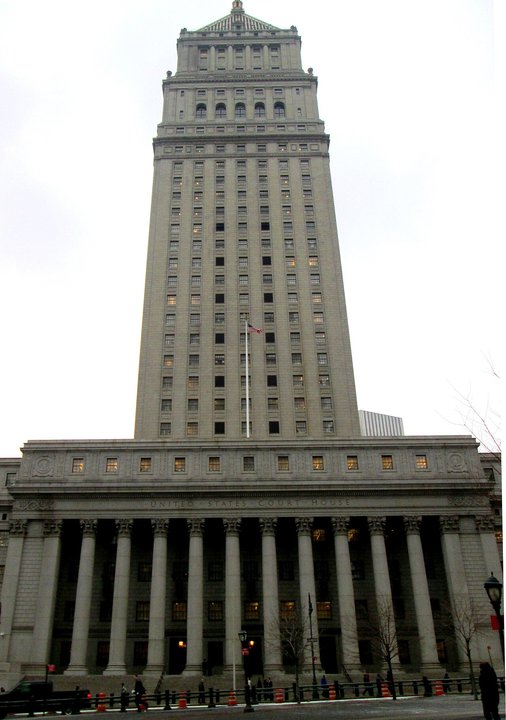
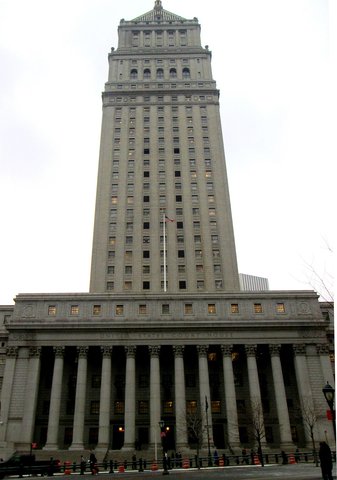
A note on the building. Contemporary reports place the trial in United States District Court in Manhattan, which in 1986 meant this one: Cass Gilbert's tower on Foley Square, completed in the mid-1930s, with UNITED STATES COURT HOUSE still carved across the entablature above the columns. The Daniel Patrick Moynihan courthouse on Pearl Street, which now holds much of the district's work, did not exist until the 1990s. The identification is therefore an inference from what the district occupied at the time, and is stated as one; no source consulted here names the courtroom. The building was later renamed for Thurgood Marshall, who sat here as a Second Circuit judge.
Coordinate: 40.713667, -74.002624, from OpenStreetMap's building entry for 40 Centre Street, agreeing with Wikidata's P625 (40.713611, -74.002778) to about twenty metres. Those two are not fully independent of one another. The Census TIGER address point for 40 Centre Street falls about 135 m north, at the Foley Square end of the frontage rather than on the tower. Precision ±80 m.
Cover: the Thurgood Marshall United States Courthouse at 40 Centre Street, photographed by Beyond My Ken in 2013, CC BY-SA 4.0 via Wikimedia Commons. The carved name above the portico is the one the building carried in 1986.
Related: memory 6738 (Radovich, 1957) established that the league could be sued at all; memory 6790 covers the narrow broadcasting exemption Congress did grant it.



 expand_more