NFL History | United States Court House, Spring Street, Los Angeles — The Jury That Unlocked Relocation
volume_up
Listen
directions
Directions
On 7 May 1982 a six-member jury in the United States District Court for the Central District of California found that the National Football League's Rule 4.3 — the clause requiring the consent of the other clubs before a franchise could move — violated section 1 of the Sherman Act. The plaintiffs were the Los Angeles Memorial Coliseum Commission and the Oakland Raiders. What they won first was not money but an injunction: on 14 June 1982 the court permanently barred the league and its member clubs from interfering with the transfer of the Raiders to the Coliseum. The Raiders played in Los Angeles that autumn.
The league had tried to get the case out of Los Angeles. Its venue motion argued that a jury here would be predisposed toward bringing a second club to the city. Harry Pregerson, a circuit judge sitting by designation, denied the transfer (89 F.R.D. 497) and ran an unusually detailed voir dire instead. An earlier trial in 1981 had ended in a hung jury and a mistrial; the second was conducted under strict limits on trial time. Among counsel for the league was Paul Tagliabue of Covington and Burling, who became its commissioner seven years later.
The damages phase finished in May 1983. The jury awarded the Raiders $11.55 million and the Coliseum $4.86 million, and the court trebled both under 15 U.S.C. § 15 — around $49 million in all, as the Washington Post reported. The Ninth Circuit affirmed liability on 28 February 1984 (726 F.2d 1381); in 1986 it affirmed the Coliseum's trebled award, vacated the Raiders' and remanded it, and reversed the judgment on the implied covenant of good faith outright (791 F.2d 1356). The league settled with the Raiders in March 1989 for $18 million.
The mechanism is narrower than the folklore around it. The court did not hold that a league may never say where its clubs play. It applied the rule of reason, found that this restraint failed on this record, and observed that a league which finds the law inadequate should look to Congress rather than to the courts. What changed was the price of a no vote. After 1982 an owners' meeting that blocked a move was a decision carrying antitrust exposure, and the decade that followed — Baltimore in 1984, St Louis in 1988, Cleveland in 1995 — was played out in a league that had learned to bargain over relocation rather than forbid it.
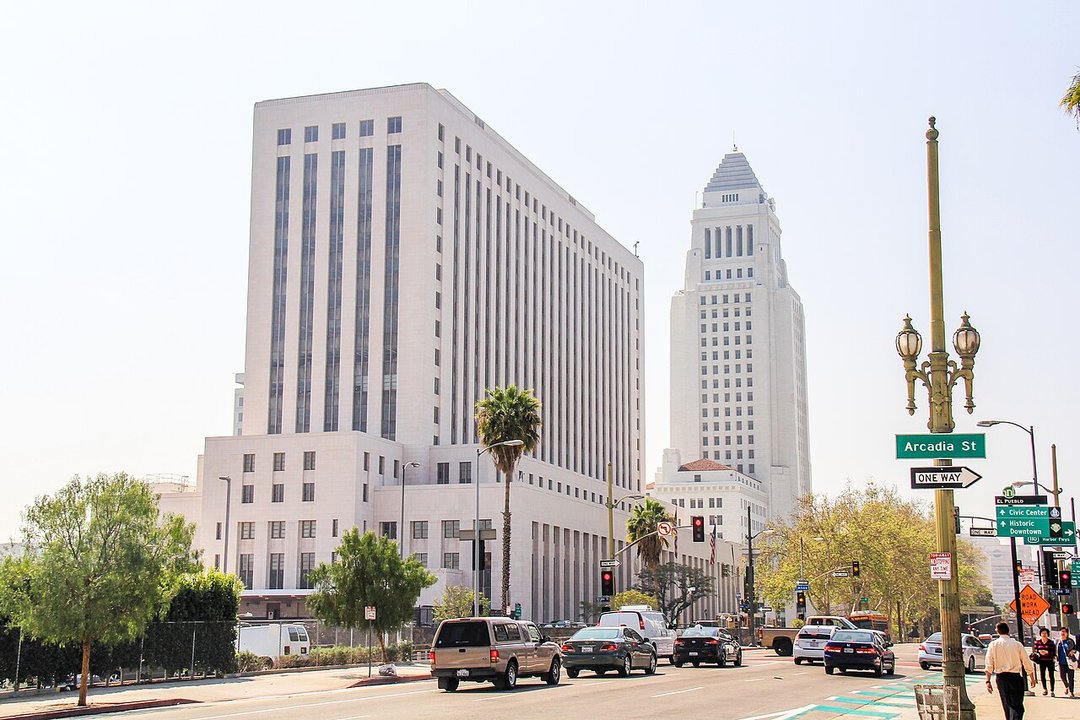
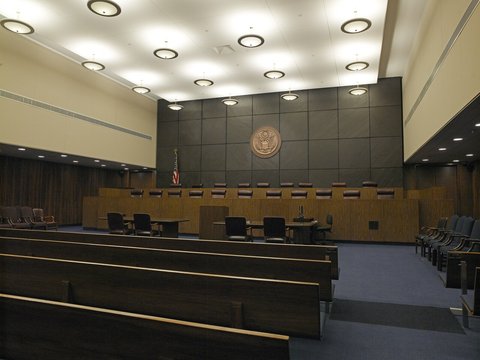
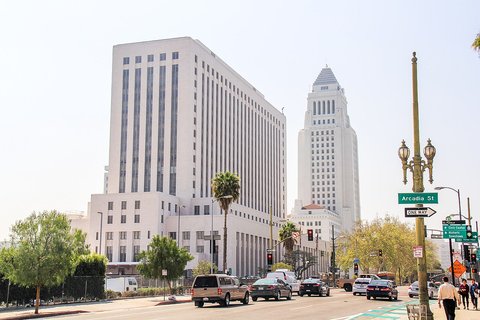
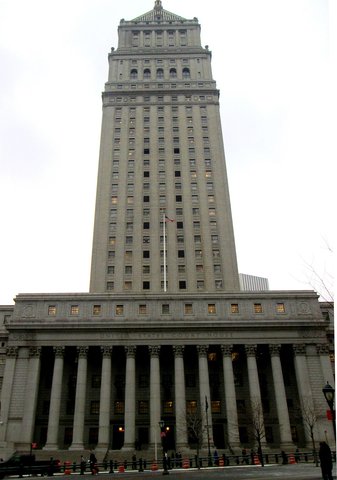
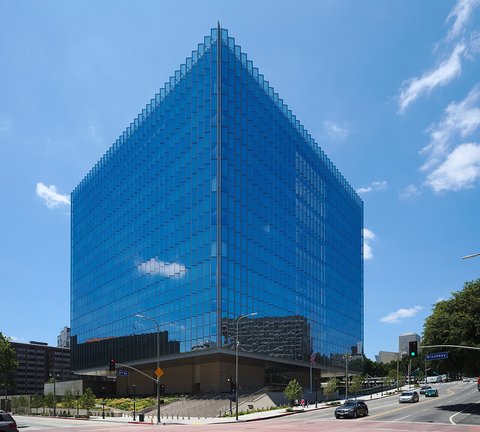
A note on the building. The trial was held in Los Angeles in the Central District of California, and the district's Los Angeles courthouse was then the United States Court House at 312 North Spring Street, a Public Works Administration building of 1937–40 by Gilbert Stanley Underwood and Louis A. Simon which served the federal judiciary until the courts moved to First Street in 2016. That occupancy is documented by the district court's own historical pages and by the Los Angeles Almanac. No source consulted here names the courtroom, so the identification of the building is an inference from the district's occupancy rather than a documented fact, and is stated as one. The building is today the Los Angeles Superior Court's Spring Street Courthouse; its 2012 National Historic Landmark designation rests on Mendez v. Westminster, not on football.
Coordinate: 34.055043, -118.242404, from the Census TIGER geocoder for 312 North Spring Street. Wikidata's P625 for the building gives 34.055, -118.241 to three decimals, and the GPS attached to Commons photographs of the façade falls within about ten metres of the TIGER point. Precision ±50 m, roughly half the block the building occupies.
Cover: U.S. Court House and Post Office, 312 N. Spring St., Downtown Los Angeles, photographed by MikeJiroch in 2014, CC BY-SA 3.0 via Wikimedia Commons. The view is from the north along Spring Street; the stepped tower behind the courthouse is Los Angeles City Hall and not part of it.
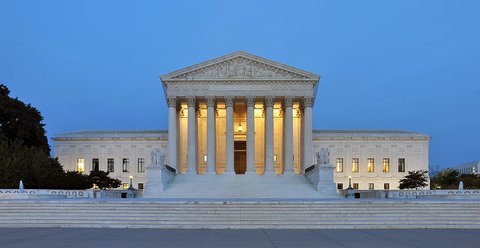
Related: memory 6738, the Supreme Court in Radovich (1957), is the decision that left football open to suits like this one.



 expand_more