Tennis History | Melbourne Park — the Australian Open reached equal prize money twice, 2001
volume_up
Listen
directions
Directions
The usual sentence is that the four major championships arrived at equal prize money thirty-four years apart, the US Open first in 1973 and Wimbledon last in 2007. That is true, and it conceals the more interesting case.
The Australian Open had equal prize money in 1984. It was the second of the four to get there, and it did so at Kooyong Lawn Tennis Club, on grass, four years before Melbourne Park existed. Then it lost it. The United States Tennis Association's own published timeline of the four tournaments dates the reversion to 1996; ESPN's account of the same history says only that a gap favouring the men had returned by the middle of the 1990s. The two sources are not identical and neither is obviously better, so both are given here. They agree on the outcome: equality was restored in 2001, by which time the tournament had been at Melbourne Park for thirteen years and was played on Rebound Ace rather than grass.
A tournament can therefore have parity and then not have it. That is the part the tidy version leaves out, and it is the reason the Australian Open is the most useful of the four to look at.
The argument made in the interval was the same everywhere. John Curry, chairman of the All England Club, said in 1999 that seventy per cent of people put the men's singles first among the things they wanted to watch. The other argument was that the women did not play best-of-five sets and so were not offering the same product. Both were made at all four tournaments, and both lost at all four. Tim Phillips, Curry's successor, announced Wimbledon's change on 22 February 2007. Wimbledon was the last.
The other two are worth stating precisely, because "equal prize money" has meant two different things. The US Open in 1973 paid its two singles champions $25,000 each — John Newcombe and Margaret Court — and left the rest of the draw unequal; the women's champion had received $10,000 the previous year. Roland-Garros equalised its two singles champions in 2006 and the whole draw in 2007. Wimbledon went to the whole draw at once.
A note on the phrase: "Grand Slam" is used here in the sense of the four major championships, not in the other sense of winning all four in one calendar year.
**Where this is pinned.** Melbourne Park, on the Yarra at Melbourne, Victoria.
Two independent sources. Wikidata gives -37.822669, 144.980050 for the complex; the OpenStreetMap sports-centre polygon centres on -37.821361, 144.979088. They are about 170 m apart, which is far enough to read as two separate placements rather than one copied from the other. The pin is set between them at -37.822015, 144.979569, with a precision radius of 400 m. That radius is honest for a precinct rather than a building: this pin is the grounds, not a particular court. The trophy presentations at which this prize money is handed over take place in Rod Laver Arena, roughly 100 m north-west of the pin.
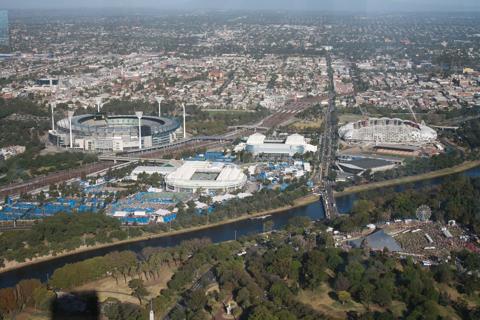
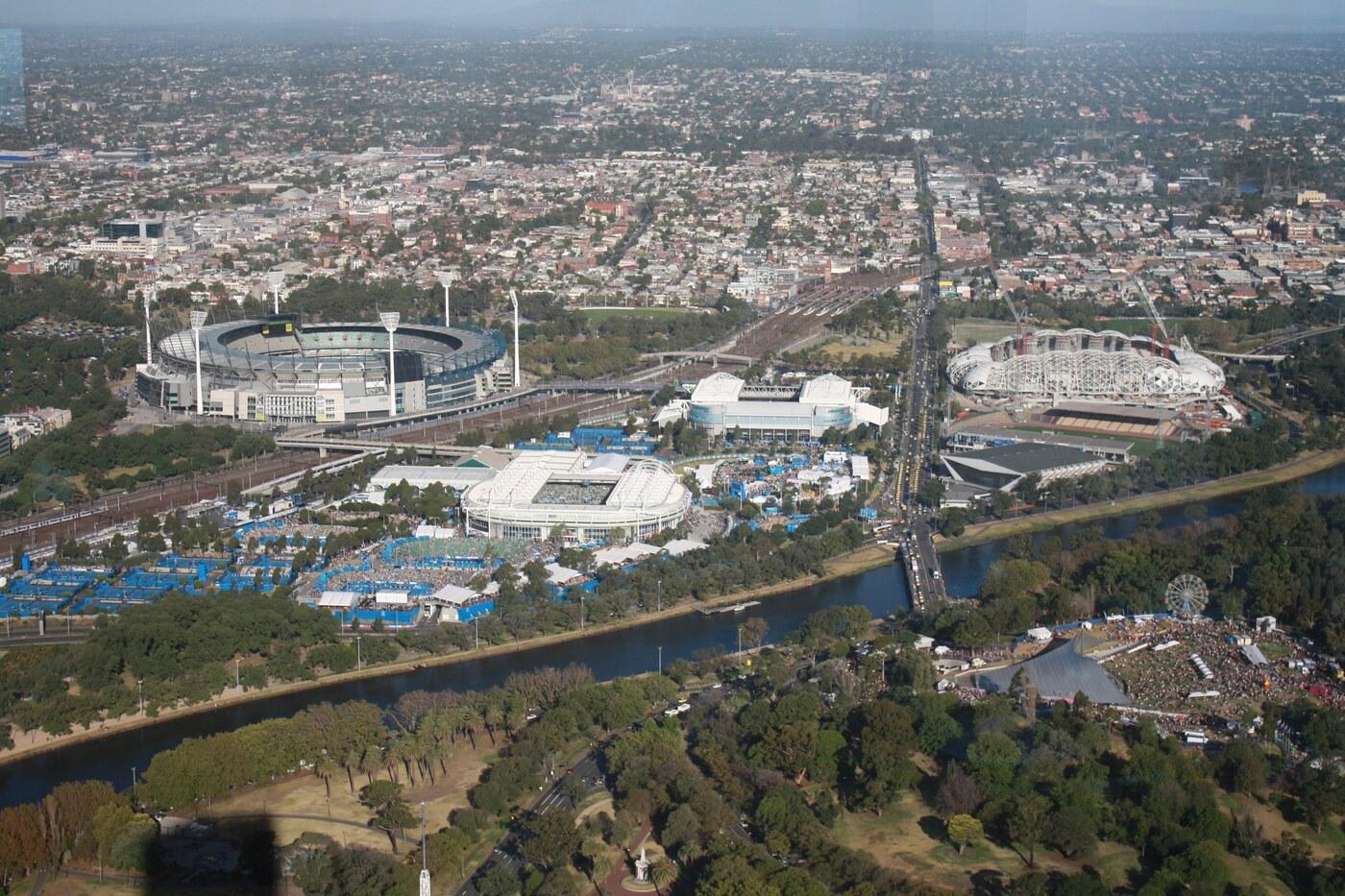
**Cover image.** The Melbourne sports precinct from the air, 23 January 2010, by the Flickr user annieb, CC BY-SA 2.0, via Wikimedia Commons.
It is not a photograph of 2001; it is nine years later, and it is included because it shows the whole precinct rather than an interior. Rod Laver Arena is the roofed arena at centre left with crowds banked around it, the blue outside courts are an Australian Open in progress, the Melbourne Cricket Ground is the oval at upper left, and the steel shell under construction at upper right is AAMI Park, which is what dates the picture. Kooyong, where the tournament first paid equally in 1984, lies about 4.8 km east-south-east of this pin, at Talbot Crescent in Toorak, and is outside the frame.
Photo: annieb, CC BY-SA 2.0, via Wikimedia Commons. Source: https://commons.wikimedia.org/wiki/File:Melbourne_Park_-_Tennis.jpg

































 expand_more