NFL History | Jeppesen Stadium, Houston — A School District's Field, a League's First Title
volume_up
Listen
directions
Directions
The first American Football League championship was won on a field the Houston public school system had built so its high schools had somewhere to play, and which banned Black players from its turf.
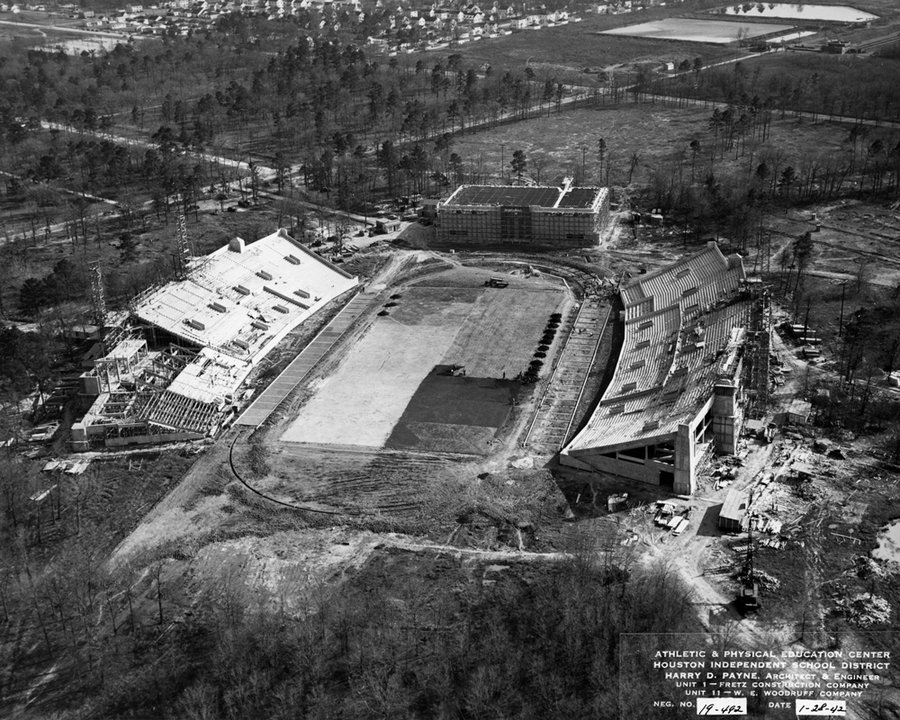
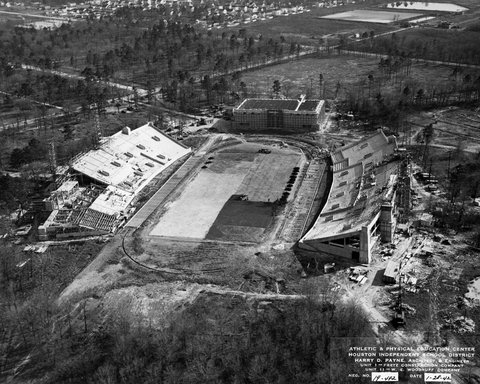
The stadium went up as Houston Public School Stadium, a joint project of the Houston Independent School District and the Works Progress Administration, with Harry D. Payne as architect and engineer. Construction photographs run from May 1941 to January 1942; accounts date its opening to 1941 or 1942 and put its original capacity at either 14,500 or 20,500. It served as the home ground for every high school in the city.
It was renamed Jeppesen Stadium in 1958. Two years later Bud Adams leased it from the school district for the Houston Oilers, a charter club of the new American Football League, and paid to expand it to roughly 36,000 seats. The school district kept using it, reportedly for around ten games a week.
On 1 January 1961 the Oilers beat the Los Angeles Chargers 24–16 here, before 32,183 people, to become the AFL's first champions. George Blanda threw an 88-yard touchdown to Billy Cannon, the Heisman winner the Oilers had signed away from the NFL, which was the entire point of the exercise: a new league proving it could take players the old one wanted.
Two Decembers later the ground held the strangest game the league ever produced. On 23 December 1962 the Dallas Texans beat the Oilers 20–17 after two overtime periods, before 37,981, the largest crowd the stadium ever took. It was the only overtime game in the AFL's ten-year existence and professional football's first double-overtime game.
Now the landlord. In 1957 the school district adopted a policy barring Black players from this field. When Adams leased the ground three years later he leased that policy with it. Black spectators were seated in the end zones, the worst seats in any football stadium, whenever white spectators were present. The Houston Informer and the Houston Forward Times, the city's Black newspapers, criticised Adams both for the few Black players on his roster and for refusing to desegregate the seating.
During the 1961 season the local NAACP picketed outside Oilers games here, as part of a national campaign against segregation in sport, and formally asked the Oakland Raiders to refuse to play Houston unless the venue changed or the ban was rescinded. The historian Frank Andre Guridy has documented the campaign; the Rice University research institute that summarises his work notes that the Oilers, rather than the stadium's owners, were the activists' main target.
The pattern is the one already visible at the Los Angeles Memorial Coliseum in 1946. When a football club rents from a public body, the public body's policies become the club's policies, and the lease becomes the place where they can be contested.
There is a coda. In January 1965 twenty-one Black AFL players refused to play the league's All-Star Game in New Orleans over the treatment they met there. The league moved the game. It moved it to this stadium, on 16 January 1965, four years after the picket lines outside it.
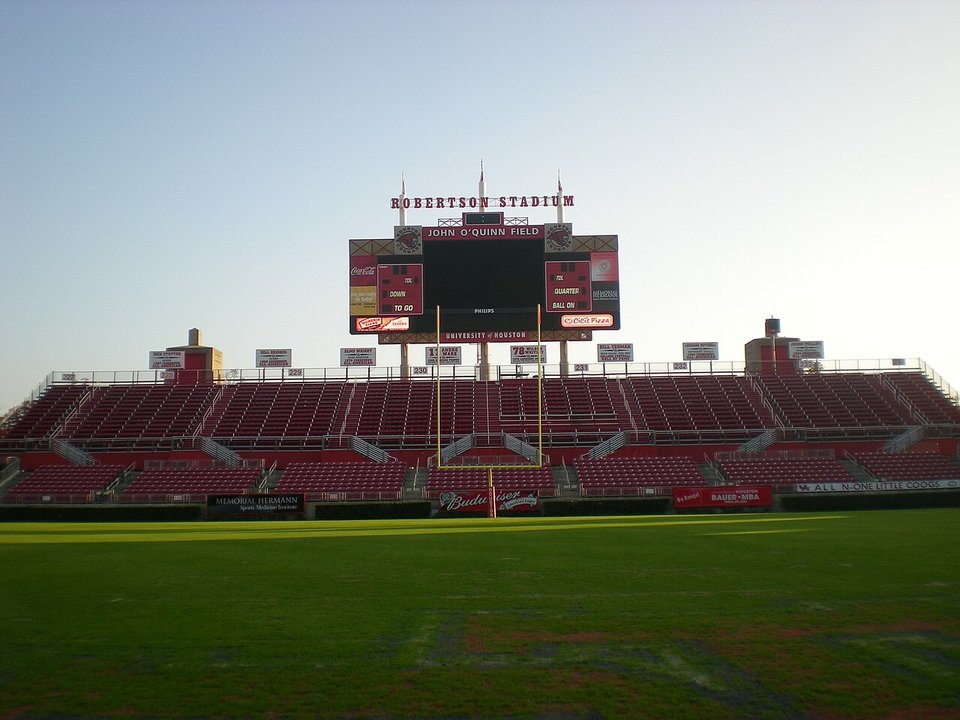
The Oilers left for Rice Stadium in 1964 and for the Astrodome in 1968, becoming the first professional football team to play in a domed stadium. The ground was renamed for Corbin J. Robertson in 1980, demolished in 2012, and replaced on the same site by the university's current stadium.
Coordinate: 29.721899, -95.349312, the value carried on Commons photographs of the stadium bowl by two separate contributors, corroborated by two further photograph-level values about 65 m south. The United States Census geocoder places the site's mailing address roughly 350 m north-west; that is a mailing-address artifact rather than a contradiction, since every photograph of the stadium itself tags the southern point. OpenStreetMap has no node for the current building and Wikidata carries no coordinate. Precision ±120 m.
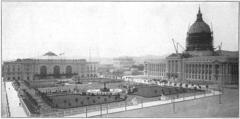
Cover: the stadium under construction on 28 January 1942, captioned in the negative as the Athletic and Physical Education Center of the Houston Independent School District. Photograph by Elwood M. Payne of Paralta Studios for the Fretz Construction Company; Harry D. Payne, architect and engineer. Attribution licence, via Wikimedia Commons.
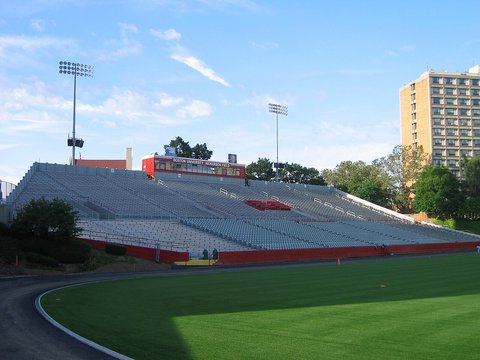
Second image: the south end zone of the stadium in its final years as Robertson Stadium. CC BY-SA 3.0, via Wikimedia Commons.



































 expand_more