NFL History | War Memorial Stadium, Buffalo — Two Gates and a Drained Reservoir
volume_up
Listen
directions
Directions
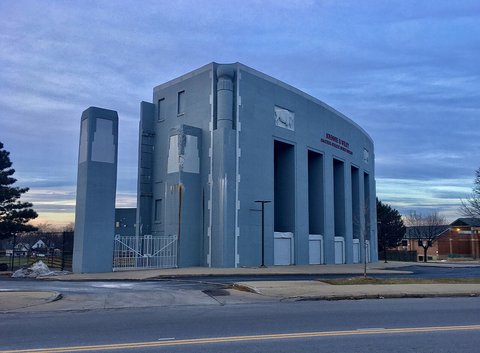
What survives of the Rockpile is two gates. The stadium behind them is a field.
Buffalo built it as a Works Progress Administration project on the site of the Prospect Reservoir, a large rectangular block on the East Side that had been drained and was on its way to becoming an eyesore. A 1940 WPA account of the work describes the basin as a natural amphitheatre, converted with concrete stands and walls. Depression relief money made a stadium out of a hole in the ground.
It went through four names before it settled: Roesch Memorial Stadium in 1937, Grover Cleveland Stadium later the same year, Civic Stadium from 1938, and eventually War Memorial Stadium, which sources date to either 1950 or 1960. Published capacities disagree as well, from 35,000 to 38,000 at the outset, rising past 46,000 when an upper deck was added in 1965.
Two different clubs called the Buffalo Bills played here and they are not the same franchise. The first were an All-America Football Conference team from 1946 to 1949, which ended when the AAFC did. The second were a charter club of the American Football League, here from 1960 to 1972, and they won an AFL championship on this ground. An earlier and unrelated league also calling itself the American Football League had put the Buffalo Indians on this block in 1940 and 1941. Three leagues, one drained reservoir.
The nickname is genuinely unsettled, and one researcher has said so in print after trying and failing to trace it. The candidates are the stone wall that ran around parts of the ground and the neighbouring Masten Park, the rocky foundation underneath, and the plain condition of the place late in its life. Sports Illustrated in 1984 quoted a writer to the effect that the stadium looked as though whatever war it commemorated had been fought inside it.
Then the arithmetic arrived. After the 1970 merger the league required a home stadium to seat fifty thousand, and War Memorial did not. The Bills left for a new stadium in the suburbs after the 1972 season. The ground stood unused from 1973 until minor league baseball returned in 1979, hosted the ballpark scenes of a 1984 film, and closed with a Bisons game in August 1987. Demolition followed, in either 1988 or 1989 depending on the source.
That seating minimum has now emptied three of the stadiums in this set of memories: Wrigley Field in 1970, War Memorial in 1972, Metropolitan Stadium in 1981. It is among the most consequential rules in the sport's property history and it is almost never named.
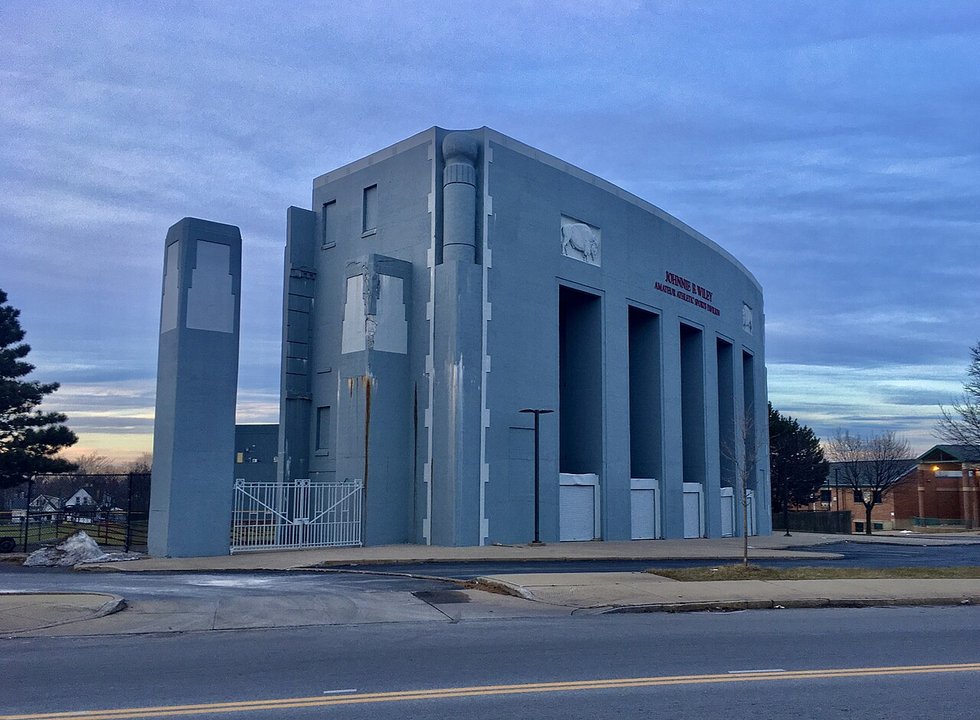
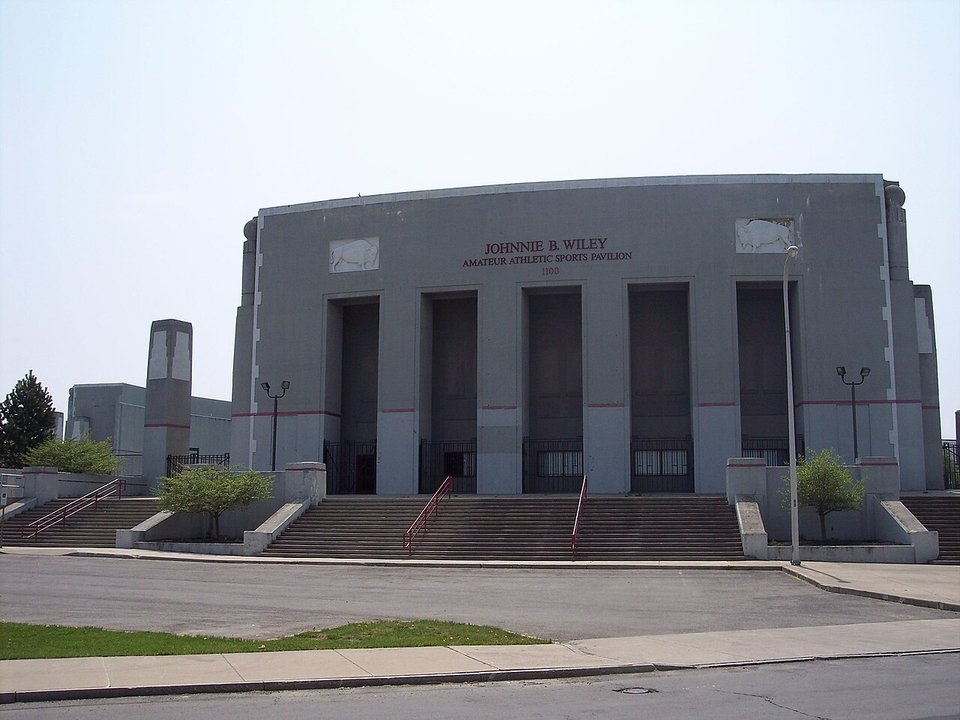
The city kept two of the four entrance gates, both on the eastern side of the block. They are Depression-era civic architecture with bison carved into the stone, and they now front the Johnnie B. Wiley Amateur Athletic Sports Pavilion, a high school athletic field built in 1992 and given that name in 1997.
Coordinate: the main gate at the north-west corner of Best Street and Jefferson Avenue. Street-gazetteer triangulation of the two roads and the GPS on a photograph of the gate agree to within about 25 m. The stadium occupied the entire block, so precision for the ground itself is ±150 m.
Cover: the preserved main entrance gate in January 2021, lettered for the pavilion that replaced the stadium. Photo: Andre Carrotflower, CC BY-SA 4.0, via Wikimedia Commons.
Second image: the other surviving gate seen head-on, with its bison reliefs. The Commons file is titled War Memorial Stadium Rockpile, but what it shows is the gate; the stadium was gone long before the photograph was taken. CC0, via Wikimedia Commons.

































 expand_more