


Landmark History | Golden Gate Bridge — The 1937 Pedestrian Day Across the New Span
· 1937-5
Unreviewed contributionBy kevin · · Report an issue







































Find memories left by people near you.
Distribute Bounty
This will distribute the bounty equally among all qualifying memories. This action cannot be undone.
Cancel Bounty
Are you sure you want to cancel this bounty? The remaining amount will be refunded to your account.
Success!
Operation completed successfully.
Error
Something went wrong.
Landmark History | Golden Gate Bridge — The 1937 Pedestrian Day Across the New Span
kevin
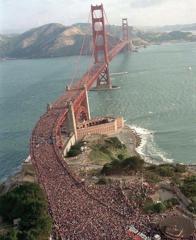
At 6:00 a.m. on 27 May 1937, foghorns sounded at the Golden Gate and turnstiles released waiting crowds onto a roadway that had not yet carried ordinary traffic, beginning a dawn-to-dusk Pedestrian Day across the newly completed bridge.
Roughly 200,000 people crossed on foot, according to contemporary accounts synthesized by PBS and the bridge district, turning the first public use of the span into a mass walk between San Francisco and Marin rather than an automobile procession.
The opening followed four years of construction begun on 5 January 1933, with Joseph B. Strauss as chief engineer, Charles A. Ellis responsible for much of the structural analysis, Leon Moisseiff consulting on suspension behavior, and Irving F. Morrow shaping the towers, lighting, railings, and International Orange color that made the engineering work legible at city scale.
Their steel suspension system carried a 4,200-foot main span across the tidal strait, while the southern approach arched over Fort Point instead of demolishing the nineteenth-century fort; the bridge was publicly financed through district bonds approved during the Depression, and its completion also rested on dangerous labor in which eleven workers died and a safety net saved nineteen others.
Pedestrian Day was not the same as the bridge's completion or its opening to vehicles: paving ended on 19 April, a last-rivet ceremony followed on 27 April, and automobile traffic began at noon on 28 May after President Franklin D. Roosevelt activated a telegraph signal from Washington.
The fixed crossing changed the geography of everyday movement north of San Francisco, and the former Southern Pacific–Golden Gate ferry service between Hyde Street Pier and Sausalito suspended operations in July 1938 after losing traffic to the bridge.
The bridge remains an active highway and working piece of regional infrastructure, not an unrestricted viewing platform; pedestrians use the east sidewalk only during posted hours, cyclists follow separate sidewalk rules, and temporary closures may override the normal schedule.
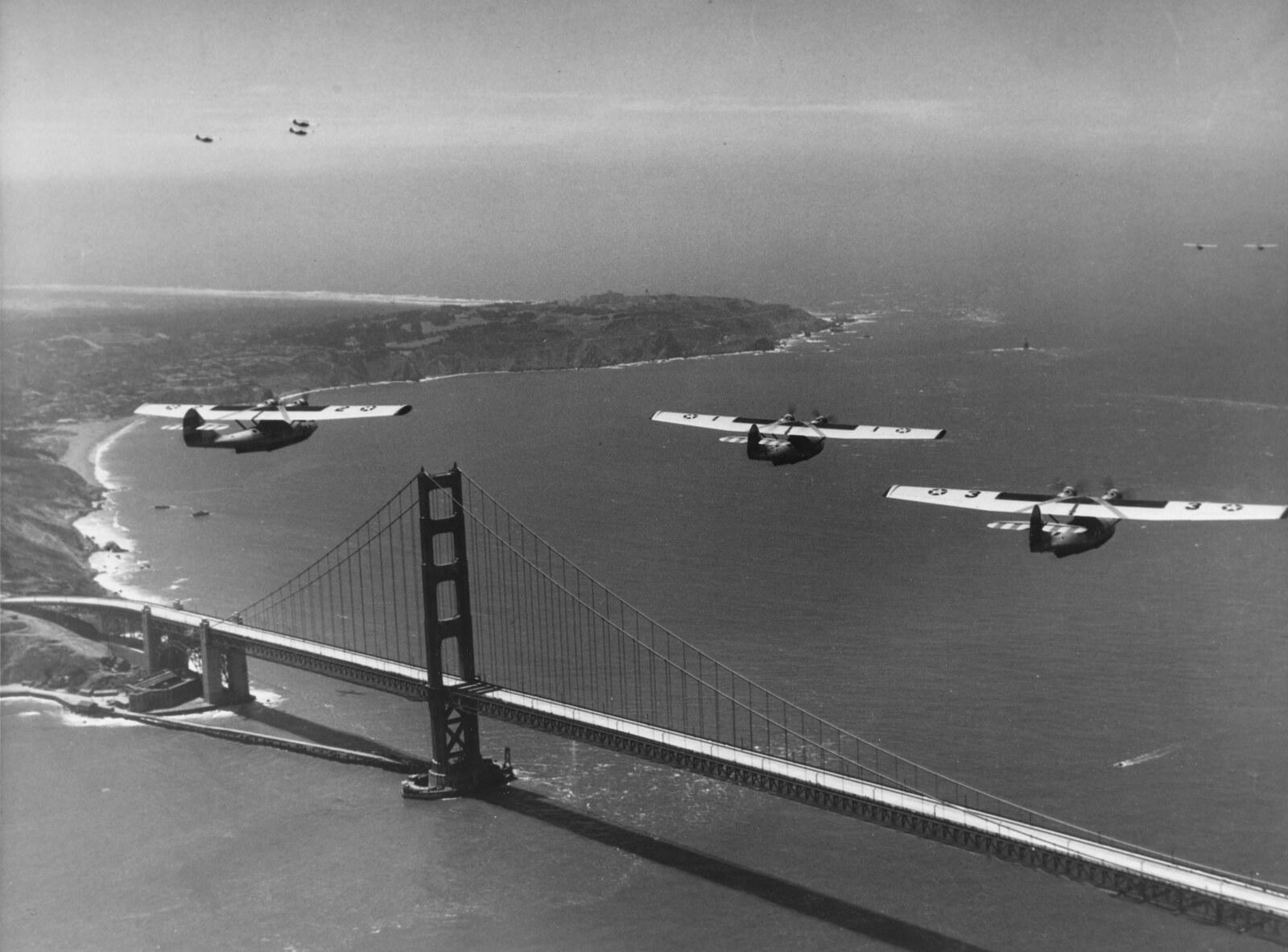
The U.S. Navy photograph used here was made in May 1937 and shows the completed southern span and an empty roadway beneath a formation of PBY-1 Catalina aircraft, documenting the bridge at the threshold of opening rather than the Pedestrian Day crowd itself.
Photo: U.S. Navy, May 1937, public domain, via Naval History and Heritage Command and Wikimedia Commons.
changes?
delete this memory?
We detected that you have a Blox in your crypto wallet! We will import the Blox into your account.
Click on done below to complete the import.
Welcome Back!
Sign in to preserve cherished moments
Don't have an account?
Welcome!!
Sign up and start preserving cherished moments
?
?


Choose your payment method
Buy with Metablox Credit
Do you want to mint Blox with Metablox Credit?
Which Crypto would you like to use?
Purchase Confirmed!
Your Blox is being minted on-chain and will appear in your profile shortly.
Log in or sign up to claim your Blox.
How many credits do you want to buy?
$100 USD = 1 Metablox Credit = 1 Blox.
Use Metablox Credit to mint any Blox you want on the map.
 expand_more