


Tennis History | Devonshire Park, Eastbourne — the champion of England won ten titles on these lawns and six at Wimbledon
· 1903
Personal memoryBy kevin · · updated · Report an issue












































Find memories left by people near you.
Distribute Bounty
This will distribute the bounty equally among all qualifying memories. This action cannot be undone.
Cancel Bounty
Are you sure you want to cancel this bounty? The remaining amount will be refunded to your account.
Success!
Operation completed successfully.
Error
Something went wrong.
Tennis History | Devonshire Park, Eastbourne — the champion of England won ten titles on these lawns and six at Wimbledon
kevin
## ⚠ Read this first: overlap with an existing entry, declared
**The career comparison in this entry's title is already the subject of [Biography | Blanche Bingley Hillyard](https://metablox.co/memory/biography-blanche-bingley-hillyard-eleven-at-eastbourne-against-six-at-wimbledon-and-a-photograph-of-what-the-amateur-game-paid-devonshire-park-1905-10244) (memory 10244), published earlier and pinned 102 m from this one.** That entry owns the argument about what an amateur woman's career was actually made of. Go there for it.
This entry was drafted on 7 September 2026 without that overlap being seen, because the deduplication pass filtered on titles beginning `Tennis History` and 10244 begins `Biography`. Titles and slugs on this platform cannot be changed after creation, so the duplicated headline stands as a permanent mark of that error and is left declared rather than quietly reworded. ➡ **The rule this cost: deduplicate a place by proximity of coordinate, never by prefix of title.**
What follows has been rewritten to be the entry for **the ground**, which 10244 is not. Its subject is who built these lawns, why a tournament here paid, and two photographs of it that were not previously on the platform.
---
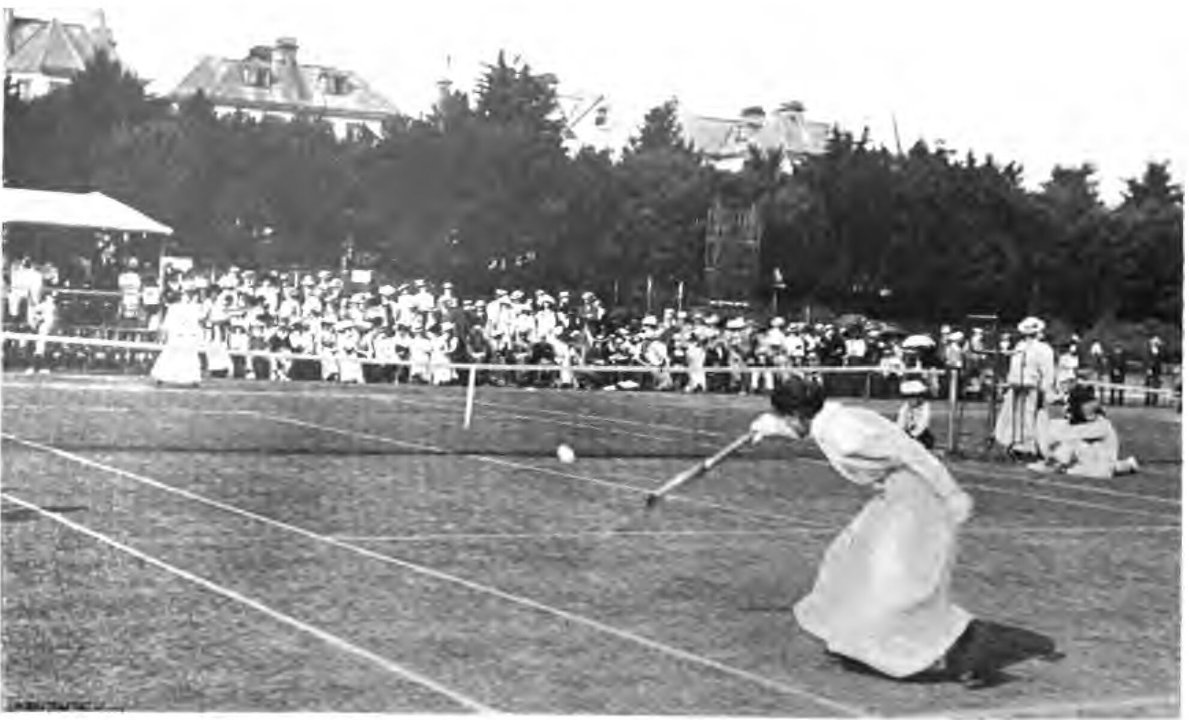
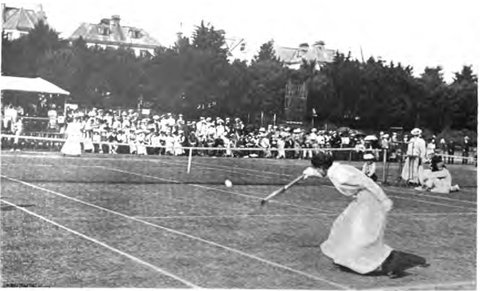
The photograph is of a grass court at Devonshire Park, Eastbourne. It was printed in 1903 under the caption **Ladies' Final at Eastbourne: Mrs. Hillyard v. Mrs. Sterry**, and it is worth looking at before reading anything else.
One player is bent low near the baseline, right arm stretched across her body, the racket head almost in the grass. The ball is in the frame, perhaps a foot above the turf and a little to the left of her strings, so the plate caught a live rally rather than a pose. The other player stands on the far side by the net, also in a full-length skirt and a hat. Behind them the crowd is four and five deep along a low rail — well over a hundred people in boaters and straw hats — with a covered stand at the left of frame. Above the trees behind the stand there are rooflines: a mansard with dormers, a gable, a square turret.
Those roofs are the argument of this entry. The tennis was on this ground because the roofs were being sold.
## A ground laid out by an estate, not by a club
Devonshire Park was not a tennis club that grew into a tournament. It was an amenity built into a property development, and the paperwork for that survives in the statutory heritage record rather than in any tennis history.
Historic England's list entry for the park's **Winter Garden** (list entry 1270271, Grade II) records it as designed in 1875–76 by **Henry Currey, architect to the Devonshire Estate**, with a double-height skating rink in the Floral Hall and refreshment, billiard and concert rooms in the Pavilion Hall. The same architect's **Devonshire Park Theatre** on Compton Street followed in 1884 (list entry 1043618, Grade II), remodelled inside by Frank Matcham in 1903.
Eastbourne's own heritage account attributes the park and its lawn tennis courts to **William Cavendish, 7th Duke of Devonshire**, laid out in the 1870s as part of the seafront expansion of the town, and dates the first championship meeting on the lawns to **1881**, won by **Edgar Lubbock** for a cup of fifty guineas.
⚠ **That 1881 attribution is single-sourced here** — to the Visit Eastbourne heritage page, read 7 September 2026 — and is recorded as the town's account of its own origins rather than as an established fact. The 1903 book used throughout the rest of this entry gives no founding year for the meeting. A contemporaneous newspaper for the 1881 season would settle it. That is a live research lead, not a closed point.
What is not in dispute is the shape of the thing: **a skating rink, a theatre, a concert hall and a set of lawns, all put up by one estate's architect inside a decade, on land the estate was selling houses around.** Nothing about that arrangement was designed to produce a championship. It produced one anyway, and the reason is in the next section.
## The commercial explanation, written down by a player in 1903
*Lawn Tennis at Home and Abroad*, edited by A. Wallis Myers and published in New York by Charles Scribner's Sons in 1903, carries a chapter of reminiscences by **H. S. Scrivener** with a section on Eastbourne. He opens a subsection headed *Out of Business Hours* with this — transcribed from the scanned page image of printed page 72, not from machine-read text:
> "I believe that the popularity of a meeting depends far more than one would ordinarily suppose upon the quality of the hotels in its vicinity."
He goes on to say that the lawn tennis player will put up with long and tedious railway journeys, indifferent courts and still more indifferent management, but wants a comfortable hotel and, in his phrase, "something to do" in the evening — and that this is one of the reasons why tournaments like Eastbourne were more popular than others.
**That is a competitive advantage made of bedrooms**, and it is stated flatly, by a player, in a book of instruction, as an ordinary condition of the game. It also explains the ground. A duke developing a resort had every reason to build the hotels, the theatre, the winter garden and the lawns together, because the tournament week was one continuous demonstration of what the town could do for a visitor. The tennis was the shop window and the accommodation was the stock.
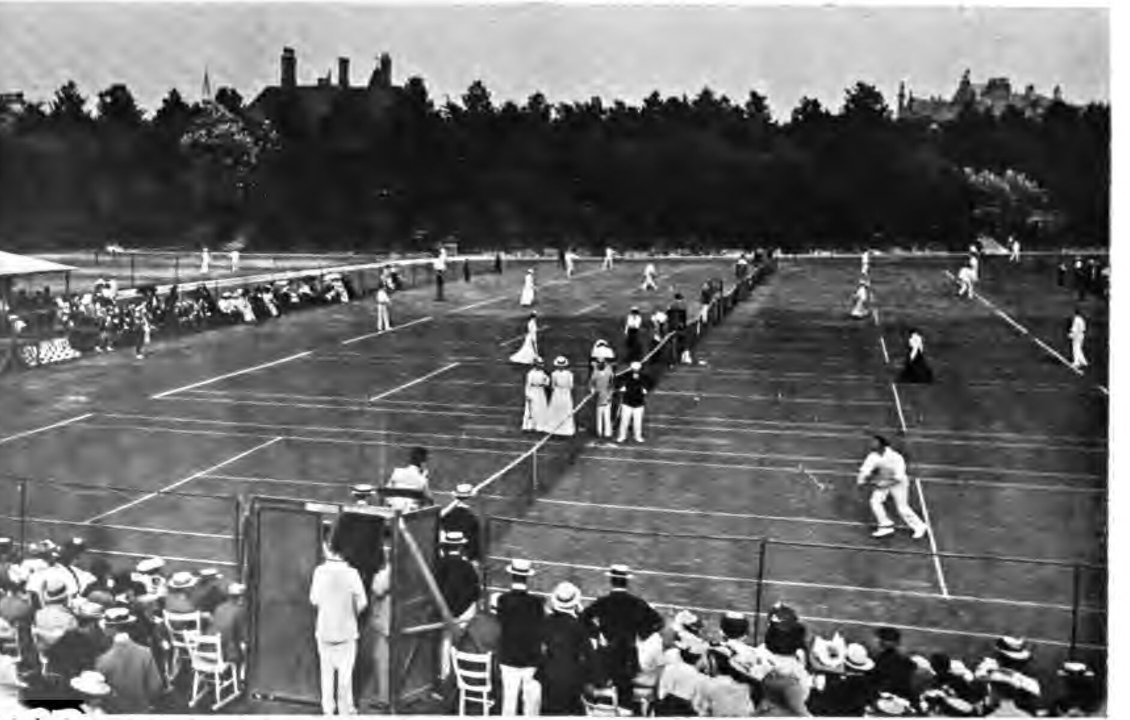
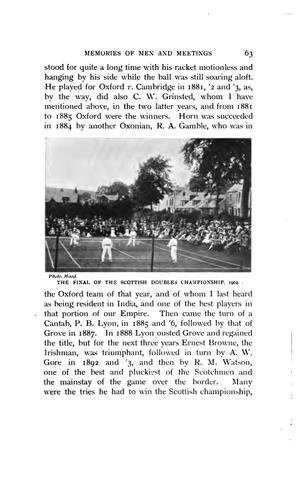
Scrivener also gives the ground its scale before it grew. He recalls Eastbourne as "not, in those days, the colossal affair which it is now, and only requiring some six or eight courts" — still, he says, big enough to fill a busy week and always well supported by leading players. The second photograph on this memory shows at least four courts in simultaneous play with more running off the frame, which fits the "now" of 1903 rather than the earlier meeting he is remembering.
## What it cost a player to be here
Chapter IV of the same volume is by **Mrs. Sterry** — Charlotte Cooper before her marriage, and the subject of a [separate entry](https://metablox.co/memory/biography-charlotte-cooper-sterry-she-won-the-title-as-miss-cooper-and-again-as-mrs-sterry-and-the-record-kept-the-names-apart-worple-road-1901-10204) (memory 10204). She names the fixtures she planned her year around: the Fitzwilliam at Dublin, the Northern Tournament, the Newcastle meeting, and "the seaside tournaments, with the 'wind-up' of the season at Brighton and Eastbourne."
She is candid about the two barriers to being at any of them. The first is money: tournament play, she writes, may involve travelling a great deal — to the North of England, or as far as Ireland or Scotland — and naturally means a good deal of expense. The second applied only to the women. Many a parent, she writes, was prejudiced against a daughter having so much freedom; her own mother turned a deaf ear to the people who advised her not to let her daughters travel about. That passage is set out at length, with its page verified off the leaf, in the [Alice Pickering entry](https://metablox.co/memory/biography-alice-pickering-a-1903-book-puts-her-tennis-at-a-country-vicarage-and-her-1896-wimbledon-win-at-the-all-comers-not-the-final-tow-law-1885-10480) (memory 10480).
**So Scrivener's hotels and Sterry's railway fares are one economy seen from opposite ends.** A meeting prospered because visitors could be comfortably housed nearby. A player was in the draw because she could pay to be housed there and had been allowed to go. Neither condition was a rule of the game; both were conditions of entry; and only one of them applied to the men in the same draw.
## The fourth pin in one sentence
Myers, writing in the same volume about Blanche Hillyard, names four championships in a single line — the Championship of England, the South of England Championship, the Northern Championship and the Irish Championship. That sentence is quoted and argued in memory 10244. What belongs here is what it does to this platform's map. Three of the four grounds were already pinned:
- The **Irish Championships** women's event and the address it moved to: [24–25 Upper Pembroke Street, Dublin](https://metablox.co/memory/tennis-history-24-25-upper-pembroke-street-dublin-the-womens-championship-was-moved-off-the-public-square-to-keep-it-private-june-1879-10216) (memory 10216)
- The **Northern Championship**, at [Aigburth, Liverpool](https://metablox.co/memory/tennis-history-aigburth-liverpool-the-womens-championship-of-the-north-began-here-in-1882-and-in-1900-the-club-built-the-women-a-pavilion-of-their-own-10445) (memory 10445), where the club built the women a pavilion of their own in 1900
- The **Championship of England** itself, at [Worple Road](https://metablox.co/memory/tennis-history-worple-road-wimbledon-a-championship-called-to-revive-a-drooping-exchequer-10599) (memories 10599, 10600 and 10601)
**Devonshire Park was the missing fourth**, and this is its pin.
One refinement this entry can offer to 10244, established here off the page image of printed page 168 rather than from a records database: **Myers, writing after the 1902 season, counted ten South of England titles, not eleven.** The figure of eleven runs to 1905. ➡ Neither number is wrong and they are not in conflict; the windows differ, and any use of either has to say which season it stops at. Amateur-era counts in this sport are almost always window claims wearing the clothes of totals.
## Naming
**The Championships, Wimbledon** — never "the Wimbledon Open"; the event has no "Open" in its name and never has. In 1903 it was the All England Lawn Tennis and Croquet Club's meeting at Worple Road, and the ladies' event within it had run since 1884. Period writers called its winner the champion of England and used the same vocabulary for the South of England, the Northern and the Irish championships, without implying a ranking between them. The ranking came later.
## Dated status note
Read on **7 September 2026**: the Visit Eastbourne heritage account states that the meeting moved from its September date to July in the 1960s, and again in 1969 to a position immediately before the Championships, which it still occupies. Grass-court tennis is still played on this ground. This entry makes no claim about the current tournament's name, sponsorship or sanctioning body, all of which have changed repeatedly and none of which are established here.
## What this entry does not establish
- **Which court in the park either photograph shows.** The lawns have been relaid and the enclosure rebuilt more than once since 1903; the present Centre Court is later. Neither plate is identified beyond "at Eastbourne".
- **The year of either photograph.** Both are undated in the book. All that is fixed is that they were in print by 1903.
- **Which player is which in the cover plate.** The caption names Mrs. Hillyard and Mrs. Sterry but does not say who is nearer the camera, and the plate is not sharp enough at this scale to tell.
- **The 1881 founding and the fifty-guinea cup**, which rest on one source, as set out above.
- **Whether the 1903 book's British issue carries the same plates.** The scanned copy is the New York issue, from the New York Public Library's shelves.
## Coordinate
Pinned at **50.763122° N, 0.282120° E**, on the College Road side of the Devonshire Park enclosure, with a precision radius of **250 m** — enough to contain the whole ground and every lawn ever laid inside it.
Two independent sources were used, and they were used to bracket the ground rather than to fix a single court, because fixing a single court would be false precision:
1. **Historic England**, list entry 1270271 (Winter Garden), National Grid Reference **TV 61202 98403**, converted from OSGB36 to WGS84 as 50.762830° N, 0.284374° E. The companion entry 1043618 (Devonshire Park Theatre) gives TV 61239 98446, 57 m away.
2. **ONS / Ordnance Survey Code-Point Open**, via the postcodes.io service: postcode **BN21 4BP**, the statutory address on the Winter Garden listing, returns 50.762769° N, 0.284514° E — **12 m** from the Historic England conversion of the same building. That agreement is what establishes the park's position.
The pin itself is the Code-Point centroid for **BN21 4JJ**, the College Road frontage of the tennis ground, **162 m north-west of the Winter Garden point** and 197 m from the theatre. The lawns lie between and north of those three points, inside the stated radius. Memory 10244 pins the same ground 102 m away; the two pins are the same place at different corners of it, not two places.
➡ **The pin is the ground, not a court.** No coordinate here is derived from a photograph, and none should be read as locating the net in either plate.
## Cover image
**"Ladies' Final at Eastbourne: Mrs. Hillyard v. Mrs. Sterry."** Photographed by Lavis. Plate facing printed page 128 of *Lawn Tennis at Home and Abroad*, ed. A. Wallis Myers, New York: Charles Scribner's Sons, 1903. Public domain by age. Digitised from the New York Public Library copy; full text and page images at https://archive.org/details/lawntennisathom00myergoog — this plate is leaf n149, and the two passages quoted above are on leaves n93 and n189.
The image reproduced here is a derivative served by that archive's own image endpoint: the plate is printed sideways on the page, so it has been rotated upright, cropped to the photograph and reduced to 1,200 pixels on the short edge. Nothing inside the frame has been altered.
## Second image
**"The South of England Championships at Eastbourne."** Photographed by Lavis. Plate facing printed page 69 of the same volume, leaf n90. An elevated view across the Devonshire Park lawns showing at least four adjacent grass courts in play at once; an umpire's box and scoreboard in the foreground with two officials beside it; spectators seated on wooden folding chairs along the near rail; an awning at the left; and beyond the treeline the chimneys, gables and a spire of the surrounding town. Rotated upright and cropped as above.
Neither plate is a photograph of the ladies' final in any identified year, and neither is presented as one beyond what its own printed caption says. Neither comes from, or through, any tournament organiser or governing body.
## Source note
All quotations here were transcribed from the scanned page images, not from the machine-read text of the volume, which carries visible optical-recognition errors elsewhere on the same pages. The book is one printing; where a second independent setting of the same words has not been found, this entry says so rather than implying corroboration it does not have. The 1881 founding claim and the eleven-title figure come from the Visit Eastbourne heritage page and are attributed to it in the text.
Sources: *Lawn Tennis at Home and Abroad*, ed. A. Wallis Myers (New York: Charles Scribner's Sons, 1903), chapters II (H. S. Scrivener), IV (Mrs. Sterry) and V (A. Wallis Myers); Historic England National Heritage List entries 1043618 and 1270271; ONS / Ordnance Survey Code-Point Open via postcodes.io; the Visit Eastbourne heritage account of tennis at Devonshire Park.


changes?
delete this memory?
We detected that you have a Blox in your crypto wallet! We will import the Blox into your account.
Click on done below to complete the import.
Welcome Back!
Sign in to preserve cherished moments
Don't have an account?
Welcome!!
Sign up and start preserving cherished moments
?
?


Choose your payment method
Buy with Metablox Credit
Do you want to mint Blox with Metablox Credit?
Which Crypto would you like to use?
Purchase Confirmed!
Your Blox is being minted on-chain and will appear in your profile shortly.
Log in or sign up to claim your Blox.
How many credits do you want to buy?
$100 USD = 1 Metablox Credit = 1 Blox.
Use Metablox Credit to mint any Blox you want on the map.
 expand_more