


Tennis History | Craigside, Llandudno — a national championship inside one hydropathic hotel, in the town that hired out the professionals it barred
· 1902
Personal memoryBy kevin · · Report an issue



































Find memories left by people near you.
Distribute Bounty
This will distribute the bounty equally among all qualifying memories. This action cannot be undone.
Cancel Bounty
Are you sure you want to cancel this bounty? The remaining amount will be refunded to your account.
Success!
Operation completed successfully.
Error
Something went wrong.
Tennis History | Craigside, Llandudno — a national championship inside one hydropathic hotel, in the town that hired out the professionals it barred
kevin
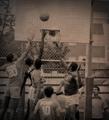
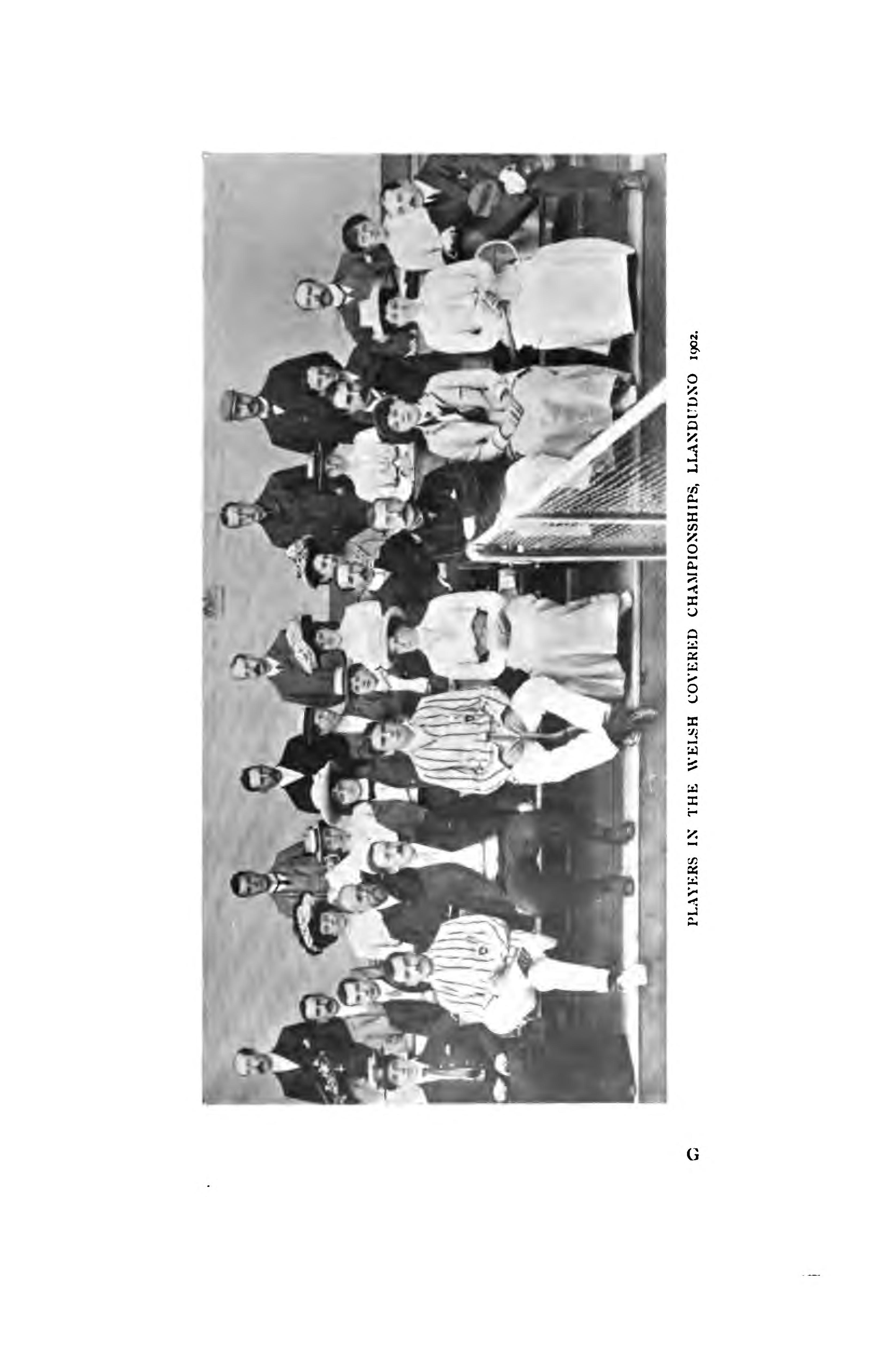
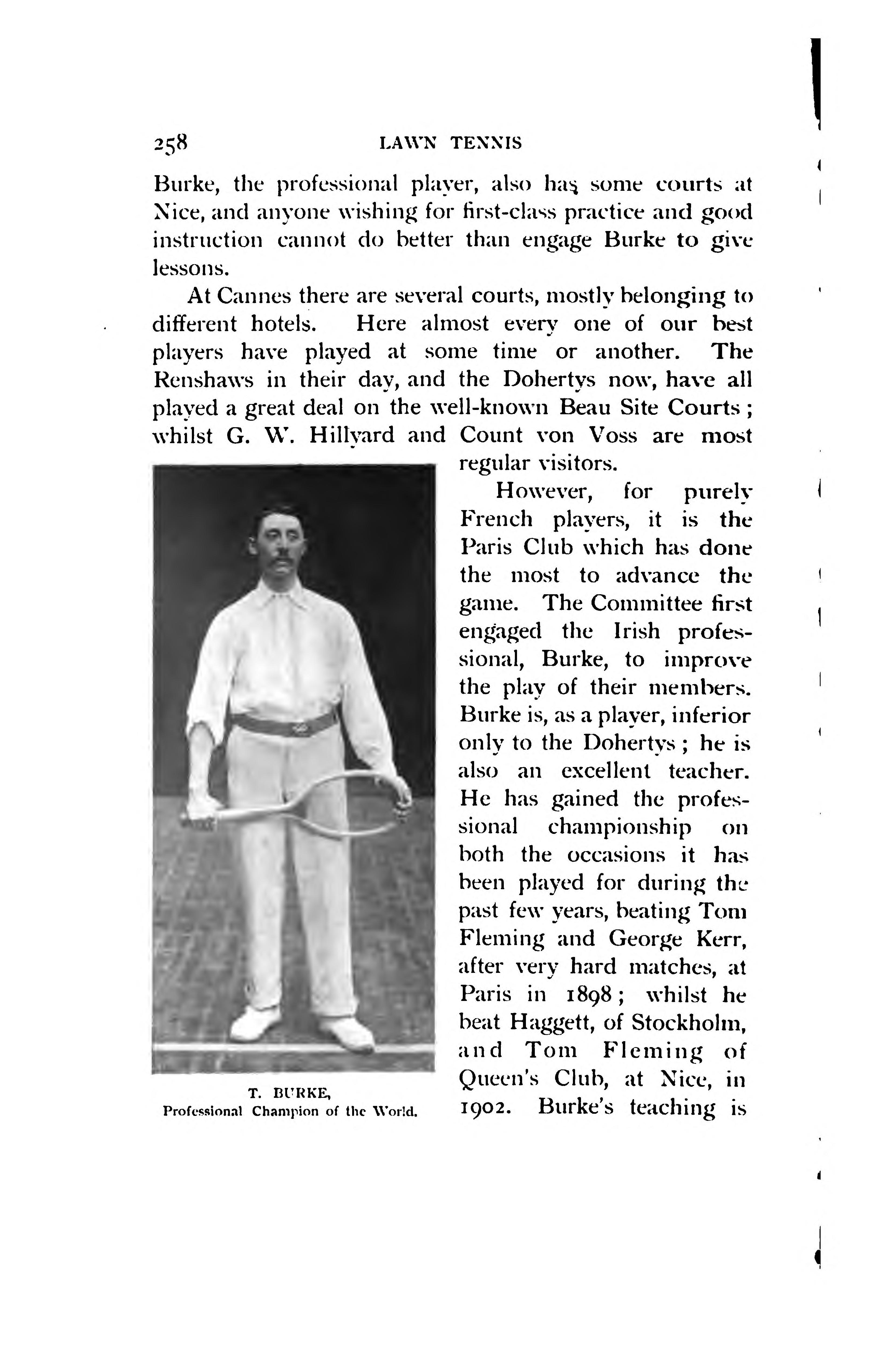
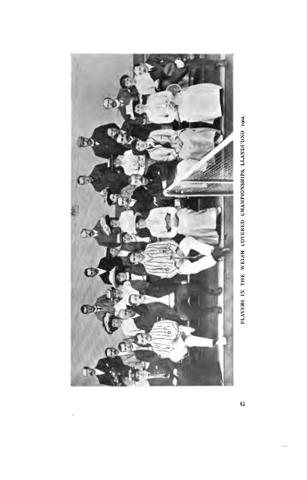
The cover of this entry is a group photograph made indoors in 1902 and printed in a book of 1903. It is here because the room it was taken in stood on the North Wales coast inside a hotel built for people taking the water cure, and because a national championship was decided in that room, on and off, across sixty-three calendar years.
Roughly thirty people, not counted exactly, are arranged on tiered benches in front of a plain pale wall. Six men in dark suits stand along the back; two rows of women in long light dresses and wide hats are set between and in front of them, mixed with men in dark jackets and straw hats; the front row sits, several with their legs crossed. Two men near the centre of the front row wear striped blazers over white flannels, and one of them holds a racket upright between his knees. At least two more rackets are held by women at the right of the group. At the right edge of the frame a tennis net is strung tight between a post and a tape, cutting across the bench ends, and both the mesh and the pale top band of the net are distinct. High on the wall behind the group, at the centre, is a small dark object above a horizontal bar; it is not legible at any enlargement used here and is not identified. At the far left, seated slightly apart, is a person in a peaked cap with a light band and a dark jacket carrying a pale badge on the breast, over a long dark skirt, dressed unlike anyone else in the picture; the long skirt reads as a woman's dress of the period, and no role is assigned to this person here, because nothing read for this entry says. Set in letterpress below the photograph: PLAYERS IN THE WELSH COVERED CHAMPIONSHIPS, LLANDUDNO 1902.
**What this entry argues.**
Two things were true of Llandudno at the same time, and the same book prints both. The two passages sit about two hundred pages apart and neither refers to the other.
The first is that the Welsh covered court championship was played here, in one building, for the whole of its life. Not in Cardiff, not in Swansea, not moved about the country in the way the Scottish meeting was moved: one room, at one hotel, on one stretch of coast, from 1893 until 1955. That is a span of sixty-three calendar years and it is not sixty-three tournaments. The roll read for this entry shows no champion between 1938 and 1950, so the wars took editions out of it, and how many were actually played was not established here.
The second is that when a Paris club wanted somebody to teach its members how to play, it sent to Llandudno. The same volume that reproduces the cover of this entry names two Llandudno professionals engaged in Paris within a few seasons of each other, says plainly that such men were well paid, and gives the French nickname they went under.
Those two facts belong together, because the men in the second one could not have entered the tournament in the first one. Every amateur championship named in this entry was closed, by rule, to anyone who had ever been paid to play. The one exception below is the professional championship Burke won, which existed precisely because the others shut him out. A town on the Irish Sea supplied the paid teachers of the amateur game and hosted a national championship of the amateur game, and the people it exported were the people it would not have let in.
That is the argument. It is not a scandal and it is not being written as one. It is what the amateur rule actually looked like on the ground: not a code of honour, but a line drawn between the man who took money for the lesson and the man who paid for it.
**The building.**
The Royal Commission on the Ancient and Historical Monuments of Wales holds a site record for the Craigside Hydropathic Hotel and Bath House, at Llandudno in the old county of Caernarfonshire, now in Conwy. The record describes an establishment originating in the 1880s as a very large building of four storeys and an attic with towers and sun terraces; says that by 1950 it took around two hundred guests and had an indoor swimming pool, tennis courts and access to a private beach; and describes a separate fortified bath-house structure standing on the beach and reached by a path from the hotel. It states that the building no longer stands, and lists period postcards, aerial photography of the 1920s and early Ordnance Survey mapping among the documentation behind the record.
A second and unrelated institutional source, an advertising leaflet catalogued by a Welsh public collections project and uploaded by the county archive service, says the Craigside Hydropathic Hotel was opened in 1888 by John Smith, and that visitors could consult the resident physician, Dr John Miles Chambers, take a Russian or Turkish bath, or have a massage. The opening date of 1888 and the name of the founder therefore reach this entry from two bodies that are not each other.
This is the same kind of place, and the same commercial logic, that this platform has already pinned three times over: the Kurpark at Bad Homburg, the Lichtentaler Allee at Baden-Baden, and the sands and gravel courts at Dinard, with the Scottish championship's thirteen years at a sulphur spa at Moffat as the fourth. Craigside is the Welsh instance. The pattern is not a coincidence and is not mysterious. A resort hotel had ground, capital, an out-of-season problem and a clientele with time; a championship needed a court, a crowd and beds for the entry. What is different here is the covered court. Hough's own phrase in the same volume, the covered court season of 1901 to 1902, spans two calendar years and indicates a winter season; a roofed court turns a summer amenity into a year-round one, and that is the likeliest reason this particular tournament outlived the outdoor one at the same hotel by four decades.
**The tournament, and the other tournament.**
The encyclopaedia article on the Welsh Covered Court Championships, consulted for this entry through a fetching layer rather than read in its own source text, gives the event as founded in 1893, played on indoor wood, held at Craigside in Llandudno throughout, and discontinued in 1955. The companion article on the Llandudno Open gives a separate outdoor tournament on grass at the same hotel, founded in 1890 and discontinued in 1914 on the outbreak of war, and describes outdoor grass courts in front of the hotel with the indoor covered courts building standing next to it.
So the hotel ran two tennis meetings on two surfaces: an outdoor grass one that the First World War killed, and an indoor wooden one that survived it and the Second and went on into the 1950s. That is worth stating plainly, because it is the covered court, not the lawn, that made this address matter.
Neither of these is the Welsh Championships proper. That is a third event, and this entry keeps it separate. Herbert Scrivener, writing his recollections for the same 1903 volume, sets it out at printed page 64: the Welsh championships came into being much later than the other three national meetings, in 1886; they were originally held at Penarth; and, as far as the men's singles went, they were more or less dominated by Irishmen, Ernest Browne winning the first two years and W. J. Hamilton the next three, with English players including Baldwin, Sweet and Lewis also well represented, and W. S. N. Heard about the best of the Welshmen of the day. He adds that the first two ladies' champions were Miss Maud Watson and Mrs. Hillyard, and that the entry of ladies was not a strong feature of the meeting. His other three national meetings are, on the natural reading, the English, Irish and Scottish championships; this entry does not press the point further, because he does not list them. A national championship of Wales won in its first five years by Irishmen is a fact about how thin the entry was and about who could travel, and Scrivener reports it without comment.
**What Scrivener says about Craigside, and where it does not agree.**
Scrivener returns to the covered game at printed page 80. He writes that the Welsh Covered Court Championship was instituted after his own time, and that although he had many times planned a visit to Craigside the plan had always so far broken down — which means the man giving this account had never been to the place. He says the first cup was won in 1893 by J. H. Crispe, a friend and contemporary, one of the best covered court players of those days, whose game suited a hard court and a high-bouncing ball because he played with a pronounced downward chop, meeting the ball as high as possible. He says that in 1894 W. S. N. Heard, the best Welsh player of those days, was the winner at Craigside. And he says that Mrs. Pickering was the first holder of the ladies' cup, instituted in 1896. Elsewhere in the same volume, in the chapter on players of the present, Myers writes that Mrs. Pickering believed in winning championships outright and gives the Welsh Covered Court Challenge Cup as one of the cups she did it to.
On two of those the 1903 book and the modern article agree, and the agreement is worth having, because it is a period participant and a modern compilation arriving independently at the same two names: Crispe in 1893 and Heard in 1894.
On two others they do not agree, and this entry names both disagreements rather than choosing.
Scrivener writes that after Heard's win there followed Reggie Doherty's three successive wins. The modern article's roll, as read this session, gives Reginald Doherty 1895 and 1897 with Laurence Doherty between them in 1896 — two brothers alternating, not one man three times. Nothing read here settles which is right. It is an easy error to make in either direction, since the brothers were both champions of England in this period and are habitually confused; and it is exactly the sort of thing a man writing from memory about a tournament he had never attended would get wrong.
Scrivener writes that the ladies' cup was instituted in 1896. The modern article's women's roll begins two years earlier, in 1894. Again, unresolved here. A cup can be instituted after an event has been run for a season or two, and the two statements are not strictly contradictory, but nothing read for this entry establishes that reading either.
**A roll that could not be trusted as a table, and why that is recorded.**
The article's champions list was obtained this session through a summarising layer, and it came back with faults that make it unusable as a table. It gives one woman a span of 1894 to 1896 and then repeats 1895 inside the same entry. It assigns 1922 to two different women. Those are not disagreements between sources; they are damage introduced between the source and this entry.
The consequence is that no roll of champions is printed below. Individual names are used only where they carry something the argument needs, and each is flagged as indicative. Anyone extending this entry should go back to the article in its own source text, and better still to the Welsh press, before setting any of it in a table.
With that stated: the list as read is dominated in its early decades by George Caridia, who appears against 1899 to 1902, 1904, and a long run from 1906; and it carries, across its later decades, players whose names sit well outside Wales and well outside Britain, among them Mohammed Sleem, Hassan-Ali Fyzee, Hendrik Timmer and Ignacy Tloczynski. This entry asserts nothing about who any of them represented at the time they played here, because it did not establish it, and the guardrail this series applies is that a player is described by the state he played for at the time of the event and not by a modern one. That a Welsh national championship played inside a Llandudno hotel drew entries from that far afield is the finding; the nationalities are work not done.
**The professionals, which is the part nobody prints.**
Chapter VIII of the same 1903 volume, Play in France and Switzerland, is signed R. B. Hough and begins at printed page 252. At pages 258 and 259 Hough sets out how the Paris club taught its members to play.
The committee, he writes, first engaged the Irish professional Burke, a man inferior as a player only to the Dohertys and an excellent teacher, who had won the professional championship on both the occasions it had been played for in recent years, beating Tom Fleming and George Kerr at Paris in 1898, and beating Haggett of Stockholm and Tom Fleming of Queen's Club at Nice. After Burke left, Hough continues, Marshall, the Llandudno professional, was engaged; Marshall was not so good a player as Burke, but he hit hard, had good style, and taught the game well. Then comes the sentence this entry is built on: both Burke and Marshall were well paid, and the services of les professeurs, as they were called, were largely in demand.
Hough records that Marshall suffered a severe sunstroke while playing at Etretat in the summer of 1901 and had been unable to play since — reported here only because it is why the post fell vacant, and reported as what Hough printed. Henton was engaged for the covered court season of 1901 to 1902. And in the season Hough was writing, the services of Cowdrey, whom he calls the very excellent professional from Llandudno, had been secured.
Two Llandudno men, named in one paragraph, hired to teach in Paris, within about two years of each other, in a book published the year after the photograph on this entry's cover was taken at Llandudno.
What Hough does not say is where in Llandudno either man worked. He calls Marshall the Llandudno professional and Cowdrey the professional from Llandudno, and stops. Nothing read for this entry establishes that either was employed at Craigside, or at the covered court, or that they ever set foot in the room on the cover. The town is the link and the town is all the source gives. This entry does not close that gap and says so here rather than letting the reader close it.
What the passage does establish, in the plainest terms available, is the economics. Being good enough to teach was a job. It was a paid job, the pay is described as good, and the demand is described as large. And a man who took it was, from that moment, ineligible for every amateur tournament named anywhere in this entry.
**The chronicler and the champion.**
The article's roll of Craigside men's champions, as read this session, gives 1903 to Robert Baldwin Hough. Chapter VIII of the 1903 book is signed R. B. Hough.
The initials match, the years match, and the subject matter matches. This entry treats that as a strong indication and not as an established identity, because nothing read this session states that the chapter's author and the 1903 champion are the same man. If they are, then the person who wrote down that Llandudno hired out well-paid professionals to Paris won Llandudno's amateur championship in the year his book appeared, and the two halves of this entry were held in one head.
That is worth flagging for a second reason. This series has repeatedly found that the men who wrote the period's books were competitors in the records those books print, and that a source can be inside the thing it describes. Scrivener, the other witness above, is in the same position: he writes about the covered court championship at Queen's as a man who won its doubles for its first two years.
**Joins to entries this platform already carries.**
Every one of these was checked against the platform's own records this run.
The Doherty brothers, whoever won what at Craigside, are the same pair who took the Scottish men's singles at Moffat across 1895 to 1898, which this platform pins. Two national championships of two countries, in the same handful of years, decided between the same two brothers.
Muriel Robb appears on the Craigside women's roll against 1899 to 1901; the Moffat entry has her as Scottish women's champion in 1901. Mary Curtis-Whyte appears on the Craigside roll several times from 1906; the Moffat entry has her as Scottish champion in 1905. Gladys Eastlake-Smith appears against 1907 at Craigside; this platform's entry on the 1908 Olympic tennis played under a glass roof at the Queen's Club concerns the same indoor competition in which she won the women's event. All three are indicative, taken from the roll described above, and none was confirmed against a period source here.
Harold Mahony appears against 1898. He is one of the named plates in this same 1903 volume that this series has logged as unused.
And the covered court itself joins a line this platform has already begun: the vanished Bayswater covered court off Porchester Road, and the covered courts at the Queen's Club where the championship went next. Craigside is the third covered court in the series and the only one outside London.
**The amateur rule, stated once and stated plainly.**
The Welsh Covered Court Championship ran from 1893 to 1955. The Llandudno Open ran from 1890 to 1914. Both fall entirely inside the period when the four major championships and every meeting described here excluded anyone who had ever taken payment for playing. No figure or record in this entry is set against anything after 1968, when that rule ended at the four majors, and no comparison across that boundary is made or implied.
The phrase Grand Slam is used nowhere else in this entry and is disambiguated here once, because readers arrive with it. It carries two ordinary senses: the four major tournaments taken as a set, and all four won inside a single calendar year. The Welsh Covered Court Championship was never one of the four in either sense, and this entry makes no claim that it was.
**Naming discipline.**
The Championships, Wimbledon is named once above and is never the Wimbledon Open; that event has no Open in its name and never has had.
The event pinned here is called the Welsh Covered Court Championship by Scrivener in 1903 and the Welsh Covered Court Championships by the modern article. The photograph's own caption, set in 1903, calls it the Welsh Covered Championships, dropping the word Court. All three forms are recorded and none is corrected.
The venue is given by the modern articles as the Craigside Hydro Badmington and Tennis Club, with badminton misspelt in that form; by the national monuments record as the Craigside Hydropathic Hotel and Bath House; and by the archive leaflet as the Craigside Hydropathic Hotel. This entry uses Craigside, which is what the district is called on the modern map and what Scrivener called it in 1903, and records the rest.
Llandudno is itself a Welsh place name and is used unchanged in English, so no choice arises there. On the site today the street the geocoder returns as Craigside Drive is carried by OpenStreetMap under its Welsh name, Rhodfa'r Graig, and both forms are given below.
**Status, dated.**
Read on 7 September 2026. The Craigside Hydropathic Hotel is gone. The national monuments record states that the building no longer stands; the fetched account of the tournament says the hotel was taken over as government offices during the Second World War and demolished in the 1970s.
A mapping query run this session over a box extending at least 900 m from the pin in every direction returns no tennis court of any kind. What the mapping does return is residential streets, among them one carried by the commercial geocoder as Craigside Drive and by OpenStreetMap under the Welsh name Rhodfa'r Graig. The pin below is the site of the vanished hotel as recorded by the national body, not any present building, and this entry pins no dwelling and identifies no occupier.
**Gaps this entry declares.**
Nothing in this entry is inside quotation marks. The condition this series applies is that machine-read text earns quotation marks only where the same copy was set by two independent printers, and nothing used here satisfies it: one book of 1903 in a single typesetting, two encyclopaedia articles reached through a summarising layer, one national monuments record and one archive catalogue entry. Every attribution above is paraphrase.
No Welsh newspaper was read. The tournament ran here for decades in a town on a main line with a large visiting population, and the North Wales press will have printed its draws every season. That is the route to a quotation, to the names of the thirty people on the cover, to the dimensions and construction of the covered court, and to the identity and employer of Marshall and Cowdrey. It is untried.
No Ordnance Survey sheet was consulted. The national monuments record names early Ordnance Survey mapping among its own sources, and the 25-inch series would place the hotel's footprint and, very probably, the covered court building beside it. That would convert the coordinate below from a site point into a building outline and would be the single cheapest improvement available here.
Nothing was read from the hotel's own records, from the Welsh Lawn Tennis Association, or from Conwy Archive Service's catalogue beyond the one leaflet entry described above.
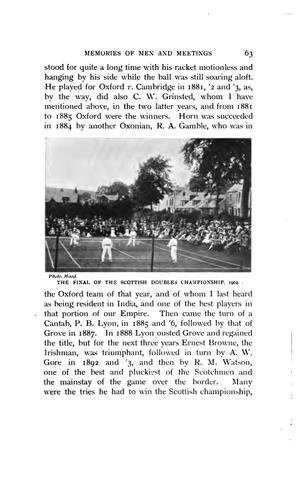
The photographer of the cover is not credited anywhere on the leaf, which is worth recording because the two Scottish plates in this same volume both carry a credit reading Photo, Hood. No attempt to identify the maker of this photograph succeeded.
No woman on the cover is named, no man on it is named, and this entry cannot say who won either title in 1902.
**Coordinate.** 53.322989, -3.789192, precision radius 250 m. The anchor is the site of the Craigside Hydropathic Hotel at Llandudno, Conwy, Wales.
The pin is a national record's own survey point, not a geocode, and it is corroborated by a second national product of a different kind. The Royal Commission on the Ancient and Historical Monuments of Wales gives its site record for the hotel the ten-figure National Grid reference SH 80924 82167, which is 280924 m east and 382167 m north on the Ordnance Survey grid. That was converted to WGS84 two ways this session, by a projection library and, independently, by using the Office for National Statistics postcode product's own published pairing of grid coordinates with latitude and longitude at this location as a local calibration; the two conversions differ by 1.6 m, and the pin is the library's result.
The second reading is that Office for National Statistics postcode centroid itself. For LL30 3BE it gives 280913 m east and 382175 m north, which is 14.9 m from the pin. The third is a commercial road-network geocode of Craigside Drive, 39.4 m away. The three lie between 14.9 m and 39.4 m from one another.
One warning about that third reading, which this series has been caught by before. The commercial geocoder's Craigside Drive and OpenStreetMap's Rhodfa'r Graig fall 3.8 m apart, and that agreement is worth nothing: both are estimates along the same modern road centreline and they are one reading, not two. The two readings that actually count here are the monuments record and the postcode centroid, and they are different products of different bodies, though both are ultimately expressed on the Ordnance Survey's grid, which is a shared frame rather than a shared method.
The radius is 250 m and it is set by what the entry cannot show, not by the scatter of the readings, which is under 40 m. The hotel was a large four-storey building with terraces; the covered court stood in a separate building beside it and the grass courts lay in front of it; and nothing read here places either relative to the grid reference. A radius that covers the room on the cover has to cover the whole complex. It should be said that 250 m reaches the modern shoreline, which lies 195 m north of the pin, so the circle may also enclose the site of the beach bath house the monuments record describes; this entry did not locate that structure and claims nothing about it.
The nearest pin of any vertical on this platform is 38.3 km away, at Caernarfon, and belongs to another series. This is not the first pin in Wales; it appears to be the first tennis pin in Wales, and the nearest other tennis pin is 57.9 km east at Aigburth in Liverpool, across the Dee estuary and the Wirral. For the argument above the distances that matter are to the other resort grounds this platform carries: 225.0 km to Beechgrove at Moffat, 535.0 km to Dinard, 919.3 km to the Kurpark at Bad Homburg and 980.8 km to the Lichtentaler Allee at Baden-Baden. All distances were computed in-session.
**Cover.** Arthur Wallis Myers, editor, Lawn Tennis at Home and Abroad, Charles Scribner's Sons, New York, 1903; digitised from a Google-sponsored scan held by the Internet Archive. The photograph on the leaf the archive numbers n102, at 3250 by 5084 px, mean brightness 214.8 of 255, standard deviation 66.5.
It is a full-page inserted plate printed sideways on the leaf, carrying no printed page number and bearing the gathering signature G below the caption. It was located by taking the page number the book's own list of illustrations prints against it, 81, and adding the offset of twenty-one that this series has established between this scan's leaf numbers and the book's printed pages; that put it on the leaf at the first attempt. The neighbouring leaves were measured before anything was concluded from it, because scans of this kind sometimes carry runs of failed halftones: n100 returns a mean of 238.2, n101 239.9, n103 237.0 and n104 236.7. n102 is the darkest of the five, which is what a full-page halftone should be, and nothing in the run is blank.
The plate was opened at full size, rotated to reading orientation, and examined in four separate enlargements before being described.
Printed matter inside the frame, recorded as a negative: the object high on the wall behind the group is not legible at any enlargement used and no lettering anywhere inside the photograph could be read. The caption and the signature are set on the page below the image.
**Second image.** The same book, the in-text halftone on the leaf the archive numbers n279, at 3250 by 5084 px, mean brightness 225.8. This leaf carries the printed page number 258 in its running head, confirming the same offset of twenty-one a further time, and it is the page on which the professionals passage described above is set: the photograph sits in the lower left of a two-column arrangement with Hough's text running around it.
It shows a man standing full length and facing the camera against a dark plain ground, on a surface that reads as a regular grid of pale lines whose material this entry does not identify. He is bare-headed, dark-haired, with a moustache, and wears a white shirt with a soft collar, a dark belt with a metal buckle, white trousers and white shoes. A single racket is held low across the front of his body, the handle in his right hand at the left of the frame and the head, an open oval, at the centre; his left hand is at the far side of the head. The halftone does not resolve whether that hand is gripping the frame or resting beyond it, and this entry does not say which. Set in letterpress beneath, in two lines: T. BURKE, / Professional Champion of the World.
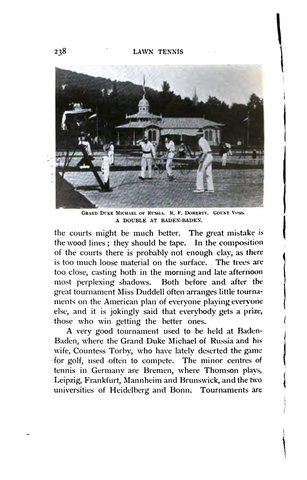
It is the second image because it is the other half of the argument. The cover is the amateurs of the Welsh covered court championship, photographed at Llandudno in 1902. This is the man who was paid, photographed for the same volume, captioned by the same publisher as champion of the world, and barred by rule from every event named on the cover.
Printed matter inside the frame, recorded as a negative: nothing legible inside the photograph itself.
**Sourcing note.** No passage in this entry is inside quotation marks, for the reason given under gaps. Where a caption, a running head, a signature or a credit line is set out in the capitals and abbreviations printed on the object, that is a description of what is on the page rather than a quotation of a text, and it follows the convention this series has used for the plates in this same volume.
**Sources.** Arthur Wallis Myers, editor, Lawn Tennis at Home and Abroad, Charles Scribner's Sons, New York, 1903, for H. S. Scrivener's chapter Memories of Men and Meetings and its sections on the Welsh Championships at printed page 64 and the Covered Court Championships at printed pages 78 to 80; for R. B. Hough's chapter Play in France and Switzerland at printed pages 252 onward and the professionals passage at printed pages 258 to 259; for the contents and the list of illustrations; and for both images: https://archive.org/details/lawntennisathom00myergoog , read as machine-read text at https://archive.org/download/lawntennisathom00myergoog/lawntennisathom00myergoog_djvu.txt , with the cover at https://archive.org/download/lawntennisathom00myergoog/page/n102.jpg and the second image at https://archive.org/download/lawntennisathom00myergoog/page/n279.jpg . Royal Commission on the Ancient and Historical Monuments of Wales, Coflein site record NPRN 415677, Craigside Hydropathic Hotel and Bath House, for the description of the building, its facilities, its beach bath house, the statement that it no longer stands, and the National Grid reference used for the coordinate: https://coflein.gov.uk/en/site/415677 . People's Collection Wales, item 1863431, an advertising leaflet for the Craigside Hydro Hotel uploaded by Conwy Archive Service, for the opening in 1888 by John Smith, the resident physician and the baths: https://www.peoplescollection.wales/items/1863431 . Encyclopaedia article on the Welsh Covered Court Championships, consulted through a fetching layer and not read in its own source text, for the founding year, the single venue, the indoor wood surface, the closing year and the champions roll used only as indicated above: https://en.wikipedia.org/wiki/Welsh_Covered_Court_Championships . Encyclopaedia article on the Llandudno Open, consulted the same way, for the outdoor grass tournament of 1890 to 1914, the arrangement of the courts around the hotel, and the hotel's wartime use and demolition: https://en.wikipedia.org/wiki/Llandudno_Open . Office for National Statistics postcode data served through https://api.postcodes.io/ , OpenStreetMap data through the Nominatim and Overpass services, and the Esri world geocoding service, for the corroborating readings and the coastline distance. Every cross-reference to this platform's own entries and every neighbouring-pin distance was queried against its stored records this run, and every distance and conversion was computed in-session.
changes?
delete this memory?
We detected that you have a Blox in your crypto wallet! We will import the Blox into your account.
Click on done below to complete the import.
Welcome Back!
Sign in to preserve cherished moments
Don't have an account?
Welcome!!
Sign up and start preserving cherished moments
?
?
Choose your payment method
Buy with Metablox Credit
Do you want to mint Blox with Metablox Credit?
Which Crypto would you like to use?
Purchase Confirmed!
Your Blox is being minted on-chain and will appear in your profile shortly.
Log in or sign up to claim your Blox.
How many credits do you want to buy?
$100 USD = 1 Metablox Credit = 1 Blox.
Use Metablox Credit to mint any Blox you want on the map.
 expand_more