


Tennis History | Beechgrove, Moffat — a national championship with no fixed home spent thirteen years at a sulphur spa, and both 1902 plates were made here
· 1902
Personal memoryBy kevin · · Report an issue





































Find memories left by people near you.
Distribute Bounty
This will distribute the bounty equally among all qualifying memories. This action cannot be undone.
Cancel Bounty
Are you sure you want to cancel this bounty? The remaining amount will be refunded to your account.
Success!
Operation completed successfully.
Error
Something went wrong.
Tennis History | Beechgrove, Moffat — a national championship with no fixed home spent thirteen years at a sulphur spa, and both 1902 plates were made here
kevin
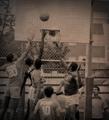
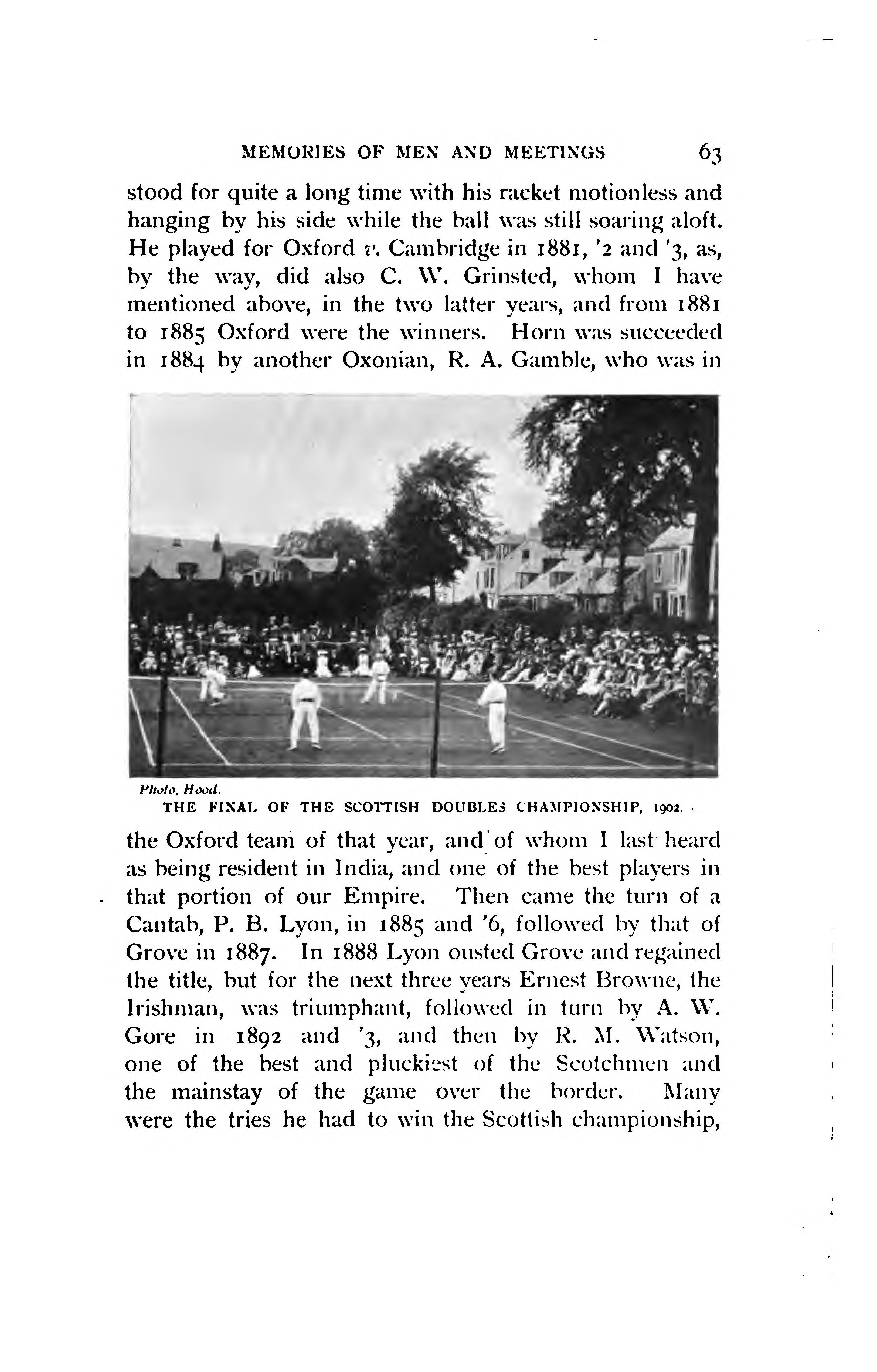
The cover of this entry is a photograph of a doubles final in progress, printed in a book of 1903. It is here because the ground in it is a field beside a street in a Scottish spa town of about two thousand people, and for thirteen years that field was where the national championship of Scotland was played.
A court is seen from one side and slightly above. The surface reads dark in the halftone and the lines are bright on it: a sideline and a tramline run along the bottom of the frame, a service line crosses the middle, and a net is strung across the picture between a post at the left edge and a second post right of centre. Four men in white are on court, two on the near side of the net and two beyond it; the nearest two stand square and still, one of the far pair is low and crouched close to the net at the left, and no racket in any of the four hands is legible at this size. Along the far side and filling the right third of the frame is a crowd several deep, some standing and some sitting on the bank, in pale dresses and light and dark hats. Behind them trees in full leaf, and behind the trees a row of houses with gables, dormers and tall chimneys, several of them pale rendered, with a steep pointed roof at the left. Beyond the roofs at the far left the ground rises into an open hillside under a light sky. Set in letterpress below: Photo, Hood. THE FINAL OF THE SCOTTISH DOUBLES CHAMPIONSHIP, 1902.
**What this entry argues.**
The Scottish Championships did not have a home. Over the span the sources cover they were played in at least seven different places, and for a stretch of forty-five years around the turn of the century most of their seasons were not played in Edinburgh or Glasgow at all. They were played in a sulphur spa town, in a spa town beside Stirling, and at a hydropathic hotel in the Borders. The arithmetic is set out below and comes to twenty-nine seasons out of forty-one.
That is not a Scottish peculiarity. This platform already carries the same mechanism at the Kurpark in Bad Homburg and on the Lichtentaler Allee at Baden-Baden, and at Dinard in Brittany. The amateur game followed the resort season, because the resort season was where the people who could afford to play without being paid actually were in July and August, and because a small town with hotels could put up a hundred visitors and a large town without them could not. Moffat is the Scottish instance, and until this entry it was the only one of the four with no pin.
**Where the pin is, and the name it is under.**
The encyclopaedia article on the Scottish Championships gives the tournament's venues in its infobox. Against Moffat it prints Moffat Beachgrove Grounds and the years 1895 to 1907.
The spelling in that line is not the spelling in the source it cites. The citation is to an Australian newspaper of 31 July 1896, digitised by a national library, and the passage quoted in the citation calls the place the Beechgrove Grounds and spells the town Mofatt. So the infobox has Beachgrove where its own source has Beechgrove, and its own source has Mofatt where the town is Moffat. This entry uses Beechgrove and Moffat, which are the spellings on the modern map, and records the other two rather than silently correcting them. The newspaper itself was not read for this entry; the wording reaches it through the citation.
Beechgrove is a residential street on the eastern side of Moffat today, and a mapped tennis ground sits immediately south-west of it. The pin below is the centre of that ground.
**Moffat.**
The encyclopaedia article on the town, read in its own source text, says Moffat is a burgh and parish in Dumfriesshire on the River Annan with a population of around 2,500, that it was a centre of the wool trade and a spa town, and that it lies about 51 miles south-west of Edinburgh and about 59 miles south-east of Glasgow. Those two figures are the article's and are reported rather than adopted: straight-line distances computed from this pin this session give 70.5 km, or 43.8 miles, to the centre of Edinburgh and 77.5 km, or 48.1 miles, to the centre of Glasgow, and the article does not say how its distances were measured or to what point.
It says the town began to grow from a small village into a popular spa from 1633, that the sulphurous and saline waters of Moffat Spa were believed to cure skin conditions, gout, rheumatism and stomach complaints, citing a Cambridge county geography of 1912 for that, and that iron springs were added in 1730. It says that in the Victorian era demand was such that the water was piped down from the well to a tank in Tank Wood and on to a purpose-built bath house in the town centre, citing a railway handbook of 1863. It gives the town's population at the 1841 census as 1,413.
And it says that luxurious hotels went up to take the increasing numbers of visitors, that one of them, a hydropathic hotel, opened in 1878, and that it was destroyed by fire in 1921.
Two dates there are worth putting side by side, and this entry does so without claiming a causal link between them, because nothing read here establishes one. The hydropathic hotel opened in 1878. The Scottish Championships began in 1878. The championship reached Moffat in 1895 and left in 1907, and the hotel burned in 1921.
**Seven towns, and the arithmetic of where the meeting actually sat.**
The same infobox lists the venues as the Grange Club in Edinburgh, St Andrews Lawn Tennis Club, the Inverkip Rovers Club, the Moffat ground, Bridge of Allan Lawn Tennis Club, the Craiglockhart club in Edinburgh, Peebles, and Glasgow, and the article's body sets out the sequence: the Grange Club from 1878 until 1892; St Andrews once only, in 1893; Moffat in the late 1890s and most of the 1900s; Bridge of Allan from 1908 to 1912 and again in 1914; Craiglockhart from 1913 and again for long stretches after both wars; the Peebles Hotel Hydro courts through the whole of the 1930s; Glasgow once, in 1958; and a single return to the Grange Club in 1994.
That infobox contains one plain error, and this entry names it rather than reading past it. In the run of years given for the Craiglockhart club it prints 1900, which cannot be right, because the same infobox gives 1895 to 1907 to Moffat. Nothing read here establishes what the figure was meant to be, and this entry does not guess.
Setting that stray year aside and counting the years the list itself gives, the pattern is clear enough to state as arithmetic. Between 1895 and 1939 the championship was played in forty-one years: twenty from 1895 to 1914, and twenty-one from 1919 to 1939, with the intervening war years absent from the list. Of those forty-one, thirteen were at Moffat, six at Bridge of Allan, and ten at the Peebles Hotel Hydro, which is twenty-nine. The remaining twelve, in 1913 and from 1919 to 1929, were at Craiglockhart in Edinburgh. Every figure in that paragraph was recomputed for this entry from the article's own venue list.
The three towns that took the twenty-nine are of one kind. The encyclopaedia article on Bridge of Allan, read for this entry, calls it a spa town and refers to the boom years of hydropathic establishments there. The article on the Peebles Hydro describes it as a hotel and spa resort built by a company whose name was the Hydropathic Company and opened in 1881, and says it is one of the hydropathic hotels still open in Scotland. And Moffat is the sulphur spa above.
Thirteen consecutive editions is also, on this list, the second-longest unbroken run the tournament ever had anywhere, behind the fifteen at the Grange Club from 1878 to 1892. That comparison holds only over the years the list assigns. The list gives no venue at all for 1971 to 1993, and this entry makes no claim about where the championship was played in those years.
**Where it started, and a disagreement about that.**
Herbert Scrivener contributed a chapter of recollections to Arthur Wallis Myers's Lawn Tennis at Home and Abroad, published in New York in 1903, and gave it a section on the Scottish Championships, printed at page 62. He opens it by saying that the early Scottish championships were held not at Moffat, as now, but on the courts of the Dyvours Club in Edinburgh.
The encyclopaedia article says the tournament was originally held at the Grange Club in Edinburgh until 1892, citing a Scottish newspaper article of 25 July 1994.
Those are two different club names for the same city and the same period, and this entry does not resolve them. Nothing read this session establishes whether the Dyvours club and the Grange club shared a ground, whether one played on the other's courts, or whether one of the two accounts is simply wrong. Both are set down. The 1903 statement has the advantage of being written eleven years after the period it describes by a man who was in the game at the time; the 1994 statement has the advantage of being what a newspaper reported when the championship went back there. Neither is adopted here, and no pin is placed in Edinburgh on the strength of either.
What both agree on is the shape of the thing: the meeting began in the capital and had left it by the middle of the 1890s.
**Who played here, and who did not.**
The article's tables of finals let the Moffat years be separated from the rest, and this matters for cross-references, because a Scottish title is not automatically a Moffat title.
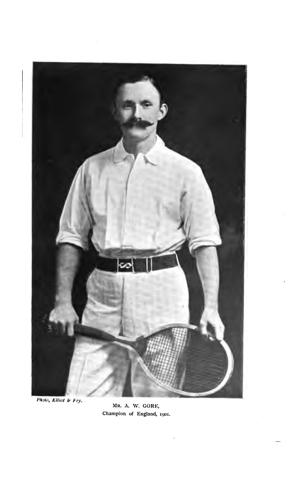
Arthur Gore, whose life this platform pins at Dinard, won the Scottish men's singles in 1892 and 1893. Both fall before Moffat: 1892 is the last Grange year and 1893 is the single St Andrews year. Gore did not win a Scottish title at this ground, and this entry says so plainly because the temptation to file him here is obvious and would be wrong.
The men's champions at Moffat, on the article's table as read this session, run: Reginald Doherty in 1895, 1896 and 1897; Laurence Doherty in 1898; Ernest Douglas Black in 1899; Charles Pritchett in 1900; Wilberforce Eaves in 1901; Frank Lorymer Riseley in 1902; Frederick William Payn in 1903; Anthony Wilding in 1904; and Alexander Morrice Mackay in 1905, 1906 and 1907.
Three of those touch entries this platform already carries. Anthony Wilding, whose life is pinned here at the place in northern France where he was killed in 1915, won this title in 1904, beating Charles James Glenny 6-1, 6-1, 6-2. Wilberforce Eaves, who appears in this platform's entries on Dinard, on the Queen's Club Olympic tennis of 1908 and on the Chiswick Park ground, was runner-up here in 1899 and champion in 1901. Frank Riseley took the 1902 title from John Mycroft Boucher over five sets, 6-4, 3-6, 7-5, 4-6, 6-2, in the same week and on the same ground as the doubles final on this entry's cover.
On the women's side the article gives the Moffat years to Lottie Paterson in 1895 and 1896, Minnie Hunter in 1897 and 1900, Madeline O'Neill in 1898, Charlotte Cooper in 1899, Muriel Robb in 1901, Alice Maud Ferguson in 1902 and 1906, M. Crawford in 1903, Winifred Longhurst in 1904, and Mary Curtis-Whyte in 1905. The rows read for this entry stop at 1906; the 1907 women's row was not read and no name is given for it here. Charlotte Cooper is the player this platform pins at Worple Road, where she won as Miss Cooper and again, later, under her married name. Her Scottish title of 1899 was won here.
Scrivener, writing in 1903, adds a line about the women's game in Scotland that the tables do not carry. He says Scotland produced few really good women players and that Miss L. Paterson, champion in 1894, 1895 and 1896, was probably the best of them, the first of those three years falling before Moffat, at the Inverkip Rovers Club, and calls her a wonderfully plucky player who never fought so gamely as in the face of almost certain defeat. That is one man's opinion set down in a book of reminiscences, and this entry reports it as his. The table agrees with him on the three years.
**Two things about the results that a modern table hides.**
The first is the challenge round. The article says in a note above its tables that under this system the winner of the knock-out phase then played the previous year's champion, who played only that one match, and that it was used in some tournaments from 1877 to 1921. The article marks challengers with an asterisk in the Moffat years, which means that Richard Millar Watson in 1895, Roy Allen in 1896, Laurence Doherty in 1897 and Reginald Doherty in 1898 were the men who had come through the draw, and the man named as champion in each of those rows was the holder defending. A row that looks like a final in a modern table is, in those four years, a different kind of match.
The second is that a good many of these titles were not played for at all. On the article's own table the 1897 challenge round between the two Doherty brothers was a walkover, and so was the 1898 one, in the other direction. Two national championships in consecutive years, between the same two men, with nothing struck. The 1892 and 1894 titles, before Moffat, were also walkovers. This entry does not speculate about why, because nothing read here says.
Everything above happened under rules barring anyone who had ever been paid to play. No figure in this entry is set against anything after 1968, when those rules ended at the four major championships. The phrase Grand Slam appears nowhere else in this entry and is worth one line of disambiguation anyway, because readers arrive with it: it carries two ordinary senses, the four major tournaments taken as a set and all four won inside a single calendar year, and neither sense was available in the years described here, since this platform's own entries record that the four were designated as majors only from the middle of the 1920s.
Nationality is the other thing a table flattens. The article's own flag icons give Wilding as a New Zealander, Ernest Browne under a pre-1922 Irish flag, Arthur Benjamin Carvosso as Australian and Eaves as British, and this entry follows the article in describing each man by what it says he represented at the time rather than by a modern state.
**Status, dated.**
Read on 7 September 2026. Moffat is still a small town in Dumfries and Galloway. A mapping query run this session returns a tennis ground on the west side of Beechgrove, tagged as a tennis pitch and named simply Tennis Courts, whose mapped outline encloses 4,210 square metres, or 1.04 acres, and reaches 69.9 m from its own centre at its furthest point. The public park immediately to the west, Hope Johnstone Park, is a separate mapped object and is not what this entry pins.
Whether the courts mapped there today occupy the same ground the championship was played on in 1895 is not established. What is established is that the street is called Beechgrove, that the source names the Beechgrove Grounds at Moffat, and that a tennis ground is there now. That is a strong circumstantial identification and it is not proof, and the radius below is set wide enough to cover a differently shaped enclosure on the same site.
The sulphurous well above the town was refurbished in the mid 1990s and, on the town article's account, is still reachable on foot or by vehicle. Nothing above should be read as describing any arrangement at the tennis ground later than the date of this reading.
**Naming discipline.**
The Championships, Wimbledon is named twice above and is never the Wimbledon Open; the event has no Open in its name and never has had. The Scottish event is called the Scottish Championships here because that was its name for the whole of the period described; the article records that it was also known as the Scottish Lawn Tennis Championships and later as the Scottish Grass Court Championships, and gives 1994 as the year the original name ended.
**Gaps this entry declares.**
Nothing in this entry is inside quotation marks. The condition this series applies is that machine-read text earns quotation marks only where the same copy was set by two independent printers, and nothing used here satisfies it: one book of 1903 in a single typesetting, and four encyclopaedia articles.
No Scottish newspaper report of a championship week at Moffat was sought or read this session. The meeting ran there for thirteen consecutive years in a town on a main railway line, and the Scottish press certainly printed its draws. That is the route to a quotation here, to the identity of the four men on the cover, and to the exact location and layout of the Beechgrove courts, and it is untried. An attempt to open the Australian newspaper page cited for the Beechgrove name returned a page whose text could not be read this session, and the negative is recorded rather than the fact taken as confirmed from a second reading.
The Scottish doubles championship has no table in the encyclopaedia article. The cover of this entry is a photograph of a doubles final and this entry cannot name a single man in it, or say who won.
Nothing was read from the club's own records, from the Moffat burgh records, or from the Scottish Lawn Tennis Association. The venue years, the spellings and the results all reach this entry through one encyclopaedia article and its citations, several of which are to a commercial tennis statistics database and to a newspaper archive behind a subscription, and none of which was consulted at source.
The photographer credited on both plates as Hood was not identified. Whether Hood was a Moffat, Dumfries or London firm is not established here.
The 1903 book's account of the Scottish meeting is Scrivener's memory, written up for a general readership, and the section carries no dates for its own composition. Where it disagrees with a modern table, as it does on nothing material here, this entry would print both.
**Coordinate.** 55.336788, -3.447424, precision radius 200 m. The anchor is the tennis ground at Beechgrove, Moffat, in Dumfriesshire, in the Dumfries and Galloway council area of Scotland.
Three readings from three different regimes were taken and the pin is the first of them rather than an average. The first is a mapped object: the OpenStreetMap way tagged as a tennis pitch beside Beechgrove, whose twelve-node outline was fetched through an Overpass mirror and whose polygon centroid is the pin. The second is a commercial geocode: the Esri world geocoder returns the street Beechgrove, Moffat, Dumfriesshire at 55.337300, -3.447314, which is 57.4 m from the pin. The third is a national statistical product independent of both: the Office for National Statistics postcode centroid for DG10 9JA, served through a public postcode interface and carrying its own Ordnance Survey grid reference of 308236 east, 605661 north, lies at 55.336400, -3.448202, which is 65.4 m from the pin. The three lie between 57.4 m and 114.8 m from one another.
The radius is 200 m and it is a judgement, not a measurement of the modern outline. Covering the whole of the mapped tennis ground from this pin needs 69.9 m, and the three readings themselves reach 65.4 m. The radius is set at 200 m instead because this entry has said it cannot show that the 1902 enclosure had today's shape, and a championship week with a marquee and several courts needed more ground than the 1.04 acres mapped now. It is not wider than that because 200 m stops short of Hope Johnstone Park, which this entry does not claim.
The nearest pin of any kind on this platform is 52.5 km away, at James Clerk Maxwell's grave at Parton in Galloway, and it belongs to another vertical. This is not the first Scottish pin on the platform; it appears to be the first tennis one, and the nearest other tennis pin is a long way off, at Upper Pembroke Street in Dublin, 287.5 km west across the Irish Sea. The nearest tennis pin in Great Britain is the vanished Bayswater covered court in London, 476.3 km south-east. For the argument above the distances that matter are to the other resort tennis grounds this platform carries: 751.1 km to Dinard, 988.7 km to the Kurpark at Bad Homburg and 1,081.3 km to the Lichtentaler Allee at Baden-Baden. All distances were computed in-session.
**Cover.** Arthur Wallis Myers, Lawn Tennis at Home and Abroad, Charles Scribner's Sons, New York, 1903; digitised from a Google-sponsored scan held by the Internet Archive. The photograph on the leaf the archive numbers n84, at 3250 by 5084 px, mean brightness 220.4 of 255, standard deviation 73.8. Opened at full size and examined, and the photograph cropped and enlarged.
The leaf carries the printed page number 63 in its running head, under the chapter title Memories of Men and Meetings, so the offset between the archive's leaf numbers and the book's printed pages is twenty-one here, the same offset this series has established on other leaves of the same scan. The neighbouring leaves were measured before anything was concluded from this one, because scans of this kind sometimes carry whole runs of failed halftones: n82 returns a mean of 214.2, n83 239.5, n85 238.3, n86 191.1 and n87 230.0. Nothing in the run is blank.
The caption does not name the place, and this entry states how the ground in it is identified. The book's list of illustrations names a second plate as a group of players at the Scottish championship meeting at Moffat in 1902; the encyclopaedia article puts the 1902 championship at Moffat; and the two plates carry the same photographer's credit and the same year. On that reasoning the court in the cover is at Moffat. It is a reasoned identification from two captions and a venue list, not a statement the book makes, and nothing read here rules out the alternative that the doubles final of that year was photographed somewhere else.
Printed matter in the frame, recorded as a negative: nothing legible inside the photograph. The photographer's credit and the caption are set on the page below the image.
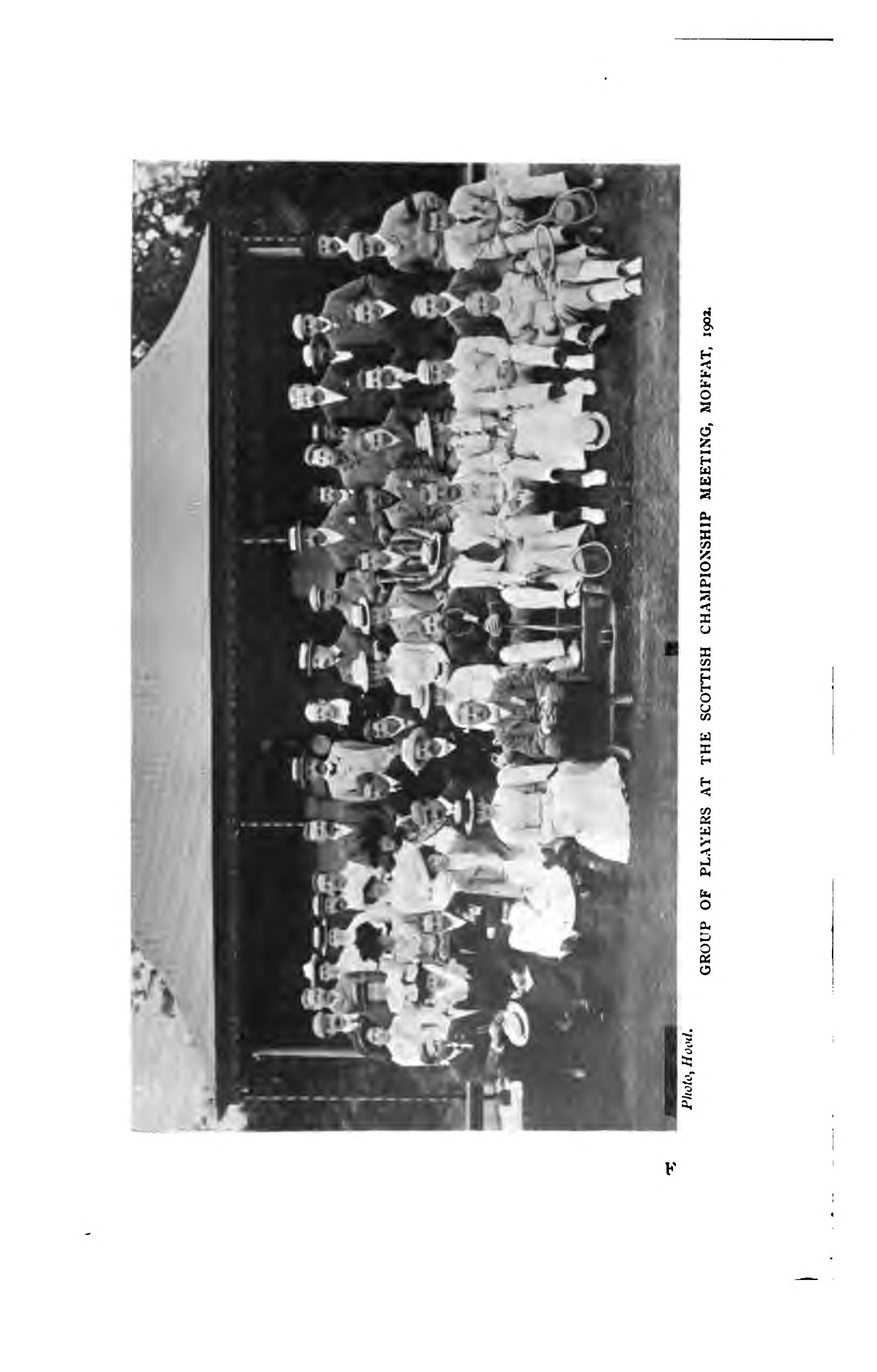
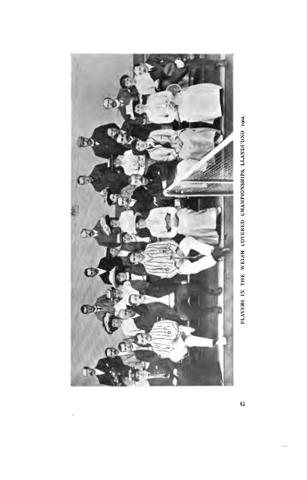
**Second image.** The same book, the full-page plate on the leaf the archive numbers n86, at 3250 by 5084 px, mean brightness 191.1 of 255, the darkest leaf in the run measured above, which is what a full-page halftone should be. Opened at full size, rotated and read.
It is printed sideways on the page and carries no printed page number, so the offset used for the cover was not applied to it; it was found by opening leaves rather than by calculation, and it is an inserted plate rather than a text page, with a gathering signature F set below it.
The photograph shows roughly forty people, not counted exactly, arranged in three or four rows on grass in front of a large pale canvas tent or marquee whose side fills the left of the frame. The front row sits, several of them on the ground; the rows behind stand. Women in light dresses and large hats are mixed through the group with men in white flannels, some in dark blazers, several in straw hats. At least four rackets are held up or across the body, one of them raised clear above a shoulder at the right. A dark object at the lower centre reads as a bench or a piece of equipment and is not identified here. Set in letterpress: Photo, Hood. GROUP OF PLAYERS AT THE SCOTTISH CHAMPIONSHIP MEETING, MOFFAT, 1902.
This is the plate that names the place, and it is the reason the cover can be attributed to Moffat at all.
Printed matter in the frame, recorded as a negative: nothing legible inside the photograph.
**Sourcing note.** No passage in this entry is inside quotation marks, for the reason given under gaps. Every attribution above is paraphrase. Where a caption, a running head or a credit line is set out in the capitals and abbreviations printed on the object, that is a description of what is on the page rather than a quotation of a text, and it follows the convention this series has used for the plates in this same book.
**Sources.** Arthur Wallis Myers, Lawn Tennis at Home and Abroad, Charles Scribner's Sons, New York, 1903, for H. S. Scrivener's section on the Scottish Championships at printed pages 62 to 64, the Dyvours Club statement, the note that the meeting was at Moffat as of writing, the passage on Miss L. Paterson, the list of illustrations, and the two plates used: https://archive.org/details/lawntennisathom00myergoog , read as text at https://archive.org/download/lawntennisathom00myergoog/lawntennisathom00myergoog_djvu.txt , with the cover at https://archive.org/download/lawntennisathom00myergoog/page/n84.jpg and the second image at https://archive.org/download/lawntennisathom00myergoog/page/n86.jpg . Encyclopaedia article on the Scottish Championships, read in its own source text, for the tournament's span and editions, the venue list and its years, the Grange Club statement, the challenge-round note, the men's and women's finals tables and their scores and asterisks, the walkovers, and the alternative names of the event: https://en.wikipedia.org/wiki/Scottish_Championships_(tennis) . Encyclopaedia article on Moffat, read in its own source text, for the burgh and parish, the population figures of about 2,500 today and 1,413 at the 1841 census, the distances to Edinburgh and Glasgow, the spa from 1633, the sulphurous and saline waters and the complaints they were held to cure, the iron springs of 1730, the piping of the water to Tank Wood and the bath house, the hydropathic hotel of 1878 and its destruction by fire in 1921, and the refurbishment of the well: https://en.wikipedia.org/wiki/Moffat,_Dumfries_and_Galloway . Encyclopaedia article on Bridge of Allan for its description as a spa town in the hydropathic boom: https://en.wikipedia.org/wiki/Bridge_of_Allan . Encyclopaedia article on the Peebles Hydro for the Hydropathic Company, the opening date of 1881 and its description as a spa resort: https://en.wikipedia.org/wiki/Peebles_Hydro . OpenStreetMap tennis-ground and street geometry obtained through an Overpass mirror, the Esri world geocoding service, and Office for National Statistics postcode data served through https://api.postcodes.io/ , for the coordinate. Every cross-reference to this platform's own entries and every neighbouring-pin distance was queried against its stored records this run, and every arithmetic figure was recomputed in-session.
changes?
delete this memory?
We detected that you have a Blox in your crypto wallet! We will import the Blox into your account.
Click on done below to complete the import.
Welcome Back!
Sign in to preserve cherished moments
Don't have an account?
Welcome!!
Sign up and start preserving cherished moments
?
?
Choose your payment method
Buy with Metablox Credit
Do you want to mint Blox with Metablox Credit?
Which Crypto would you like to use?
Purchase Confirmed!
Your Blox is being minted on-chain and will appear in your profile shortly.
Log in or sign up to claim your Blox.
How many credits do you want to buy?
$100 USD = 1 Metablox Credit = 1 Blox.
Use Metablox Credit to mint any Blox you want on the map.
 expand_more