
- Home
- Technology History | IBM Across a Century | Cambridge, San Jose, Poughkeepsie, Boca Raton and New York
- Technology History | Equitable Center — Nineteen Moves, and the Champion Stood Up
Technology History | Equitable Center — Nineteen Moves, and the Champion Stood Up
· 1997-5
Personal memoryBy kevin · · Report an issue
Find memories left by people near you.
Distribute Bounty
This will distribute the bounty equally among all qualifying memories. This action cannot be undone.
Cancel Bounty
Are you sure you want to cancel this bounty? The remaining amount will be refunded to your account.
Success!
Operation completed successfully.
Error
Something went wrong.
Technology History | Equitable Center — Nineteen Moves, and the Champion Stood Up
kevin
Game six lasted an hour and nineteen moves.
Garry Kasparov pushed back his chair and walked out, and the match went to a machine, three and a half to two and a half.
That was 11 May 1997, on the thirty-fifth floor of the Equitable Center at 787 Seventh Avenue.
About five hundred spectators watched from an auditorium downstairs on closed-circuit television, most of them having paid $25 for the game.
The qualifier matters here, because two different firsts get run together.
Deep Blue had already beaten a reigning world champion in a single game, in Philadelphia in February 1996, and then lost that match four to two.


New York was the first time a computer took a whole match from a reigning world champion under standard tournament time controls.
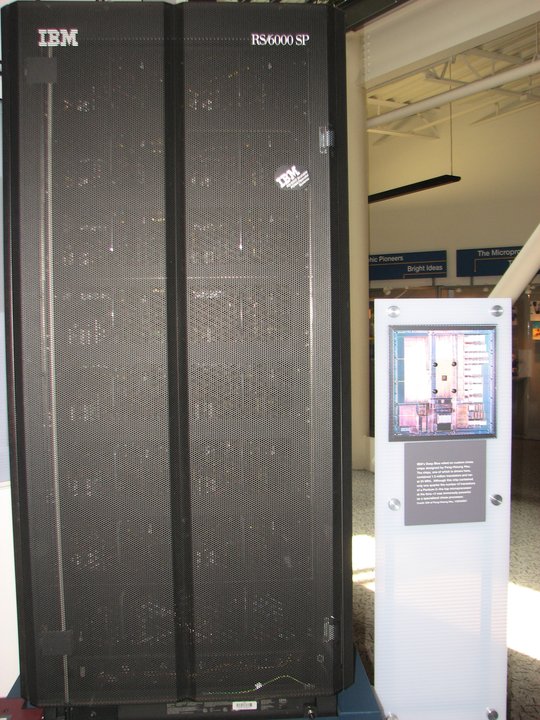
The machine was an IBM RS/6000 SP carrying thirty processors and 480 custom chess chips built around Feng-hsiung Hsu's designs, searching in the region of 200 million positions a second.
Kasparov opened with the Caro-Kann and played 7...h6, a move he believed sat outside Deep Blue's opening book.
It did not.
Deep Blue sacrificed a knight on e6, and the position never came back.
Kasparov told reporters afterwards that the computer was far stronger than anyone had expected, which was gracious.
He then accused IBM of human intervention during the games, which was not, and asked for a rematch.
IBM declined, retired the machine, and never played it competitively again.
Reports that Deep Blue was dismantled circulated widely and were wrong; it stayed in operation for several years.
Both racks survive.
One is held by the Smithsonian's National Museum of American History, and the other went to the Computer History Museum in 1997, where it stands in the Revolution exhibition's artificial intelligence gallery.
That second rack is what this photograph shows, with the interpretive panel beside it displaying one of Hsu's chess chips.
787 Seventh Avenue is a working Midtown office tower, and the thirty-fifth floor is not open to visitors.
Sources: IBM Heritage; Wikipedia's game and match records checked against the Chess Programming Wiki; University of Alberta match report; Forbes.
Photo: Erik Pitti, CC BY 2.0, via Wikimedia Commons.
changes?
delete this memory?
We detected that you have a Blox in your crypto wallet! We will import the Blox into your account.
Click on done below to complete the import.
Welcome Back!
Sign in to preserve cherished moments
Don't have an account?
Welcome!!
Sign up and start preserving cherished moments
?
?
Choose your payment method
Buy with Metablox Credit
Do you want to mint Blox with Metablox Credit?
Which Crypto would you like to use?
Purchase Confirmed!
Your Blox is being minted on-chain and will appear in your profile shortly.
Log in or sign up to claim your Blox.
How many credits do you want to buy?
$100 USD = 1 Metablox Credit = 1 Blox.
Use Metablox Credit to mint any Blox you want on the map.
expand_more