


NFL History | Griffith Stadium Site, Washington — The Title Game That Was Sold to a Radio Network
· 1940-12
Unreviewed contributionBy kevin · · updated · Report an issue









.jpg?width=1280)



































Find memories left by people near you.
Distribute Bounty
This will distribute the bounty equally among all qualifying memories. This action cannot be undone.
Cancel Bounty
Are you sure you want to cancel this bounty? The remaining amount will be refunded to your account.
Success!
Operation completed successfully.
Error
Something went wrong.
NFL History | Griffith Stadium Site, Washington — The Title Game That Was Sold to a Radio Network
kevin
On Sunday 8 December 1940 the Chicago Bears beat Washington 73-0 in the National Football League's championship game, on a baseball ground at Georgia Avenue NW where the football club was a tenant. Pro-Football-Reference's box score gives the crowd as 36,034. Three weeks earlier, on Sunday 17 November, the same two clubs had played on the same field, Washington had won 7-3, and 35,331 people had watched. Between those two Sundays the gate moved by about seven hundred.
What changed was outside the ballpark. The Pro Football Hall of Fame's chronology records that the Mutual Broadcasting System paid $2,500 for the rights and that Red Barber called the game to 120 Mutual stations, and describes it as the first championship carried on network radio. That wording is narrower than it first reads, and worth keeping narrow: the claim is about a title game and about network radio, not about broadcasting in general. What it marks is a sale: the rights to one football game, to one network, for one fee. Set against the 36,034 people who paid to be there, the result went out over 120 stations.
The statute that let the clubs sell their broadcast rights as a single package was twenty-one years away. Public Law 87-331 was signed on 30 September 1961.
## The game the network got
The Hall of Fame's chronology credits the Bears' attack that afternoon to the T formation with a man in motion, developed by George Halas with Clark Shaughnessy of Stanford. The Pro Football Researchers Association's account of the season, published in The Coffin Corner, puts the formation's yardage that day above five hundred and describes the modern additions that made it work: flankers, men in motion, splits in the line.
The Bears scored eleven touchdowns. Their own club history records eight interceptions of Washington passes, three of them returned for scores. Toward the end the officials asked Halas to run or throw the conversions rather than kick them, because kicked balls were going into the crowd and the game was down to its last football. The Bears' account and History.com agree on that; neither is a contemporary newspaper, and this entry does not try to reconcile the story with the conversion line of Pro-Football-Reference's box score.
Three weeks of grievance sat behind it. In the November game the Bears believed a pass interference call had been missed on the last play; Washington's owner George Preston Marshall answered by calling them quitters and crybabies. Both the Bears' club history and History.com report the insult and report Halas putting it in front of his players before the championship. The Researchers Association's account has Washington's Sammy Baugh, asked afterwards about a pass his own receiver had dropped in the first quarter, answering that catching it would have made the score 73-7. Marshall's words and Baugh's reach this entry second hand, through summaries rather than through the newspapers that printed them, so neither is quoted.
## A baseball park with a gridiron in it
The ground was the American League Senators' home, rebuilt in steel and concrete in 1911 on the block bounded by Georgia Avenue, W Street, Fifth Street and Florida Avenue NW. The National Ballpark Museum lists Washington's professional football club as a tenant from 1937 to 1960, and gives the park's capacity as 32,000 in 1921 and 27,550 in 1961.
Both of those numbers are smaller than either announced football crowd of 1940. Nothing consulted here reconciles them. A football configuration of a baseball park is not the same set of seats as the baseball one, and standing room was ordinary in both sports, but that is an explanation rather than a source, and the figures are left as they were published.
The last game at the park was played on 21 September 1961. The National Ballpark Museum dates the demolition from 26 January to 14 August 1965. Howard University Hospital stands on the site.
## Coordinate
The pin is 38.918270, -77.021825, with a precision radius of 150 metres.
Two federal records were used and they agree. The United States Census Bureau's TIGER geocoder returns 38.918270, -77.021825 for 2041 Georgia Avenue NW; the Department of Health and Human Services' hospital facility file, published on healthdata.gov as dataset anag-cw7u, carries Howard University Hospital at 38.918, -77.021. They are not fully independent of one another, and that is stated rather than dressed up: both answer the question where is this postal address, and neither answers where was the ballpark.
The ballpark was a block, not an address. TIGER puts the corner of Georgia Avenue NW and W Street NW at 38.918989, -77.021899, about eighty metres north of the pin, and the block ran east to Fifth Street and north to Florida Avenue. The radius is set to cover that ground rather than the hospital's entrance. Visitors should remember this is a working hospital.
## Cover image
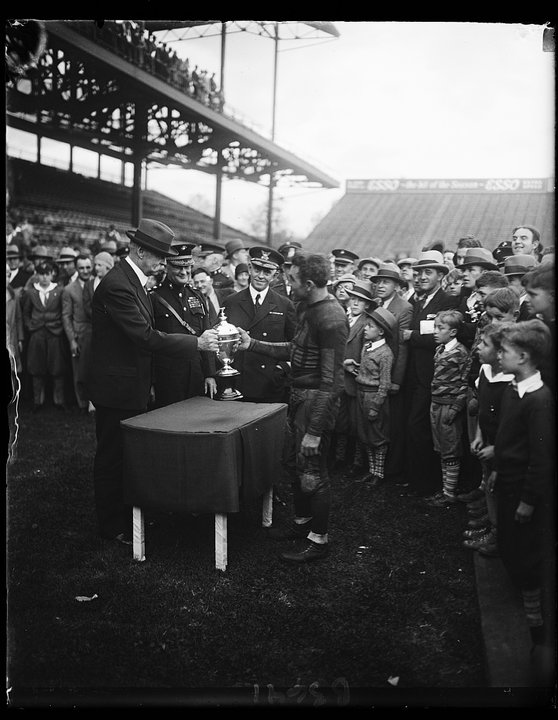
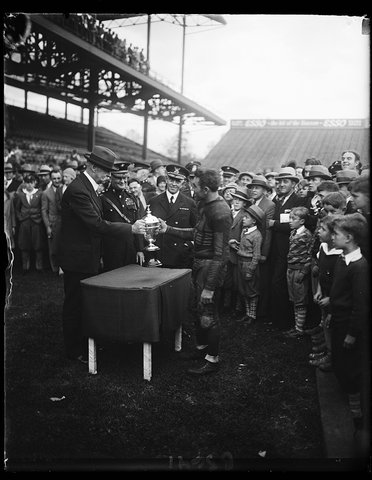
The President's Cup being handed to the winning Marine Corps captain after a service football game at Griffith Stadium on 2 October 1929, photographed by Harris and Ewing. Library of Congress Prints and Photographs Division, digital id hec.35567; no known restrictions on publication. It is football on this ground, eleven years before the championship, with the grandstand and the outfield advertising in frame; it is not a photograph of the 1940 game. The Library holds one of those, George McAfee running for seven yards, but it carries publication restrictions and is not used here.
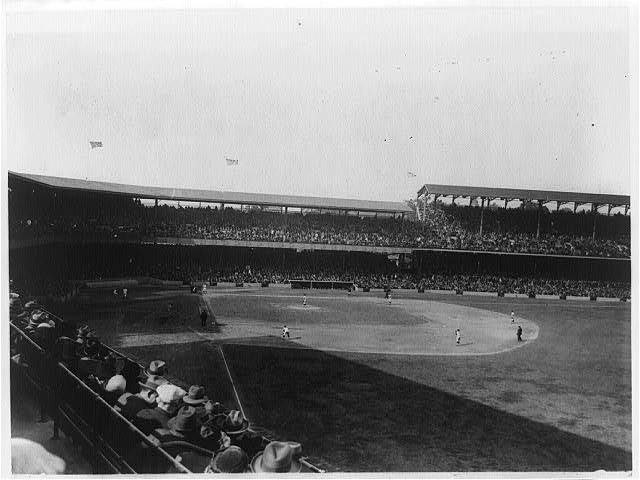
Second image: a baseball game at the same park between 1909 and 1932, showing the diamond a gridiron had to be laid across. National Photo Company Collection, Library of Congress Prints and Photographs Division, digital id cph.3b40851; no known restrictions on publication.



changes?
delete this memory?
We detected that you have a Blox in your crypto wallet! We will import the Blox into your account.
Click on done below to complete the import.
Welcome Back!
Sign in to preserve cherished moments
Don't have an account?
Welcome!!
Sign up and start preserving cherished moments
?
?



Choose your payment method
Buy with Metablox Credit
Do you want to mint Blox with Metablox Credit?
Which Crypto would you like to use?
Purchase Confirmed!
Your Blox is being minted on-chain and will appear in your profile shortly.
Log in or sign up to claim your Blox.
How many credits do you want to buy?
$100 USD = 1 Metablox Credit = 1 Blox.
Use Metablox Credit to mint any Blox you want on the map.
 expand_more