


NFL History | Adelphia Coliseum, Nashville — The Standard of Proof Decided It, Not the Throw
· 2000-1
Unreviewed contributionBy kevin · · Report an issue






.jpg?width=1280)







































Find memories left by people near you.
Distribute Bounty
This will distribute the bounty equally among all qualifying memories. This action cannot be undone.
Cancel Bounty
Are you sure you want to cancel this bounty? The remaining amount will be refunded to your account.
Success!
Operation completed successfully.
Error
Something went wrong.
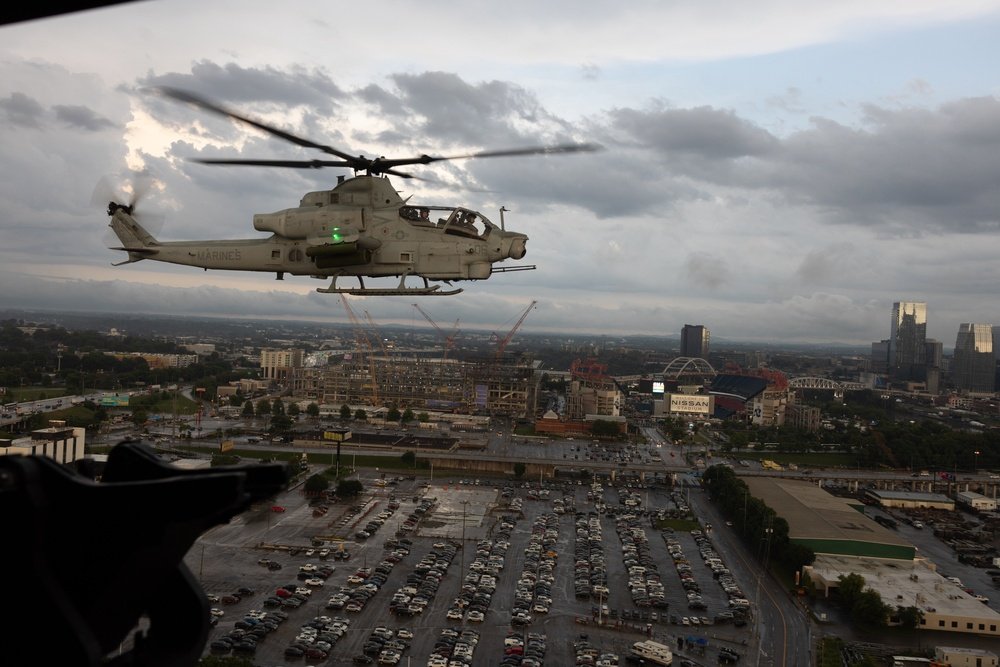
NFL History | Adelphia Coliseum, Nashville — The Standard of Proof Decided It, Not the Throw
kevin
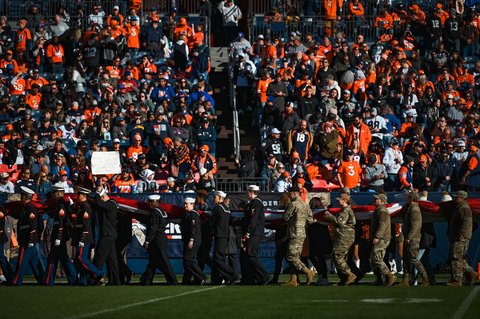
On 8 January 2000 the Tennessee Titans beat the Buffalo Bills 22-16 in an AFC wild-card game on this ground. Pro-Football-Reference records the attendance as 66,782 and names the venue Adelphia Coliseum, which is what the building was called that afternoon. What the game is remembered for happened in its last sixteen seconds, and what decided it was not the play.
Buffalo had gone ahead 16-15 on a 41-yard field goal by Steve Christie. The Seattle Times, reporting the following morning, sets out what followed: the Bills kicked short, the fullback Lorenzo Neal fielded the ball instead of the intended returner, and Neal handed it to the tight end Frank Wycheck. Wycheck carried it to about the 25-yard line and threw it across the field to Kevin Dyson, who caught it near the opposite sideline and ran 75 yards to the end zone. Tennessee's coach Jeff Fisher said afterwards that he had taken Dyson off the bench for the play and told him what the side meant to do. Nashville's name for it, then and since, is the Music City Miracle.
Whether Wycheck's throw travelled forward is the question the game is argued about. It is not the question the review answered.
The play was reviewed by the referee, Phil Luckett, at the sideline monitor. The Seattle Times records his ruling and his reasoning: the line judge's call on the field had been that the pass was not forward, and on the monitor the ball appeared to leave Wycheck's hand and to be caught on the same yard line. The touchdown stood. Buffalo's owner Ralph Wilson said afterwards that he thought the ball had gone forward, and in the same breath that there had never been any prospect of the referee overturning it.
Wilson had described the mechanism exactly. Under the system the league was then operating, a ruling made on the field is not decided again from nothing; it is reversed only where the referee has indisputable visual evidence to reverse it. Chad M. Oldfather and Matthew M. Fernholz, writing on NFL replay as a form of appellate review in the Indiana Law Review in 2009, call that standard highly deferential to the official on the field, and record that it was drawn that way on purpose, so that reversals would not end up more contested than the calls they replaced. A cross-field throw between two men a few feet apart, filmed from the side, is very hard to prove indisputably in either direction. So the standard never asked whether the pass was lateral. It asked whether the film proved it was not. It did not, and the ruling on the field survived - and the ruling on the field was a touchdown.
The review was also not Buffalo's to ask for. Under the restored rules a coach bought a review by spending a timeout, but inside the last two minutes of a half the challenge did not apply and the review official in the booth initiated the review instead. With sixteen seconds on the clock, nobody on the Buffalo sideline chose this review, and nobody there could have chosen a different one.
Two things at Adelphia Coliseum that afternoon were about four months old. The Pro Football Hall of Fame records that the owners voted 28-3 on 17 March 1999 to adopt an instant replay system for that season, and that an earlier system, adopted in 1986, had been abandoned in 1991. The 1999 season was the first played under the restored rules, which makes this a game in its first postseason. The building was newer still: StadiumDB gives it an opening date of 27 August 1999, a construction cost of 290 million dollars and a capacity of 69,143, and sets out the sequence of its names - Adelphia Coliseum to 2002, then The Coliseum, then LP Field from 2006, then Nissan Stadium from 2015.
A substitute deciding a wild-card game is something this vertical has already recorded from the other side. Memory 9513 covers 3 January 1993 at Orchard Park, where a Buffalo reserve quarterback erased a thirty-two-point deficit. Seven years later Buffalo lost a wild-card game to a returner taken off the bench for one play. No rule joins the two, and the note is here so that the coincidence is not mistaken for one.
Status note, 4 September 2026: the stadium described here still stands, and a replacement is being built immediately to its east, on ground that was previously parking. StadiumDB's construction record, last updated 28 May 2026, gives the project a cost of about 2.1 billion dollars, of which 1.26 billion is public - 500 million from the State of Tennessee and 760 million from metropolitan Nashville - against 840 million from the club, with completion anticipated in spring 2027 and a capacity of roughly 60,000, some ten thousand fewer than the building it replaces. StadiumDB describes that public share as the largest committed to any NFL stadium project; that is StadiumDB's characterisation, and no independent ranking is offered here. The source does not say what becomes of the older stadium. All of this is live and should be checked before it is relied on.
Coordinate: 36.166389, -86.771389. Two sources were run for this pin and they do not agree. The value used is the stadium-centre coordinate recorded in this vertical's earlier research. A United States Census TIGER geocode of 1 Titans Way, Nashville, run on 4 September 2026, returned 36.166985, -86.773987 - about 240 m to the north-west. The disagreement cannot be resolved from here, and the reason for distrusting the second value is in the paragraph above: a second stadium is going up on adjacent ground and the approach roads are shared, so a 2026 address geocode should not be assumed to point at the 1999 building. The pin stays on the recorded value and the radius is widened to cover both. Precision plus or minus 300 m.
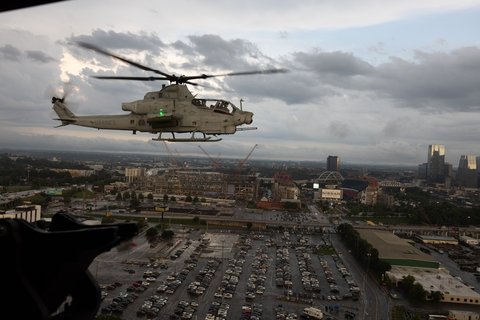
Cover: the stadium seen from a helicopter on 6 June 2025, its exterior lettering legible, the towers of downtown Nashville on the skyline beyond it, a second Marine Corps helicopter crossing the frame above the parking lots, and a large construction site with tower cranes standing between the camera and the stadium. Photograph by Lance Corporal Kiara Rawls, United States Marine Corps, made during Marine Week Nashville and distributed through DVIDS; a work of the United States Government, in the public domain. It shows the building twenty-five years after the game described here, and it is not a photograph of that game.



changes?
delete this memory?
We detected that you have a Blox in your crypto wallet! We will import the Blox into your account.
Click on done below to complete the import.
Welcome Back!
Sign in to preserve cherished moments
Don't have an account?
Welcome!!
Sign up and start preserving cherished moments
?
?
Choose your payment method
Buy with Metablox Credit
Do you want to mint Blox with Metablox Credit?
Which Crypto would you like to use?
Purchase Confirmed!
Your Blox is being minted on-chain and will appear in your profile shortly.
Log in or sign up to claim your Blox.
How many credits do you want to buy?
$100 USD = 1 Metablox Credit = 1 Blox.
Use Metablox Credit to mint any Blox you want on the map.
 expand_more