Finance History | Tontine Coffee House, Wall and Water Streets, New York, 1793 — The Brokers Got Indoors, and Paid for It With a Bet on Who Would Live
volume_up
Listen
directions
Directions
Twenty-four brokers signed two sentences on Wall Street in 1792, and then needed somewhere dry to use them.
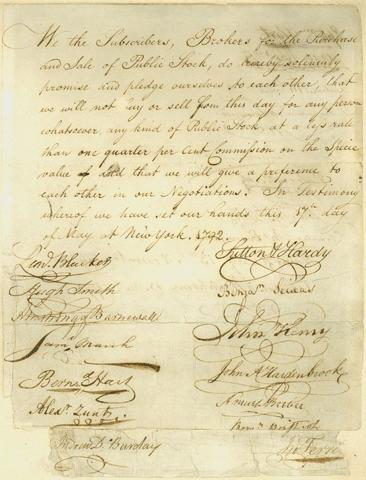
The Buttonwood Agreement is dated 17 May 1792. It bound its signers to trade securities with one another, to give each other preference, and to charge a minimum commission of a quarter of one per cent.
The tree is the part to handle carefully. The agreement takes its name from a buttonwood, an American sycamore, under which dealers had been meeting in the open, and the traditional account has them signing beneath it.
That the signing itself happened there is not established, and one account has the group meeting at Corre's Hotel that March to arrange the thing. The document and its date are the facts; the tree is the tradition.
Wall Street in 1792 was a lane running from Broadway down to the East River wharves, and business was done outdoors, in taverns and in coffee houses.
Within a year the brokers had a building. The cornerstone of the Tontine Coffee House was laid on 5 June 1792 at the northwest corner of Wall and Water Streets, and the house was finished by the middle of 1793.
How they paid for it is the interesting half. The association sold 203 subscriptions at 200 apiece, and sources disagree over whether that 200 was pounds or dollars, which is a fair description of New York a few months into having a national currency of its own.
A tontine is a pooled annuity. Each subscriber nominated a person, often a young child, and the income was divided among the subscribers whose nominees were still living, with the last survivors taking what remained before the assets were wound up.
So the first indoor home of American securities trading was financed by a security written on human mortality, sold to men who were about to spend their days pricing other people's risk upstairs.
The brokers moved their business inside once it opened, which makes this corner rather than the tree the first fixed address of what became the New York Stock Exchange.
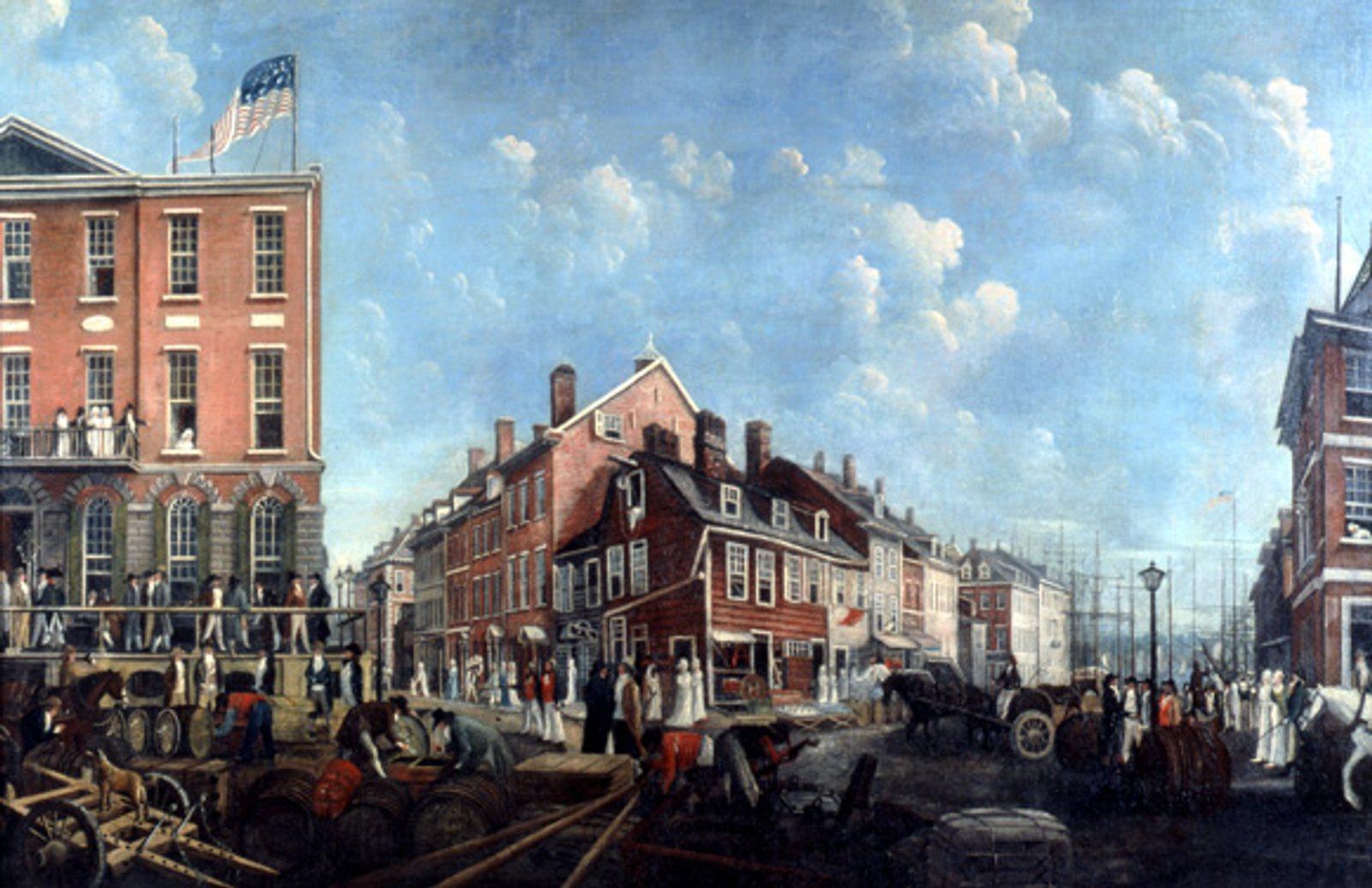
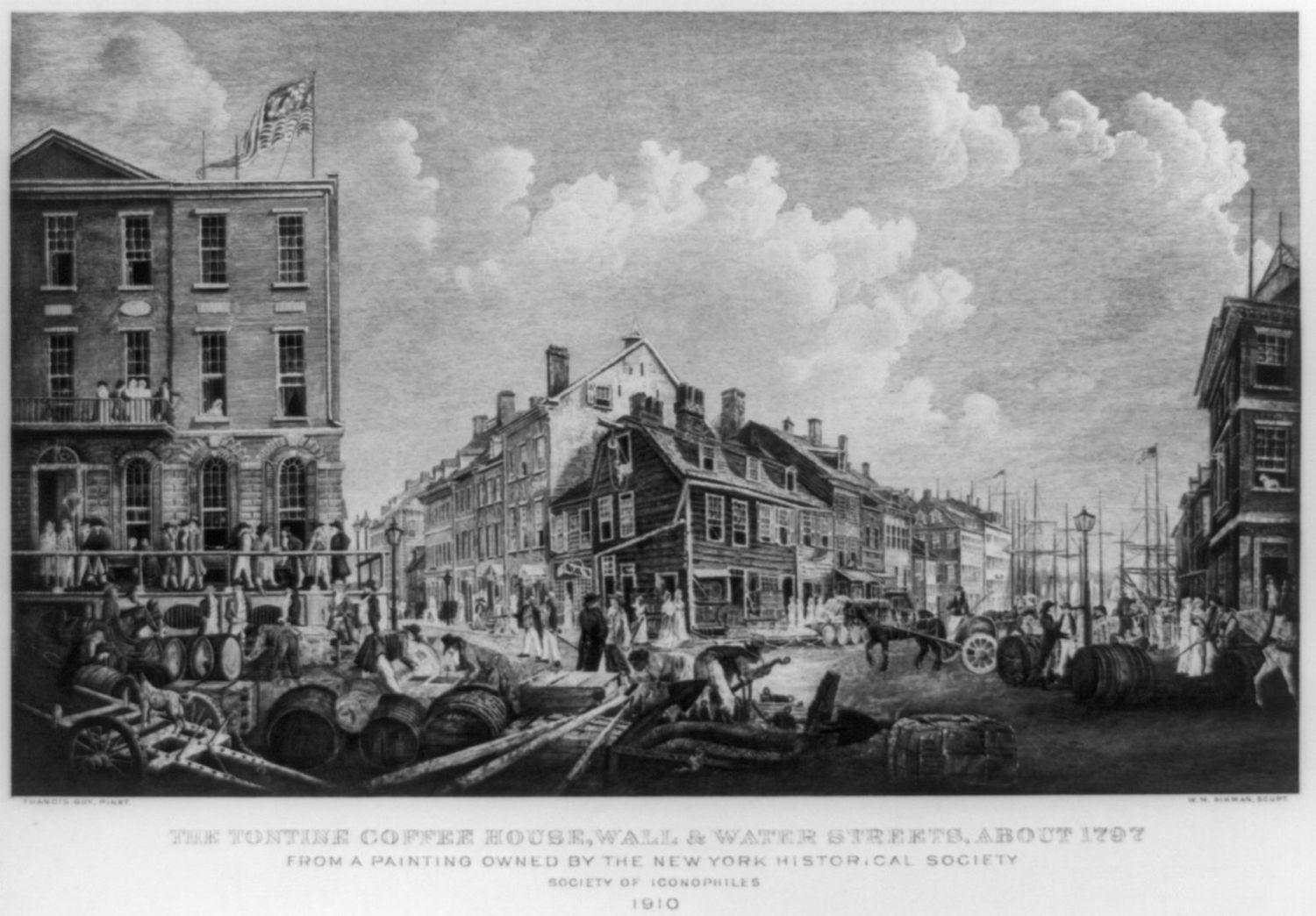
Francis Guy painted the junction around 1797. The Tontine is the brick building on the left with a crowd on its stoop and a flag above it, and the street in front is full of casks and drays, because a securities market in 1797 still sat in the middle of a working port.
The building stopped being a coffee house in 1834, became the Tontine Building in 1843, and was demolished in the spring of 1855.
Cover image: engraving by Walter Monteith Aikman after the Francis Guy painting held by the New-York Historical Society, published in 1910 by the Society of Iconophiles. Library of Congress, public domain. The print is of 1910; the scene it records is of about 1797. Second image: a reproduction of Guy's painting, public domain.
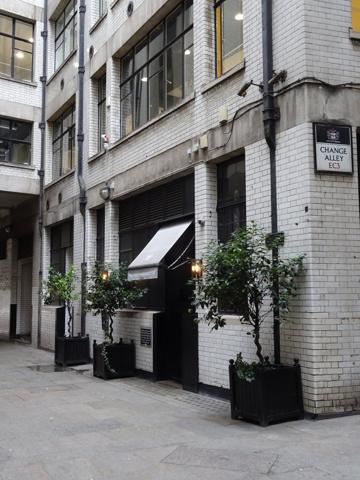
Coordinates 40.705483, -74.007574, the northwest corner of Wall and Water Streets as resolved by Nominatim from the modern street numbers. Accurate to about 25 m, and nothing of the building remains.







 expand_more