

- Home
- Finance History | From Trade to Finance | Antwerp, London, Amsterdam and New York - Exchanges, Prices and Bubbles
- Finance History | 68 Wall Street, 17 May 1792 — Twenty-Four Brokers Made Trust a Membership Rule
Finance History | 68 Wall Street, 17 May 1792 — Twenty-Four Brokers Made Trust a Membership Rule
· 1792-5
Personal memoryBy kevin · · updated · Report an issue
Find memories left by people near you.
Distribute Bounty
This will distribute the bounty equally among all qualifying memories. This action cannot be undone.
Cancel Bounty
Are you sure you want to cancel this bounty? The remaining amount will be refunded to your account.
Success!
Operation completed successfully.
Error
Something went wrong.
Finance History | 68 Wall Street, 17 May 1792 — Twenty-Four Brokers Made Trust a Membership Rule
kevin
Two sentences and twenty-four signatures were enough to define who could be trusted in New York’s small securities market.
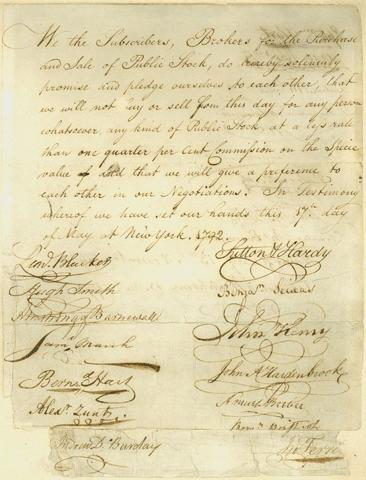
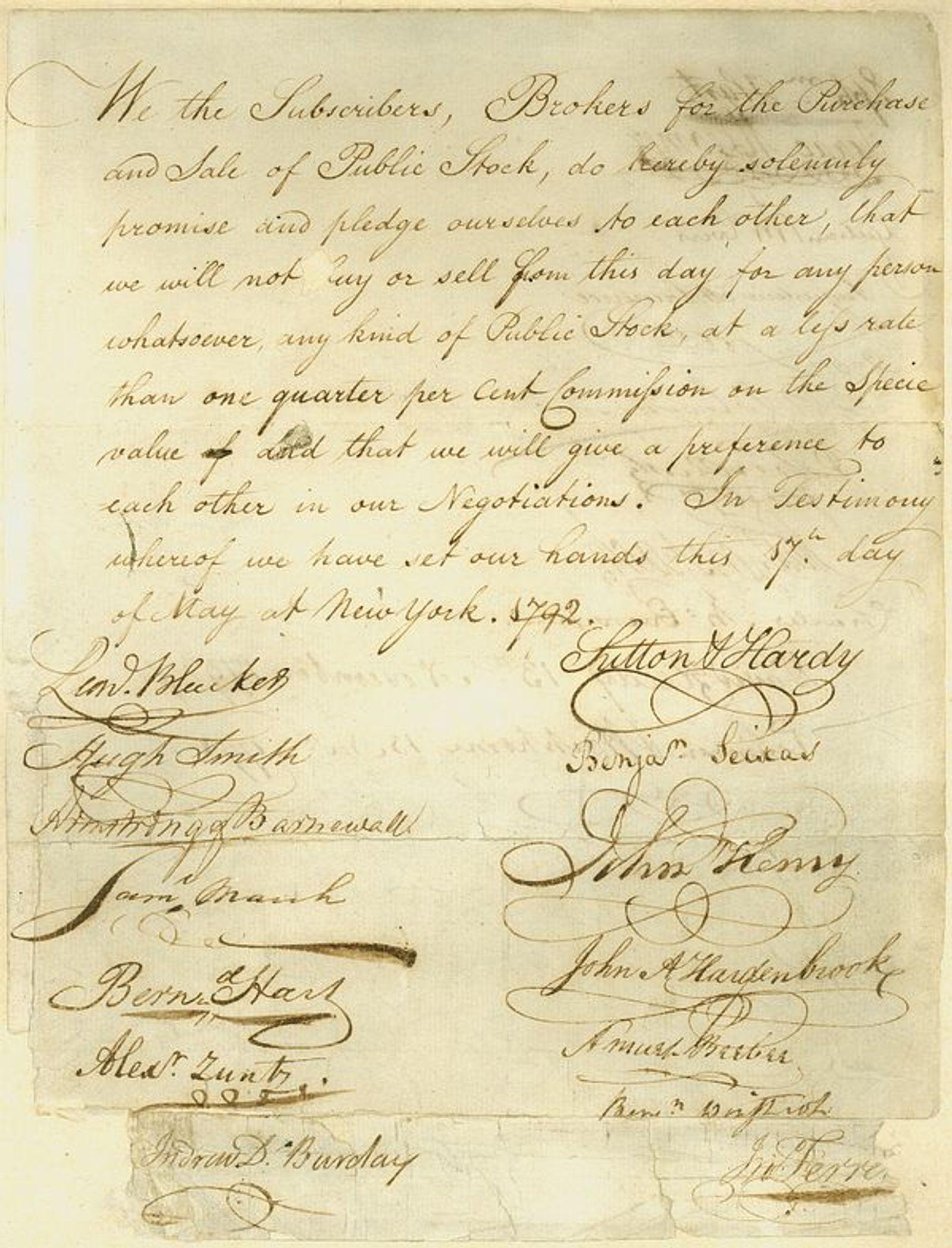
On 17 May 1792, twenty-four brokers signed the Buttonwood Agreement after the young United States had endured its first financial panic. The New York Stock Exchange treats the document as its founding compact.
The brokers made two promises. They would charge no less than one-quarter of one percent of the specie value as commission, and they would give one another preference when arranging trades.
The mechanism was membership before there was an exchange building. Preference kept business inside a known circle, while the commission floor stopped members from winning orders simply by undercutting one another.
That arrangement reduced one kind of risk by making repeated dealing more valuable than a single opportunistic trade. It also created a cartel: customers gained a more orderly market, but the members protected their own access and fees.
The document did not create a corporation, a trading floor, or a complete rulebook. Brokers continued to meet informally until 1817, when they adopted a constitution for the New York Stock and Exchange Board and rented a room at 40 Wall Street.
The famous tree belongs to tradition rather than to the text. The agreement says that it was executed in New York, but it does not mention a buttonwood tree or give an address.
This pin therefore marks the traditional site outside 68 Wall Street, between William and Pearl Streets, rather than a location proved by the surviving sheet. The distinction matters because the agreement is strong enough without turning an inherited story into a documented coordinate.
The image shows the compact itself: a short rule among brokers that became the institutional ancestor of the New York Stock Exchange.
Photo: public domain, via Wikimedia Commons; source artifact held and displayed by the Museum of American Finance.
changes?
delete this memory?
We detected that you have a Blox in your crypto wallet! We will import the Blox into your account.
Click on done below to complete the import.
Welcome Back!
Sign in to preserve cherished moments
Don't have an account?
Welcome!!
Sign up and start preserving cherished moments
?
?

Choose your payment method
Buy with Metablox Credit
Do you want to mint Blox with Metablox Credit?
Which Crypto would you like to use?
Purchase Confirmed!
Your Blox is being minted on-chain and will appear in your profile shortly.
Log in or sign up to claim your Blox.
How many credits do you want to buy?
$100 USD = 1 Metablox Credit = 1 Blox.
Use Metablox Credit to mint any Blox you want on the map.
expand_more