Finance History | Piazza de' Peruzzi, Florence, 1343 — The Crash That Taught the Medici to Split the Firm
volume_up
Listen
directions
Directions
The moral usually drawn from this square is that you should not lend to kings. The evidence for it is weaker than the moral.
By 1300 the Bardi and the Peruzzi were the largest commercial firms in Europe, with branches from London to the eastern Mediterranean, trading grain from Sicily, English wool and luxury goods, and lending to popes and monarchs. Historians call them super-companies.
The Peruzzi were not simply a family business. Their surviving account books from the 1330s show outside partners and investors who tended to outnumber the family members, one of whom was Giovanni Villani, a partner posted to Bruges who also happened to be the chronicler of Florence.
The Peruzzi went bankrupt in 1343. The Bardi followed in 1346. Creditors of the Peruzzi eventually recovered about 37 per cent, and of the Bardi about 48 per cent, so these were ruinous restructurings rather than total wipeouts.
The standard explanation is that Edward III of England defaulted on enormous war loans. Villani put the figures at 900,000 florins owed to the Bardi and 600,000 to the Peruzzi.
There are three problems with that, and they are worth setting out because the story is repeated everywhere.
First, Villani was a Peruzzi partner writing about his own firm's collapse, and the surviving Peruzzi records show the company never had capital on anything like the scale he describes.
Second, Edward did not straightforwardly repudiate. His commissioners audited the claims, disputed them, cut them down sharply, and then the acknowledged remainder was simply never paid, which is a slower and more ordinary kind of ruin.
Third, and hardest to argue with, the Acciaiuoli were the third of the great Florentine houses and they failed in the same year as the Peruzzi without having lent Edward anything at all.
What else was happening: a catastrophic flood in Florence, a repudiation by the king of Sicily, an uprising in the city in September 1343, and the Florentine government's own default. Edward's unpaid debts were one weight among several on firms already carrying too much.
The structural point survives the correction, and it is the one that matters here.
These were single undivided companies. Partners were liable, capital was pooled, and there was no wall between a bad exposure in London and the depositors in Florence.
Fifty years later Giovanni di Bicci de' Medici built his bank as a set of legally separate partnerships precisely so that a branch could fail without the rest. He had watched this happen. The Medici entry in this collection is the sequel to this one.
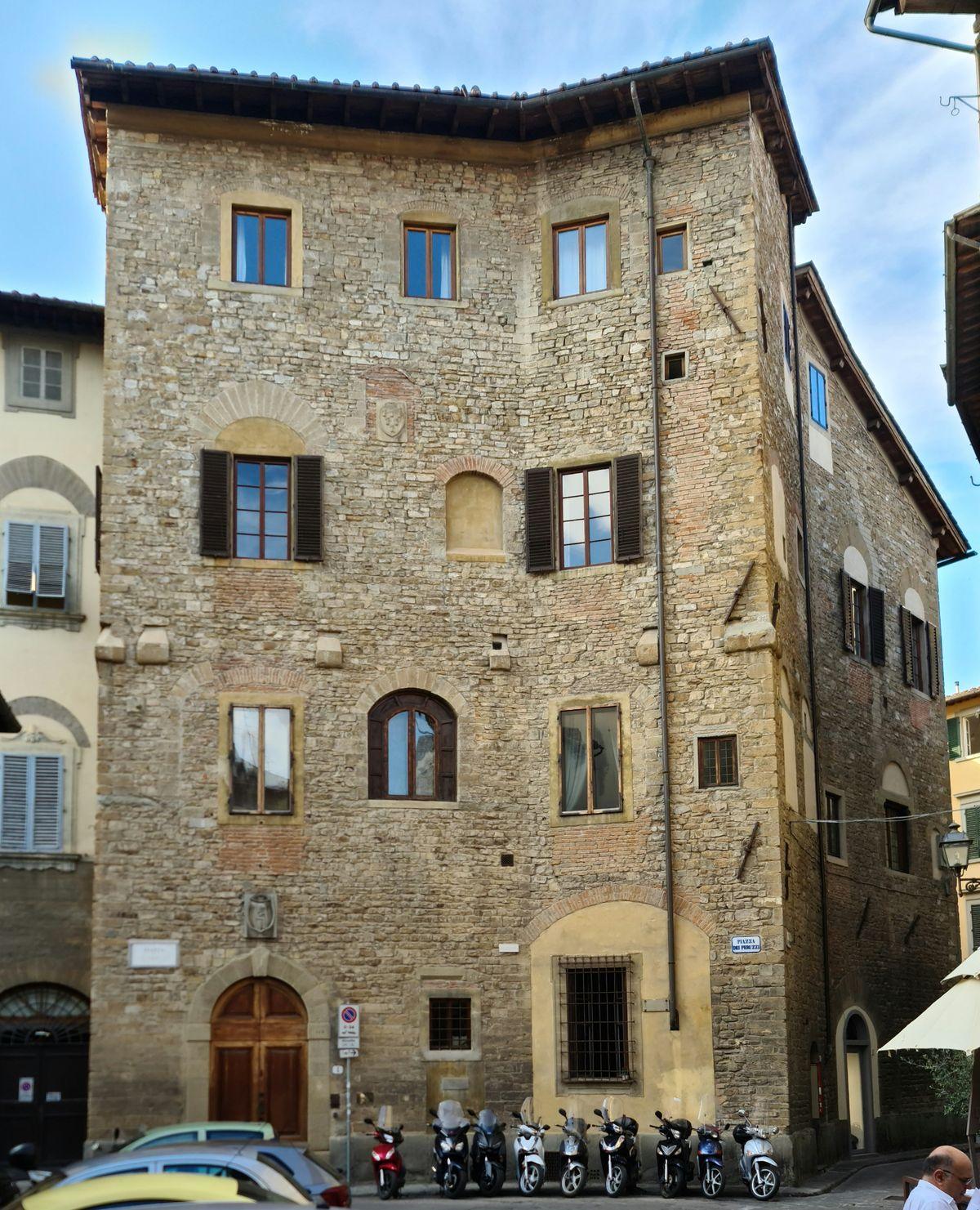
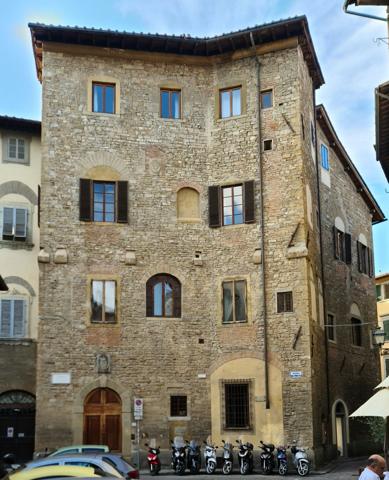
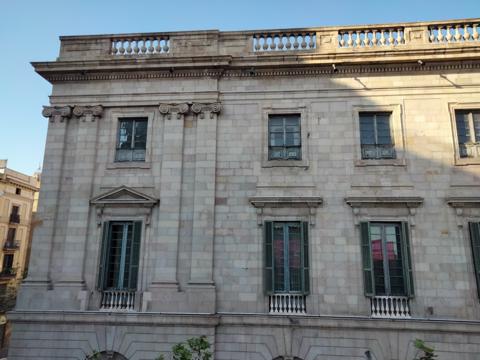
The Peruzzi took their name from the pear on their arms, and their palaces stand around a small piazza that curves because it follows the line of the Roman amphitheatre buried underneath it.
Cover photo: Ricardalovesmonuments, CC BY-SA 4.0, via Wikimedia Commons. The file is titled Piazza dei Perugia, which is a misspelling; the street sign visible in the photograph reads Piazza de' Peruzzi.
Coordinates 43.768657, 11.259313, from the Commons geotag on the cover photograph, about 35 m from the Nominatim node for Piazza dei Peruzzi. Accurate to about 35 m.









 expand_more