Finance History | Amsterdamsche Wisselbank, the Dam, 31 January 1609 — Money That Was Better Than Coin, Until the Coin Was Gone
volume_up
Listen
directions
Directions
Amsterdam in 1600 was awash in about five hundred different coins, foreign and domestic, legal and otherwise, many of them clipped or debased. There was no reliable way to say what any of them was worth.
The city council's answer, on 31 January 1609, was to open a bank in the town hall.
The Amsterdamsche Wisselbank took in coin and bullion, assessed it by weight and fineness, and credited the depositor with a balance in the bank's own unit of account. That balance was bank money, and it did not vary because somebody had shaved the edges off a coin.
Then comes the step that made it more than a weighing service. Balances could be transferred between accounts in the bank's ledgers, so a merchant settling a debt of several thousand guilders did not move a single coin. He moved a line in a book.
This is why the bank belongs in the same collection as the exchange buildings. Handing over the price of a parcel of VOC stock in physical coin was a genuine obstacle, and every trader who mattered on the Amsterdam exchange held a Wisselbank account. The share market described elsewhere in this collection ran on top of this bank's ledgers.
Bank money became better than coin, and it traded at a premium against the current stuff, an agio that held for most of the seventeenth century.
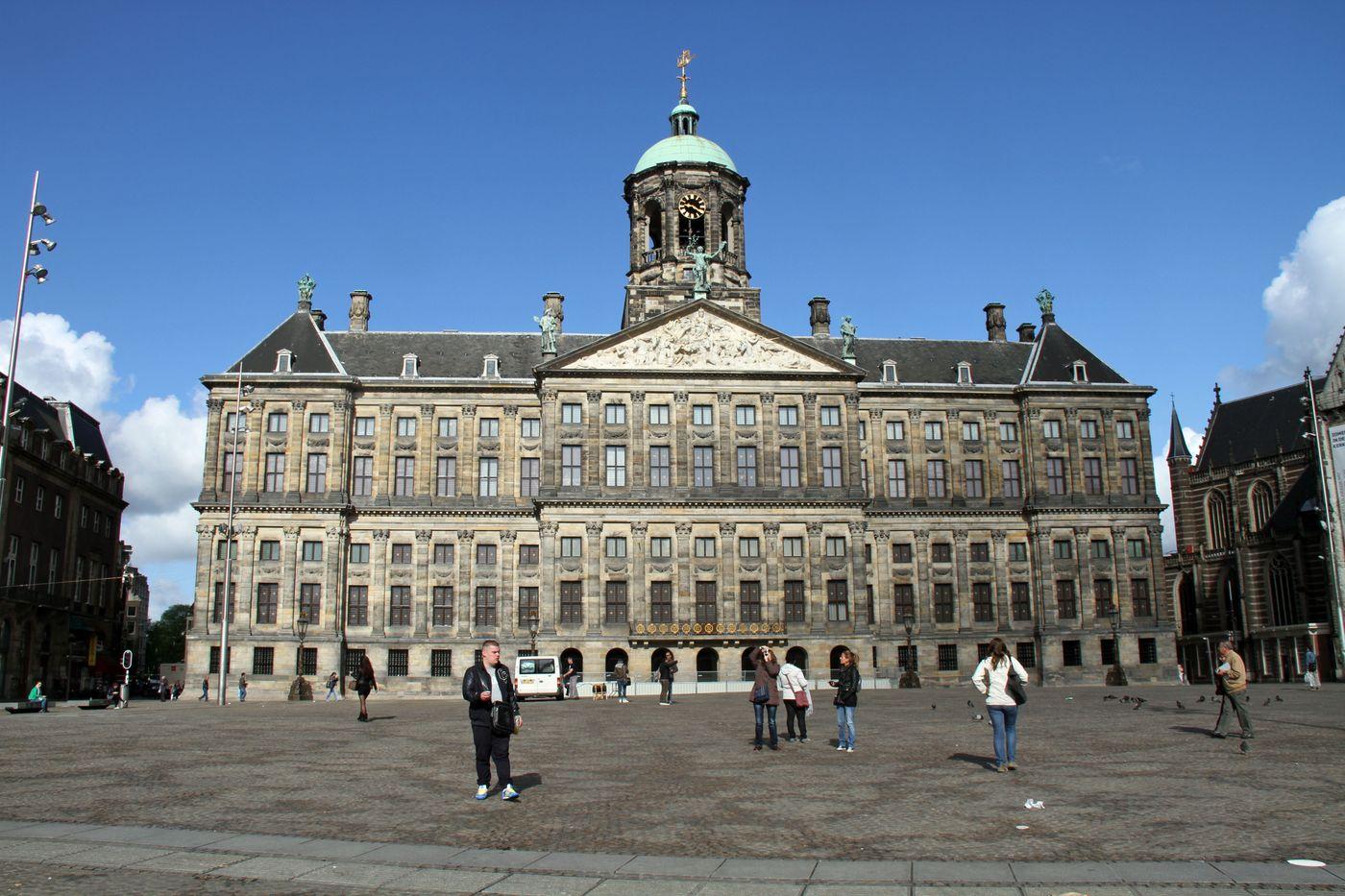
A caution about the address, because the building is a trap. The bank opened in the old town hall on the Dam, which burned down in 1652. What stands here now is Jacob van Campen's replacement, begun in 1648 and finished in the 1660s, which housed the bank for most of its life and is a royal palace today. The 1609 building is gone.
The bank was famous for holding the coin it had been given. Its whole value rested on a depositor being able to walk in and take metal out.
It stopped doing that. Over the eighteenth century the Wisselbank lent quietly to the Dutch East India Company and to the city itself, which meant the metal was not there.
When the city magistracy ordered the books opened in 1790 the position was visible: of roughly 28 million florins banco outstanding, only about 10.5 million was backed by coin or bullion. The premium on bank money went to a discount and never came back.
After French revolutionary armies arrived, the new city council published the balance sheet in 1795, breaking two centuries of secrecy. De Nederlandsche Bank was founded in 1814 and the Wisselbank went into liquidation in 1819.
Cover photo: Greg Schechter, CC BY 2.0, via Wikimedia Commons.
Coordinates 52.373145, 4.891336, resolved by Nominatim for the Koninklijk Paleis on the Dam. Accurate to about 25 m, and it is the second building on the site, not the one of 1609.













 expand_more