Finance History | Palazzo Salimbeni, Siena, 4 March 1472 — A Pawnshop Secured on a Grand Duke's Pastures
volume_up
Listen
directions
Directions
The oldest bank still trading began as a pawnshop set up to put moneylenders out of business.
Monti di Pietà spread through Italy in the second half of the fifteenth century, mostly promoted by Franciscans, lending small sums against pledged goods at rates low enough to undercut usurers.
Siena's was different in one respect that mattered later. It was founded on 4 March 1472 by the magistrates of the Republic itself, not by a religious order, and it was funded with a 5,000-florin loan raised by the city through taxation.
So from the first day it was a public institution with a civic balance sheet, run in a city that had been in the banking business since the thirteenth century.
For its first century and a half it lent against what people brought in. Clothing and jewellery at first, then land, which had a consequence nobody planned: when borrowers defaulted the Monte kept the collateral, and it slowly became one of the largest landowners in the region.
The change that made it a bank came in 1624, after Siena had been absorbed into the Grand Duchy of Tuscany. The citizens asked for an institution that could support farmers and graziers and take deposits of private capital.
Ferdinando II granted it on a condition, and the condition is the invention.
Depositors would be guaranteed by the state, and the guarantee was secured on the income of the state-owned pasture lands of the Maremma, the paschi. That pledge gave the bank both its security and its name.
Look at what that does. A Monte di Pietà lends against your goods, so the depositor's safety depends on the borrower's pledge. After 1624 the depositor's safety depended on grazing revenue in a marsh sixty miles away, pledged by a sovereign.
It is the same device Genoa used for its public debt two centuries earlier, an assigned revenue stream standing behind a financial claim, pointed at depositors instead of creditors.
The grand-ducal rescript is dated 30 December 1622 and the institution was established on 2 November 1624, which is why the founding of the modern bank is given as 1624 while the bank's own age is counted from 1472.
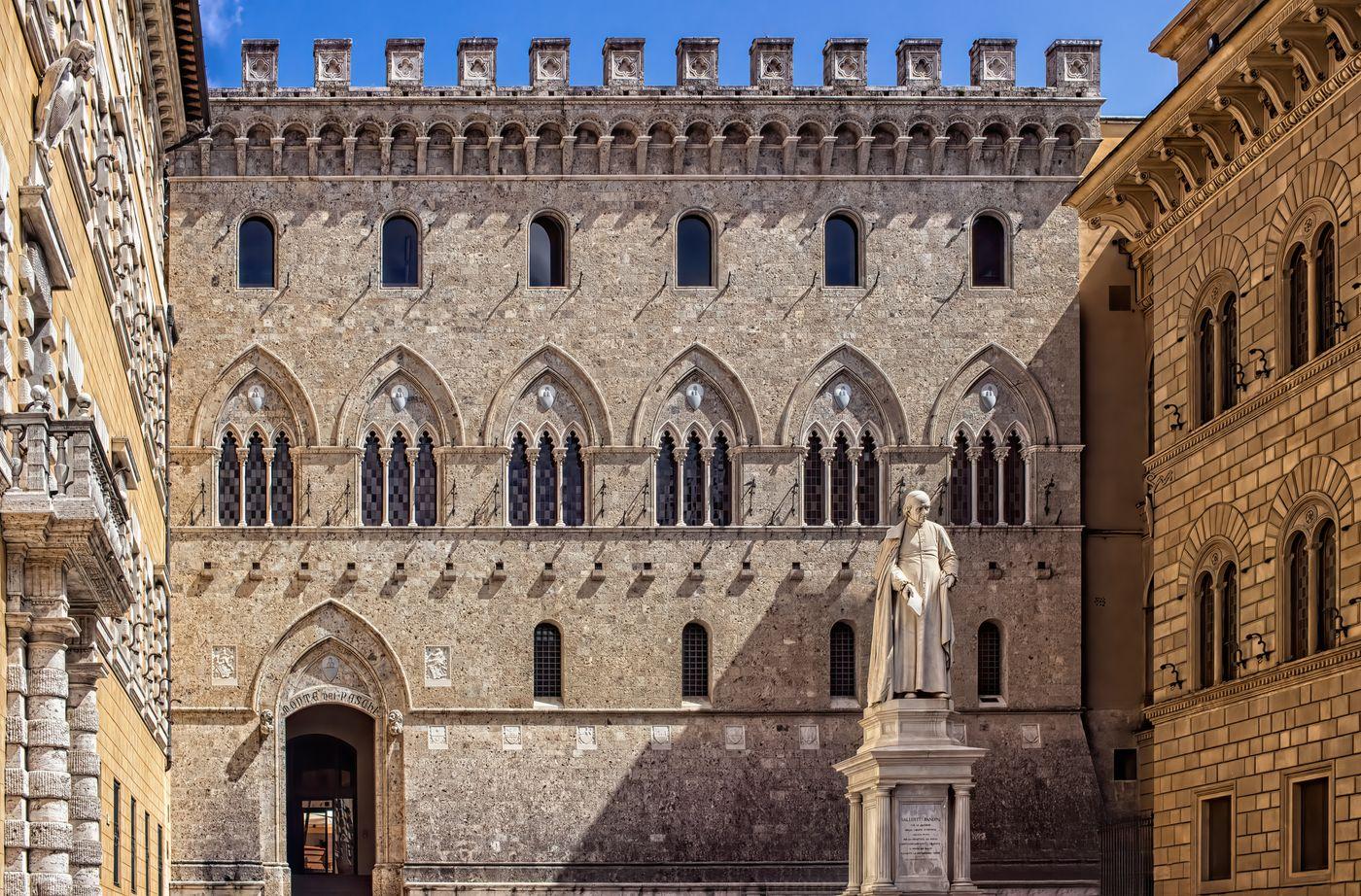
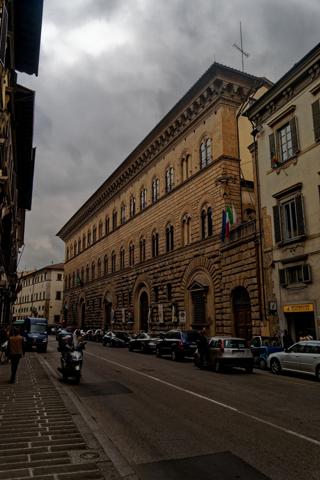
Palazzo Salimbeni was taken from the Salimbeni family, served as a customs and tax house in the fifteenth century, and housed the Monte Pio from 1472.
What you photograph today is largely Giuseppe Partini's nineteenth-century neo-Gothic reworking, with the merlons, the blind arcading and the triple lancet windows copied from Siena's Palazzo Pubblico. The fortress look is partly Victorian.
The bank was still trading at the time of writing, having become a limited company in 1995, and in 2025 acquired Mediobanca.
Cover photo: Ray in Manila, CC BY 2.0, via Wikimedia Commons.
Coordinates 43.321392, 11.330913, resolved by Nominatim for Palazzo Salimbeni on Piazza Salimbeni. A Commons geotag on the cover photograph sits about 200 m away and was not used; the Nominatim value matches the square.













 expand_more