
- Home
- Finance History | Tulipmania | Leiden, Alkmaar, Amsterdam and Haarlem
- Finance History | Stadhuis, Grote Markt, Haarlem, May 1637 — The Crash Was Settled at Three and a Half Per Cent
Finance History | Stadhuis, Grote Markt, Haarlem, May 1637 — The Crash Was Settled at Three and a Half Per Cent
· 1637-5
Personal memoryBy kevin · · updated · Report an issue

Find memories left by people near you.

Distribute Bounty
This will distribute the bounty equally among all qualifying memories. This action cannot be undone.
Cancel Bounty
Are you sure you want to cancel this bounty? The remaining amount will be refunded to your account.
Success!
Operation completed successfully.
Error
Something went wrong.
Finance History | Stadhuis, Grote Markt, Haarlem, May 1637 — The Crash Was Settled at Three and a Half Per Cent
kevin
A city council, not a court, finally decided what a broken tulip contract was worth, and the figure it chose was 3.5 per cent.
Haarlem had been the centre of the bulb trade, so Haarlem was left with the wreckage of it.
The sequence after the February 1637 collapse was quick and inconclusive. Growers in Utrecht met on the 7th to elect representatives, and an assembly gathered in Amsterdam at the end of the month.
Their compromise was that contracts made before December 1636 would stand, while later ones could be cancelled by paying the seller 10 per cent of the price.
The Court of Holland declined to rule either way and sent the question back to the city councils.
Holland's legislature leaned instead toward voiding contracts altogether so that a clean trade could begin that summer.
Haarlem's own government told the parties to sort it out by arbitration, and only in May 1637 did the city rule that a buyer could cancel an outstanding contract for 3.5 per cent of the price.
Read that as a market mechanic and it is a retrospective conversion. A forward contract obliges the buyer to pay the full price, while a fee to walk away is an option premium, and the second is far kinder to a buyer holding a bad position.
The economist Earl Thompson argued that traders had anticipated exactly this change from late 1636, which would make the soaring winter quotes strike prices rather than commitments; other economists dispute that reading, and the price data are too thin to settle it.
What is not disputed is the outcome. Most contracts were simply never honoured, Dutch courts were still hearing tulip disputes in 1639, and Goldgar found fewer than half a dozen traders in real financial difficulty afterwards, with tulips not clearly to blame even in those.
This is where the ruin story should be handled carefully. Charles Mackay's 1841 account of a bankrupted nation came through a 1797 compilation by Johann Beckmann, which drew on satirical pamphlets written to mock speculators rather than to report on them.
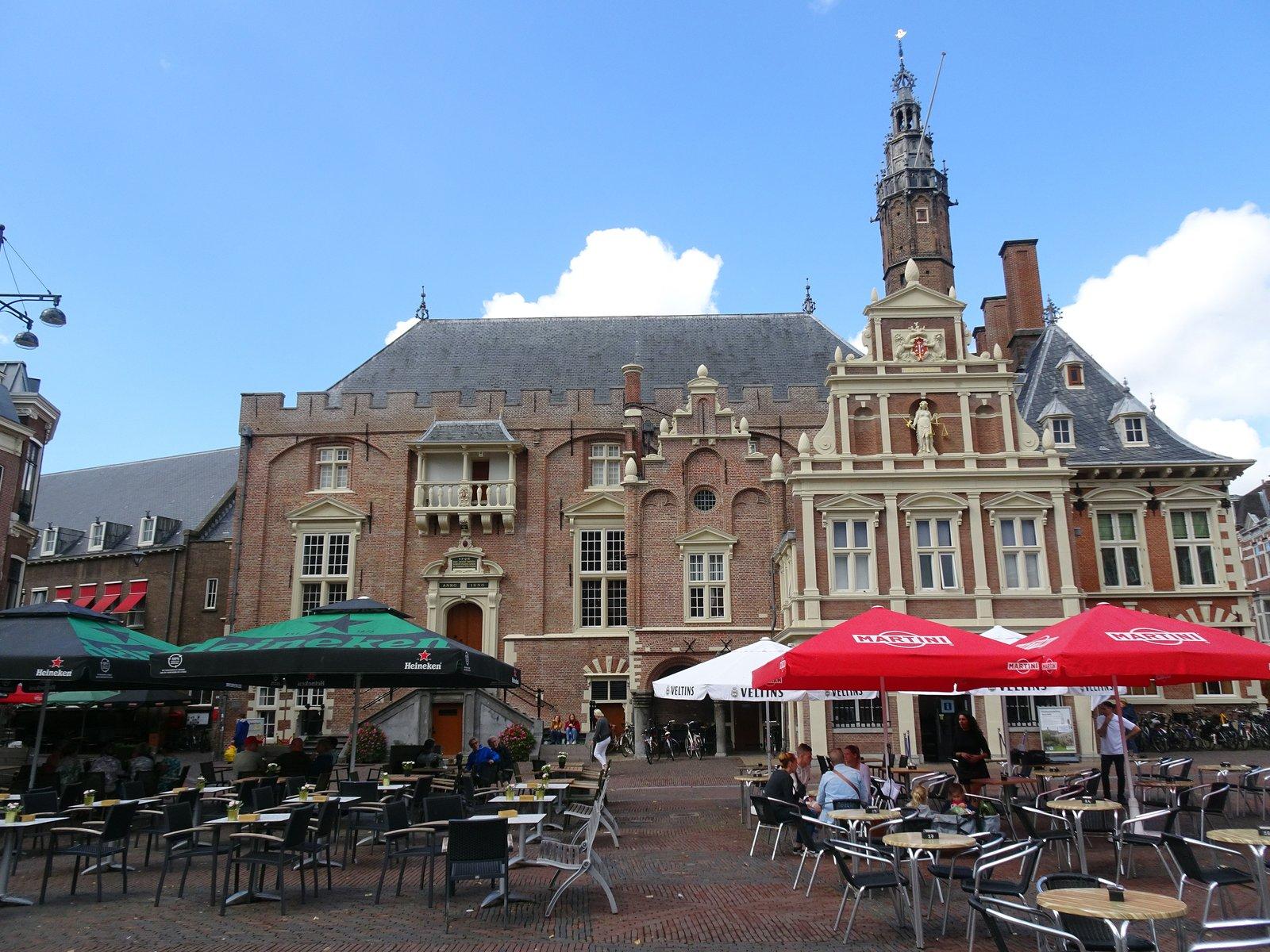
The Dutch economy went on growing for decades. The town hall on the Grote Markt, where the 3.5 per cent was set, grew out of the counts' hall on this site and is still Haarlem's seat of government.
Photo: Spudgun67, CC BY-SA 4.0, via Wikimedia Commons.
changes?
delete this memory?
We detected that you have a Blox in your crypto wallet! We will import the Blox into your account.
Click on done below to complete the import.
Welcome Back!
Sign in to preserve cherished moments
Don't have an account?
Welcome!!
Sign up and start preserving cherished moments
?
?

Choose your payment method
Buy with Metablox Credit
Do you want to mint Blox with Metablox Credit?
Which Crypto would you like to use?
Purchase Confirmed!
Your Blox is being minted on-chain and will appear in your profile shortly.
Log in or sign up to claim your Blox.
How many credits do you want to buy?
$100 USD = 1 Metablox Credit = 1 Blox.
Use Metablox Credit to mint any Blox you want on the map.
expand_more