


Dynastic History | The Ark of Bukhara — The Citadel That Stopped Being a Palace
· 1920-9
Personal memoryBy kevin · · Report an issue








.JPG)

































Find memories left by people near you.
Distribute Bounty
This will distribute the bounty equally among all qualifying memories. This action cannot be undone.
Cancel Bounty
Are you sure you want to cancel this bounty? The remaining amount will be refunded to your account.
Success!
Operation completed successfully.
Error
Something went wrong.
Dynastic History | The Ark of Bukhara — The Citadel That Stopped Being a Palace
kevin
By the early twentieth century the Ark was a city inside a city. The museum service that runs it today lists what stood behind the walls: the ruler's palace, the offices of the official nobility and the army commanders, craft workshops, the treasury, the arsenal, and stores of clothing, carpets, weapons and palace valuables. About three thousand people lived inside. The Leiden Iran-and-Turan project's account of the citadel adds the throne room, the reception hall, a mint, a dungeon and slave quarters.
That last item is not incidental. Bukhara's Twelver Shia population was made up largely of people brought from Iran as slaves, along with former slaves and their descendants. When the treaty of 1873 turned what was left of the emirate into a Russian protectorate, one of its terms required the emir to abolish the slave trade.
The mound underneath is very old — excavation dates the earliest walls found in it to the fourth and third centuries BCE — but the fortress's present shape is sixteenth-century Shaybanid work, and every building standing in it belongs to the Ashtarkhanid and Manghit centuries after that. The enclosure covers about 3.9 hectares, its wall runs some 789 metres, and it rises sixteen to twenty metres above the square.
It stopped being a palace in 1920. Alim Khan, the last Manghit emir, left the city at the end of August; the eastern part of the citadel was destroyed in the first days of September. The Leiden account attributes that destruction to Red Army troops under Mikhail Frunze, while the museum that runs the site calls it the anti-monarchical coup. A revolutionary committee took over on 14 September, a People's Soviet Republic followed, and it lasted until 1924.
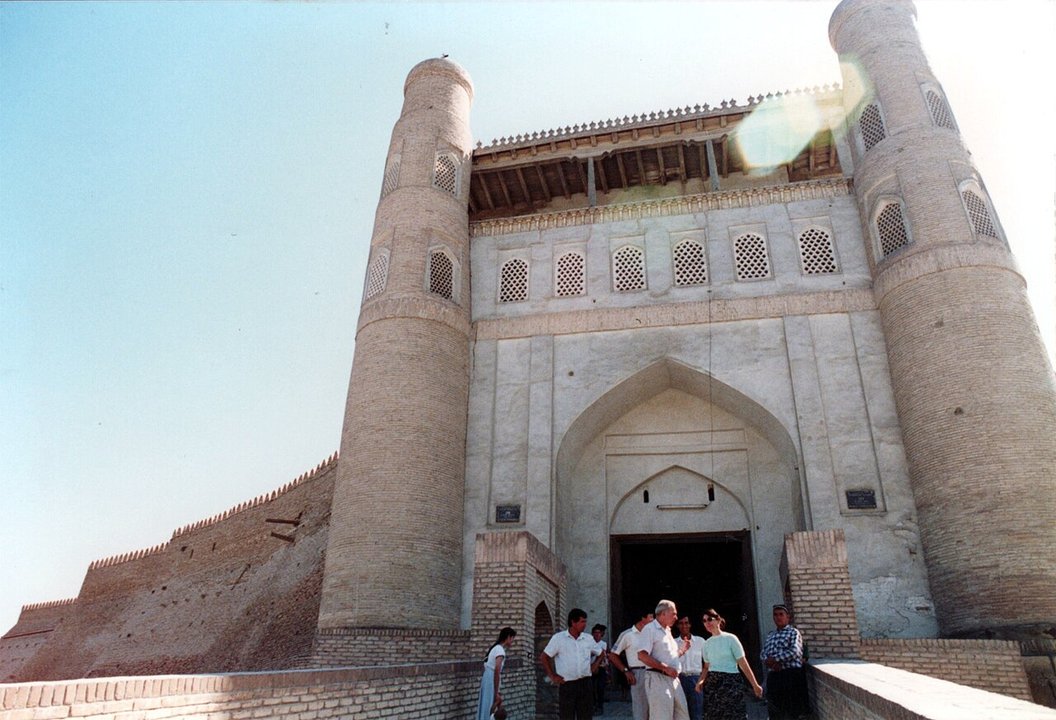
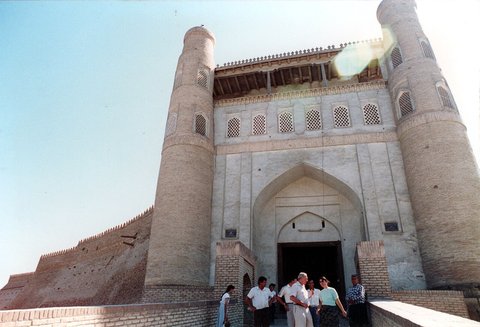
The ruined eastern half is an archaeological reserve now. What survives on the west side holds the museum's displays, and visitors go in through the gate onto the Registan and up the same ramp.
📸 Cover: The west gate of the Ark, photographed in 1990, Lesley Parker, CC BY 2.0 via Wikimedia Commons


changes?
delete this memory?
We detected that you have a Blox in your crypto wallet! We will import the Blox into your account.
Click on done below to complete the import.
Welcome Back!
Sign in to preserve cherished moments
Don't have an account?
Welcome!!
Sign up and start preserving cherished moments
?
?

Choose your payment method
Buy with Metablox Credit
Do you want to mint Blox with Metablox Credit?
Which Crypto would you like to use?
Purchase Confirmed!
Your Blox is being minted on-chain and will appear in your profile shortly.
Log in or sign up to claim your Blox.
How many credits do you want to buy?
$100 USD = 1 Metablox Credit = 1 Blox.
Use Metablox Credit to mint any Blox you want on the map.
 expand_more